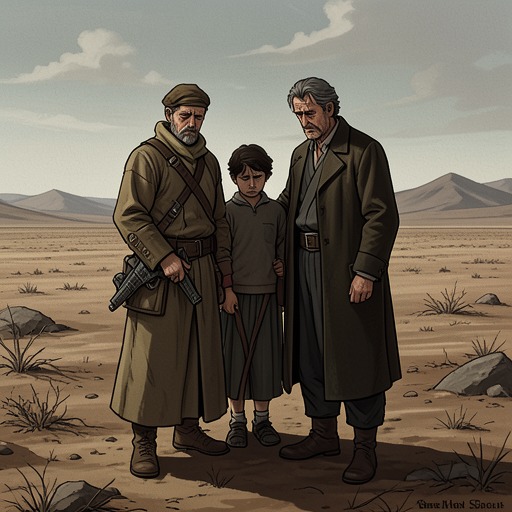
Milotan Bureau Earth-Posting Policy
The People UpstairsThe Milotan Bureau Earth-Posting Policy is the administrative logic that places Milotan secret agents on Earth for permanent infiltration rather than temporary service. It treats biological adaptation, reproductive capacity, cultural concealment, and eventual loyalty as operational variables: women sent to Earth are presumed unable to bear children, agents are physically altered for a lifetime assignment, and children born into Earth society are imagined as uniquely valuable native-born operatives. The policy’s central irony is that its most promising innovation also threatens its political purpose, because a child formed by Earth culture may belong to Earth more deeply than to the Bureau that created the plan.
Selection for Permanent Service
The Bureau’s posting system assumes that an Earth assignment will last for life. Dan Greene explains that women are sent out only when they are believed to be sterile or presumably past the age of childbearing, a precaution meant to prevent precisely the domestic and biological complications created by May Greene’s pregnancy. The couple had accepted their placement on the understanding that May was old and barren; her belief that she would never have a child had helped persuade her to accompany Dan to the post.
The policy is therefore built on a bureaucratic judgment about bodies as much as on professional suitability. May’s age and presumed infertility are treated as safeguards for the mission, while reproduction is defined as an operational failure rather than a private possibility. When she announces that she is going to have a baby, Dan immediately understands that the Bureau will blame them for having failed to take proper precautions. Their intimate life has exposed a weakness in an institution that believed it could classify fertility reliably enough to organize an interplanetary espionage system.
Adaptation and the Impossibility of Return
The lifetime character of the posting is enforced through extensive physical adaptation. May’s hair is dyed an Earth pepper-and-salt color, the couple avoid leaving Milotan artifacts in their apartment, and their domestic objects are subtly modified to suit bodies that are humanoid but not fully human. Their adaptations also include amputations. The result is a permanent reversal of belonging: on Earth they require disguises to pass as human, while on Milotis they would appear as grotesque distortions of their natural forms.
May recognizes that the adaptations make ordinary reassignment impossible. The Bureau will never send the couple to another Earth post, she believes, and returning home would also be difficult because they can no longer be readapted. The assignment has converted exile into a bodily condition. Dan’s reluctance to terminate the pregnancy is partly practical: he has adjusted himself to spending the rest of his life on Earth, even though he dislikes being a secret agent and cannot genuinely like the natives. Their salaries and comfortable standard of living are better than what they would have after dishonorable discharges, so the Bureau’s policy binds them through both bodily irreversibility and economic dependence.
The pregnancy exposes the policy’s moral pressure as well as its administrative rigidity. Dr. Robinson offers to end May’s condition without reporting it to Milotis, but May refuses because she has wanted a child all her life. The Bureau’s presumed solution would protect the posting at the cost of the desire it had dismissed as impossible. Its rule turns a long-denied hope into evidence of professional misconduct, forcing the Greenes to choose between obedience, recall, and a child whose existence could not be concealed indefinitely.
The Native-Born Agent Proposal
May attempts to transform the policy’s failure into a strategic discovery. She argues that a person born on Earth and raised within Earth culture could not make the kind of cultural slip that might expose an immigrant agent. Such a child would know the local habits from within rather than merely performing them through training and disguise. She imagines that the Bureau could then send young married couples to Earth specifically to bear children, producing millions of agents more cheaply and rapidly than the existing system of individually adapted infiltrators.
This proposal changes the meaning of the Earth posting. The agent would no longer be merely an outsider concealed among natives; the family would become a production site for native-born operatives. May hopes that proving the strategy would cause the Bureau to forgive the Greenes’ breach of procedure. The policy’s harshness might be suspended in favor of a larger colonization program, with reproduction recast as the most economical instrument of infiltration.
Dan identifies the danger May’s enthusiasm overlooks. Children born into Earth culture might identify with the natives, while the Bureau’s intentions toward Earth are ultimately hostile. The native-born strategy therefore contains a contradiction at its foundation: cultural immersion may perfect an agent’s cover while weakening the allegiance that makes the agent useful. The Bureau wants Earth-born fluency without Earth-born attachment, but the very success of assimilation may make that separation impossible.
Enforcement Through Earth Institutions
The policy’s consequences are not confined to Milotan administration. Once Terence Greene is born, Earth’s schools, medical expectations, and compulsory attendance laws become the institutions through which the Bureau’s assumptions are tested. Terence is legally an American citizen because he is born in the United States of America and possesses a genuine birth certificate; technically, he is not even a Milotan. Yet his body still requires masks and contact lenses, and his parents must conceal him from the ordinary procedures of Earth life.
The Greenes speak both Milotan and English at home, teach Terence to avoid Milotan in public, and keep him away from other children as much as possible. These precautions preserve the policy’s secrecy but undermine the cultural isolation that a child needs in order to pass naturally. When Terence turns six, compulsory school attendance makes private concealment untenable. May chooses a private day school and tells its principal that the family are Christian Scientists so that Terence will not undergo medical examinations. The fee buys understanding, but not safety: an institutional exemption can delay inspection without eliminating the body that inspection would reveal.
The school’s response demonstrates how quickly a local rule can overtake a covert interplanetary policy. After a swimming lesson, Terence’s alien body is exposed. He tells May that he is different, and the accusation falls on the parents’ secrecy as much as on his physical difference. The principal concludes that he cannot remain at the school, while urging May to tell the authorities what is wrong with him before enrolling him elsewhere. The language of help and friendship becomes another form of pressure, showing that the Bureau’s long-term posting depends on navigating a dense network of Earth institutions it cannot fully control.
Terence and the Policy’s Reversal
Terence’s birth initially seems to vindicate the Bureau’s unplanned experiment. Milotan gestation is roughly the same as terrestrial gestation, and after eight months he is born on Earth without forged papers. Because Milotan infants grow more slowly and mature later, the disguises can be used over a longer developmental period, although they remain expensive. The child is thus both an ordinary infant requiring constant care and a strategic problem requiring specialized equipment.
The cost of the posting becomes immediate. May must leave her income behind to care for the baby, while Dan continues working. Their salaries are supposed to supplement allowances from their own government, but life on an alien planet is so expensive that the loss of May’s income is severe. The couple give up every luxury, including Dan’s specially imported tobacco substitute and May’s repackaged Milotan delicacies, and eventually begin reducing necessities. The Bureau’s policy assumes a controlled professional mission; parenthood converts it into financially precarious domestic labor.
May also has to expose the child to Earth’s pale yellow sun and exchange guarded pleasantries with neighbors whose prams and deck chairs form a daily audience outside the house. At night she briefly takes Terence to the roof to see the distant bright sun of Milotis, then stops when the neighbors become curious. The family’s cross-planetary identity survives through fragments—language, remembered light, a beam sent home—but every visible sign risks discovery.
After the swimming-lesson exposure, May removes Terence from the school and plans to move from Washington Heights to the suburbs, where his history will be unknown. She delays the full explanation until they are leaving the school, then confirms that Milotis is real and tells him that she and Dan will explain everything at home. At the same time, she announces that they will send a beam back to Milotis telling the Bureau all about him. The policy has therefore produced its own decisive challenge: the child who might have become the perfect native-born agent has first become a son who knows he is alien, resents the secrecy surrounding him, and may no longer be available to the Bureau’s intended purpose.