Milotan Secret-Agent Cover Protocol
The People UpstairsThe Milotan Secret-Agent Cover Protocol is a comprehensive regime of bodily disguise, cultural discipline, and information control used by Milotan agents operating on Earth. It does not merely hide an alien appearance: it attempts to manufacture an apparently ordinary terrestrial life, while preserving the agents’ connection to Milotis and their allegiance to its long-term project of infiltration. The protocol succeeds only so long as bodies, language, family routines, institutions, and personal history remain synchronized. The birth of Terence Greene exposes how fragile that synchronization is.
Bodily Disguise and Irreversible Adaptation
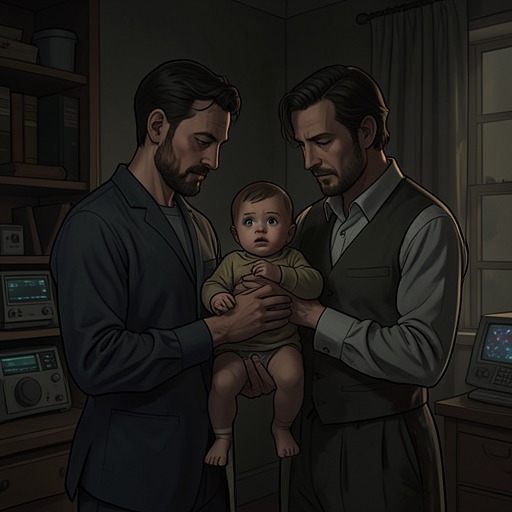
The protocol begins with the body itself. Milotan agents assigned to Earth must alter their natural appearance so thoroughly that they can pass among humans without attracting attention. May Greene removes a silk-thin plastomask from her face and slips off her contact lenses after returning from New York to see Dr. Robinson, revealing that her apparent human face and eyes are equipment rather than a natural identity. Dr. Robinson later fits Terence Greene with smaller masks and lenses in his laboratory, extending the same system to the next generation.
The disguise is not limited to detachable devices. The agents’ bodies have been biologically adapted for a lifetime posting, including amputations. May explains that returning to Milotis would be difficult because the changes cannot be reversed: they would be as physically monstrous there as they would appear on Earth in their natural condition. Dan’s broad hands, built to support more than five fingers, embody the protocol’s permanent cost. When he looks at them, he sees a double exclusion: they have the wrong color for Earth and the wrong number of fingers for Milotis. The protocol therefore creates no secure home. It makes the agents legible as human only through continual maintenance, while making their return to their own society physically hazardous or impossible.
Even ordinary objects are subordinated to concealment. May’s hair is dyed an Earth pepper-and-salt color, and the terrestrial hairbrush she uses has been subtly altered to suit her needs. Milotan artifacts cannot be left lying around. Such precautions show that the protocol treats the household as an evidentiary scene: a neighbor, a visitor, or an investigator must find nothing that contradicts the cover story.
Cultural and Domestic Discipline
Physical disguise is reinforced by years of indoctrination. Dan describes the agents as living in constant fear that they will make a slip despite their training. Their task is not simply to imitate human gestures, but to inhabit a culture whose habits they regard with reserve and whose inhabitants they cannot truly like. The agents receive Earth salaries and live comfortably by their standards, yet they understand that their position is provisional and that a failure may bring punishment or a dishonorable discharge from Milotis.
Their domestic life is consequently organized around secrecy. May and Dan use Earth-equivalent names even when alone, so that they will not accidentally use their Milotan names in public. They speak both Milotan and English at home to educate Terence Greene in both languages, but forbid him to speak Milotan outside the house. An occasional Milotan word may be dismissed as childish babble, yet the rule remains essential: language is both a cultural inheritance and a possible breach in the cover.
The household must also conceal its points of emotional and astronomical attachment. May takes Terence into the sun each day because Earth’s pale yellow sunlight is better than none, but she stops taking him onto the roof at night to look toward the distant bright sun of Milotis once neighbors become curious. She must exchange evasive pleasantries with the permanent line of neighbors, perambulators, and deck chairs outside the building while avoiding any disclosure of what the child’s sky-gazing means. The protocol reaches into motherhood, turning an affectionate routine into surveillance management.
Institutional Cover and the Risk of Exposure
The protocol depends on institutions accepting carefully selected explanations. When Terence Greene reaches school age, May enrolls him in a private day school and tells its principal that the family are Christian Scientists, so that he will not undergo medical examinations. The expensive fees purchase a degree of institutional discretion, while a boarding school is rejected because prolonged separation would make supervision and concealment more difficult. The cover story is therefore calibrated to a specific institution: it uses a recognized human belief to block the examination most likely to reveal the child’s body.
The same strategy operates socially through improvised nationality. When Mrs. Danko’s suspicions and the surrounding talk threaten to draw attention, Dan proposes allowing a Russian story to stand, implying that the Greenes come from a Balkan state absorbed by Russia and are keeping quiet because reprisals might endanger relatives. This is not a full confession but a plausible human narrative designed to explain reserve, foreignness, and the family’s reluctance to discuss its past. The cover protocol can accommodate suspicion so long as suspicion is redirected toward an ordinary political explanation.
School nevertheless contains a rule the family cannot evade. At six, Terence must attend because compulsory attendance requires it. The private school’s medical-examination exemption protects him only until swimming lessons begin. When those lessons expose his body, the principal reports a horrible scene and says he cannot remain. The school’s offer of help is itself a threat: its authorities believe they are friends, but their demand that the defect be disclosed would place the family under human scrutiny. The protocol is thus defeated not by an extraordinary investigation but by an ordinary educational requirement that makes concealment physically impracticable.
The Child as a Strategic Exception
Terence Greene’s existence forces the protocol to expand beyond its original design. The Milotan Bureau had sent women thought to be sterile or past childbearing to Earth, and Dr. Robinson offers to end May’s unexpected pregnancy without reporting it. May refuses because she has always wanted a child. Dan initially fears the professional and political consequences, since the Bureau may blame them and refuse to reassign them to another Earth post, while returning home would be difficult after their adaptations.
May then reframes the breach as a strategic discovery. A child born in Earth culture, she argues, would not need years of indoctrination to avoid cultural mistakes because he would belong to that culture from birth. If the Bureau could be persuaded to send young married couples to bear children on Earth, it could create agents more cheaply and quickly than training adults. The secret-agent cover protocol would become a program of native-born infiltration, potentially producing millions of agents who could pass without the habitual slips of foreign adults.
Dan identifies the danger that May’s plan tries to suppress: children born on Earth might identify with humans, while Milotis’s intentions are ultimately hostile. The protocol requires cultural concealment, but its proposed improvement requires genuine cultural formation. Terence is meant to be a perfect agent because he is native-born, yet native birth also gives him a competing identity that the protocol cannot guarantee will remain subordinate.
Terence is legally and administratively unusual from the moment of birth. He is born on Earth, in the United States of America, and possesses a genuine birth certificate and citizenship rather than forged papers. Technically, he is not even a Milotan. This legal status does not remove the need for disguises: Dr. Robinson must still equip him with masks and lenses, and the cost of maintaining them becomes severe as May loses her income and the family gives up luxuries before cutting necessities. The protocol therefore separates civic belonging from bodily belonging. Terence can be an authentic citizen by law while requiring continuous concealment to survive socially.
Breakdown and Final Disclosure
The protocol also shapes the parents’ decisions about knowledge. May and Dan initially tell Terence only that they come from a far-off place. They want him to know that he is different and to understand that the difference must be concealed, but they withhold the reason because they cannot rely on his discretion. Dan favors telling him the truth early to prevent identification with humans; May believes time remains because he will discover that he is an alien soon enough. Their disagreement reveals a basic paradox: secrecy protects the cover, but secrecy also prevents the child from understanding the identity that the parents want him to preserve.
The school crisis makes concealment impossible in both practical and emotional terms. After swimming lessons begin, Terence tells May that he is different, and his statement turns the protocol’s protective language into an accusation. The masks have hidden his body from others, but they have not prevented him from recognizing that he is being made to appear unlike himself. May transfers him to another school in the suburbs, claiming that Washington Heights is too dangerous for raising a child, while the principal insists that the authorities should be told what is wrong with him. The family’s mobility is therefore another cover maneuver, not a solution.
After leaving the school, Terence asks whether his parents invented their story. May confirms that Milotis exists and promises to explain everything at home. She then pats the plastoskin covering his small, mutilated hand and announces that they will send a beam back to Milotis reporting all about him. The communication system that normally sustains the agents’ allegiance becomes the instrument for reporting the protocol’s failure and its possible future. Terence’s exposure is not merely the collapse of a disguise; it is the moment when the Bureau receives evidence that a child born into Earth culture can be produced, concealed, and perhaps claimed as the foundation of a new strategy.