Mrs. Danko
The People UpstairsMrs. Danko is a neighbor in the Greenes’ apartment building whose suspicions form one of the story’s most persistent, if socially discredited, threats to the family’s disguise. She notices that May Greene, Dan Greene, and Terence Greene are subtly different from the people around them and mutters about the evil eye. Although she cannot identify the truth—that the family are Milotans living undercover on Earth—her unease repeatedly brings the hidden alien body into contact with the ordinary rituals of neighborhood surveillance.
Identity and Introduction
Mrs. Danko is introduced as an old woman whose perception is filtered through superstition. She senses something unusual about the Greenes and associates it with the evil eye, while other residents treat her suspicions as evidence that she is not quite right in the head. This judgment matters because it gives the Greenes an unexpected protection: a dangerous observation can be dismissed before it becomes an investigation. Mrs. Danko is therefore both a watcher and a socially neutralized witness.
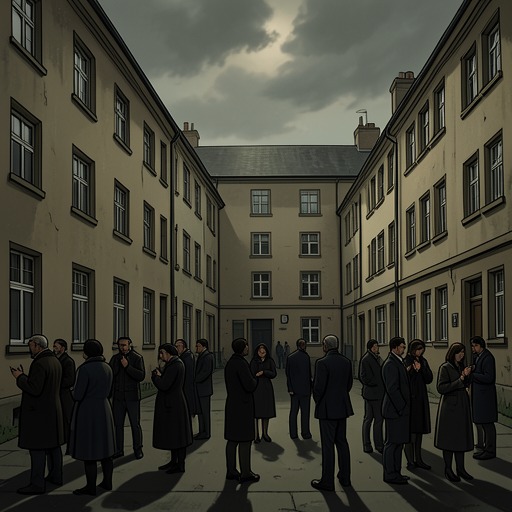
Her position in the building places her within the dense network of communal observation that surrounds the Greenes. The neighbors discuss one another behind their backs, and Mrs. Danko’s attention is directed especially toward the family’s difference. The story does not present her as an informed investigator with a coherent theory. Instead, she occupies an unstable border between accurate intuition and fantastical explanation, making her suspicions more unsettling precisely because they are mixed with error.
Suspicions About the Greenes
Mrs. Danko’s most pointed suspicion concerns Terence Greene. After the child’s unusually slow development—he does not walk until he is two or speak until he is three—the neighbors assume that he is backward. May Greene knows that they speak about the family differently from the way they speak about everyone else, and she wonders whether Mrs. Danko has muttered the word “Changeling” after the babies in the building. The possibility frightens May in her role as a mother even while it does not seriously endanger her role as a secret agent.
The irony is that Mrs. Danko’s superstition comes closer to the truth than the respectable explanations offered by the other adults. A changeling is not a scientific account of Terence’s origin, but it recognizes him as a child who does not belong entirely within the ordinary human order. Mrs. Danko has perceived the family’s alienness without possessing the conceptual language needed to name it. Her mistake is not that she sees nothing; it is that the culture around her can only classify what she sees as folklore or madness.
Her suspicion also exposes the vulnerability of the Greenes’ domestic performance. The family uses face and hand masks and contact lenses to conceal their green skin, unusual fingers, and other bodily differences. Their apartment is furnished in deliberately banal Earth fashion, yet it retains an indefinable emotional hint of alienness. Mrs. Danko’s response suggests that concealment is never complete: even when the visible evidence is controlled, behavior, atmosphere, and family difference may still invite interpretation.
Conflict and Escalation
Mrs. Danko’s hostility becomes explicit when Terence’s schooling raises questions about the family. She snarls, “Too good for public school!” and calls them “Commissars!” before making a sign to ward off the evil eye. Her accusation links several incompatible explanations—social elitism, political subversion, foreignness, and supernatural danger. The confusion is comic, but it also shows how quickly unfamiliarity becomes a threat in the neighborhood’s imagination.
The Greenes respond strategically rather than emotionally. Dan Greene decides that the family should allow the Russian story to stand, implying that they come from a Balkan state absorbed by a larger power and are keeping quiet because relatives might suffer reprisals. Mrs. Danko’s accusation thus helps produce a cover story that is false but plausible within the political atmosphere surrounding them. Her suspicion does not uncover the Milotan secret; instead, it supplies material that the Greenes can redirect into a safer human explanation.
Later, after the swimming-lesson exposure of Terence’s alien body, Mrs. Danko again behaves as a hostile observer. As May Greene drives away from the school, she hears Mrs. Danko hiss something in her native tongue and senses that the older woman is holding up two fingers after the retreating car. The gesture extends the threat beyond spoken accusation. Even without a public confrontation, Mrs. Danko’s body language marks the Greenes as objects of suspicion and leaves May aware that the family’s performance has been noticed by someone who remains unwilling to accept its surface.
Relationship to the Alien Secret
Mrs. Danko never learns that the Greenes are Milotans, but her presence helps define the difference between genuine detection and social interpretation. When the school principal sees Terence’s body, she explains the anomaly through radiation from bombs and assumes that the Greenes have concealed a mutation. May recognizes that Earth people are so confined by their own mental habits that they prefer explanations involving Russians, radiation, or witchcraft to the possibility of life and science beyond their awareness.
Mrs. Danko belongs to this same interpretive world, though in a more primitive and openly superstitious form. Her evil eye and changeling suspicions stand beside the principal’s radiation theory as competing ways of containing the unfamiliar. Both fail because neither can imagine the actual origin of Terence’s difference. The story’s satire does not make Mrs. Danko uniquely foolish; it shows a society capable of seeing bodily deviation only through inherited categories.
Her role also sharpens the contrast between the Greenes’ private knowledge and public vulnerability. Dan Greene looks at his hands and sees the wrong color for Earth and the wrong number of fingers for Milotis. Mrs. Danko cannot see the whole truth, but she senses the contradiction that the Greenes themselves must constantly manage: they are biologically Milotan, socially embedded on Earth, and dependent on disguises that can fail in ordinary public settings.
Narrative Function and Significance
Mrs. Danko functions as a recurring figure of misrecognition. She is not the person who reveals the alien secret; instead, she demonstrates why the secret can remain hidden. Her reputation for being “not quite right in the head” protects the Greenes from the consequences of her insight, while her accusations keep reminding readers that the family’s difference is visible enough to provoke a response.
Her presence also gives the story a social scale beyond the Greene household. The family’s secret is not endangered only by governments or formal institutions. It is endangered by elevators, neighbors, school conversations, gossip, gestures, and the accumulated pressure of being watched. Mrs. Danko embodies that informal surveillance in its most abrasive form. She turns the apartment building into a space where private identity is constantly exposed to communal judgment.
At the same time, her hostility is part of the story’s broader treatment of alienation and exclusion. She labels the Greenes through suspicion, political insult, and superstition, while the human community later labels Terence a freak or a product of radiation. These labels differ in content but share the same function: they convert an unfamiliar body into a social problem. Mrs. Danko’s failure to recognize the Milotan truth therefore becomes a measure of the limits of the society around her, while her imperfect intuition makes her one of the story’s sharpest instruments of irony.