Mrs. Schultz
The People UpstairsMrs. Schultz is one of the Greenes’ neighbors and a representative of the ordinary social world against which May Greene and Dan Greene must constantly perform normality. She is younger than some of the women around her and has more children, including Linda and Rory, yet her confidence rests less on genuine authority than on public claims about respectable family life. Through her blunt opinions about schooling, discipline, and self-reliance, she turns neighborhood conversation into a test that May Greene must survive without revealing the family’s secret.
Identity and Social Position
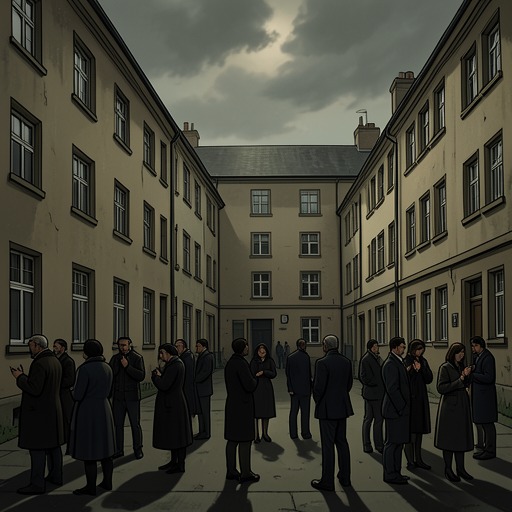
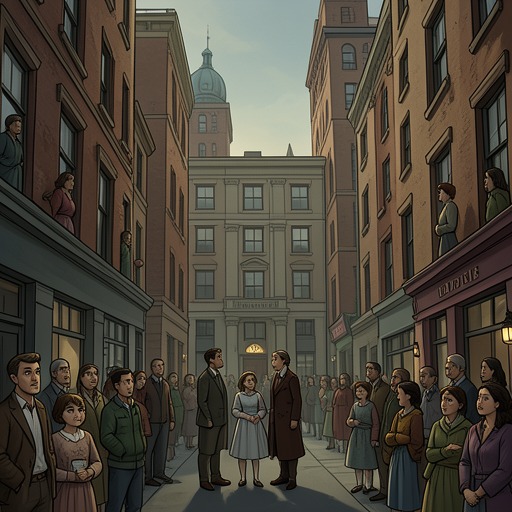
Mrs. Schultz belongs to the apartment-house circle that watches, compares, and discusses its neighbors. She presents herself as the mother of fine children, declaring that Linda and Rory attend public school and that everybody considers them exemplary. The narration sharply undercuts this boast: when Mrs. Schultz is absent, the neighborhood says the children are terrors. Her social power therefore comes from controlling the public version of her family rather than from an objectively secure reputation. She is able to make her own household stand for conventional success while treating May Greene’s household as suspiciously overprotected and socially aloof.
Her manner is marked by physical and verbal assertiveness. She tosses her hennaed head, snaps replies, wags it in judgment, and treats her own experience as a universal rule. When she says that a child must learn to take care of himself, she converts a personal preference into a law of social survival. That certainty gives her a recognizable, relatively flat comic-social function, but it also makes her consequential: she supplies the language of normality that threatens to expose anything unable to conform.
Conflict with May Greene
Mrs. Schultz becomes most visible when the neighbors discuss Terence Greene’s education. Mrs. Gottesmann has just inferred that a private school must cost the family plenty, and Mrs. Schultz immediately champions public schooling as good enough for her own children. May cannot answer by calling Terence delicate or backward while he is present, nor can she disclose that his unusual development and appearance arise from his Milotan biology and the disguises required to pass on Earth. Instead, she offers the safer explanation that the neighborhood contains juvenile delinquency and gang wars and that a parent cannot be too careful.
Mrs. Schultz rejects this caution as weakness. Her insistence that a child must learn to take care of himself places May in an impossible position: any defense of special protection risks sounding unnatural, while agreement abandons the concealment on which Terence’s safety depends. May jumps at the force of the rebuke, then retreats into an apologetic admission that she may be overprotective. The exchange shows how the Greenes’ secret is endangered not only by formal institutions but by ordinary conversation, where another parent’s confidence can compel explanations the family cannot safely give.
Surveillance and the School Crisis
Mrs. Schultz’s attitude turns from criticism to retrospective triumph when May rushes out of the apartment house after the school has discovered a problem involving Terence. Beside the entrance, Mrs. Gottesmann and the other women watch eagerly, hoping to learn what has happened. Mrs. Schultz observes that she had always said private schools were no good. The remark is not an attempt to understand Terence; it is an effort to claim that the crisis confirms her earlier judgment and that May’s protective choices deserve blame.
The timing gives her comment particular force. May is already struggling to suppress fear about what the school may have learned, and she automatically tells the women that nothing is wrong while fumbling with the car door. She has spent eighteen years avoiding antagonizing them because managing their opinions is part of her work as a secret agent, not because she values their approval. Mrs. Schultz’s judgment thus becomes one element in the larger apparatus of scrutiny surrounding the Greenes. The neighborhood does not know the truth, but its curiosity and moral certainty create the conditions in which the truth might be forced into the open.
Contrast with the Greenes’ Family Burden
Mrs. Schultz’s easy doctrine of toughness contrasts with the actual burden carried by May Greene and Dan Greene. Their child requires costly masks and lenses fitted by Dr. Robinson, develops more slowly than a terrestrial child, and must be raised under constant fear that his body will be recognized as alien. The family’s resources are already strained: May has stopped earning income to remain at home, living on Earth is expensive, and the Greenes have surrendered luxuries before cutting into necessities. Mrs. Schultz sees only a parent who is too protective; she cannot see that protection is a biological and political necessity.
The contrast is also emotional. May sometimes spoils Terence because guilt follows her disappointment that motherhood has not brought the pleasure she expected, and because remorse drives her to give him things that are not good for him but that he wants. Mrs. Schultz’s public language reduces such complicated care to a failure of discipline. Yet the later school episode reveals that May’s protectiveness has not been pointless. When swimming lessons threaten to expose Terence’s disguised body, his accusation that he is different and alien turns the family’s hidden condition into an immediate crisis. Mrs. Schultz’s earlier demand for toughness offers no protection against that danger; it merely names concealment and caution as social defects.
Narrative Significance
Mrs. Schultz embodies the pressure of assimilation in its most mundane form. The Greenes are not challenged only by Milotan authorities, the costs of biological disguise, or the possibility of institutional discovery. They are also challenged by neighbors who measure children against local standards, celebrate public conformity, and treat deviation as evidence of parental failure. Her claim that public school is sufficient and her satisfaction when the private school appears to fail express the community’s preference for sameness over the exceptional care Terence requires.
Her presence also sharpens the irony of Terence’s identity. He is Earth-born, possesses a genuine United States of America birth certificate, and technically is not even a Milotan, yet his parents must hide him behind masks and lenses because his body is the wrong color for Earth and has the wrong number of fingers for Milotis. Mrs. Schultz has no access to this truth, but her insistence on judging visible behavior and conventional choices helps create the hostile surface beneath which it remains concealed. Against that pressure, Terence eventually clings to May Greene’s hand after the school crisis and asks her to tell him about Milotis, the place where everyone is like them. Mrs. Schultz does not cause this new intimacy, but the social world she represents helps make the revelation necessary: the child who was expected to endure difference must finally learn what that difference means.