Pregnancy
The People UpstairsPregnancy is the decisive disruption in the Greenes’ carefully managed existence on Earth. What first appears to be an illness when May Greene returns from New York to see Dr. Robinson is revealed to be an unexpected pregnancy, a condition that threatens the couple’s lifelong secret-agent assignment, their bodily adaptations, and their ability to remain inconspicuous among humans. It also creates the first Milotan life whose relationship to Earth cannot be reduced to a mission posting: Terence Greene will be born there, possess genuine Earth citizenship, and grow up between biological difference and legal belonging.
Discovery and Immediate Crisis
May Greene’s pregnancy is disclosed only after she removes the silk-thin plastomask from her face and slips off her contact lenses. Dr. Robinson has examined her in New York, and Dan Greene initially assumes that she has contracted an Earth disease, despite the Greenes’ belief that they are immune to all terrestrial illnesses. His alarm reflects both practical concern and the precariousness of their situation: an organic condition that Earth medicine could not adequately treat might require an immediate return to Milotis.
The diagnosis overturns that expectation. May explains that she is going to have a baby, and Dan reacts with disbelief because she is considered past the age of childbearing. The pregnancy is therefore extraordinary not merely because it is unexpected, but because it contradicts the biological assumption on which the Bureau’s assignment was based. The Bureau sends women to Earth who are believed to be sterile or beyond childbearing; May and Dan had been selected partly because officials presumed that conception was no longer possible.
May’s response combines exhaustion, resentment, and long-suppressed desire. She has felt old and barren for a long time and had agreed to the Earth posting because she believed she would never have a child. The pregnancy reopens a hope that she had deliberately abandoned, while also making the Bureau’s likely punishment unavoidable. She expects the authorities to blame both agents for failing to take proper precautions, and she does not try to place the entire burden on Dan. Their shared responsibility becomes part of the emotional pressure surrounding the decision.
The Decision to Continue the Pregnancy
Dr. Robinson offers to terminate the pregnancy without reporting it to Milotis. His discretion would allow the Greenes to preserve their assignment, and May acknowledges that the offer is considerate. She refuses because she has wanted a child all her life. Her decision gives the pregnancy its central moral force: it is not treated as an accident to be erased for the sake of professional duty, but as a life May chooses to protect despite the consequences.
Dan is less immediately willing to accept that choice, not because he lacks affection for May or the unborn child, but because he has organized his future around remaining on Earth. He understands that their salaries and government allowances provide a relatively comfortable life, whereas a return to Milotis with dishonorable discharges would leave them materially worse off. He also recognizes the unpleasantness of secret-agent work without seeing it as optional; someone must perform the assignment, and they have become accustomed to their surroundings even though they cannot truly like the human population.
The couple considers ways to conceal the child. May imagines keeping the baby at home and obtaining masks of progressively larger sizes from Dr. Robinson. Dan points out that concealment might work only while the child is very young. At about six, compulsory schooling would require Terence to leave the apartment, and medical examinations could expose him even if Robinson managed to make the disguise pass a superficial inspection. A private tutor would also endanger the operation, since the Greenes must appear to be inconspicuous, average, middle-class individuals in Washington Heights; a tutor would draw attention and would require either another trusted Milotan or an additional person to learn their secret.
The pregnancy thus collides with the ordinary institutions of Earth. School attendance, medical examination, domestic visibility, and neighborhood scrutiny are not incidental inconveniences but mechanisms through which the child’s body may become legible to others. The law makes private concealment temporary, while the Greenes’ own operational rules make conspicuous protection impossible. Their pregnancy produces a child whom ordinary family life will continually threaten to reveal.
Birth and Material Consequences
Eight months later, with Milotan gestation roughly comparable to terrestrial gestation, Terence Greene is born. His birth on Earth places him in a legally unprecedented position. He is born in the United States of America, is technically a citizen of that country, and possesses a bona fide birth certificate rather than forged papers. Yet the narrative also notes that, technically speaking, he is not even a Milotan. Pregnancy therefore creates a category that neither side’s ordinary identity system fully contains: Terence has Milotan biology and heritage, but Earth birth and formal civic status.
Dr. Robinson fits the infant with small masks and lenses in an unusually complete laboratory for a New Jersey general practitioner. The disguises are necessary from the beginning and remain expensive. Because Milotan children grow more slowly than terrestrial children, the masks do not need to be replaced as rapidly as human parents might expect, but the financial burden still strains the family. Their Earth salaries were intended only to supplement allowances from the Milotan government, and life on an alien planet is already costly.
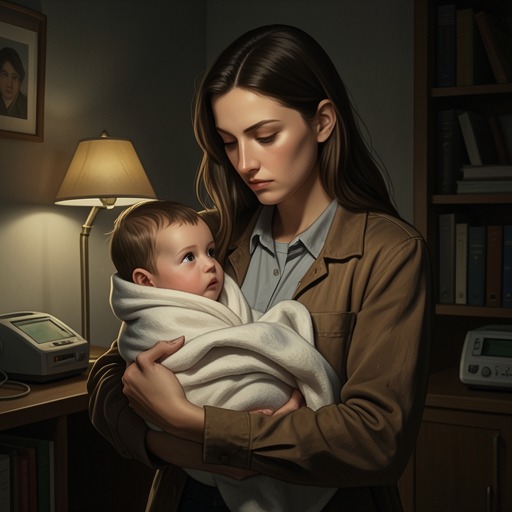
The pregnancy also reorganizes the Greenes’ labor. Caring for a first child proves difficult for a couple old enough to have become grandparents more comfortably. Milotan infants have the same broad physical demands as terrestrial babies, while the robots that would have provided childcare on Milotis are unavailable in this technologically inferior environment. To conform to Earth customs, May remains at home with Terence while Dan continues working. Her loss of income becomes an immediate consequence of choosing the pregnancy, and the family must surrender not only luxuries but eventually necessities.
Their sacrifices are concrete. Dan gives up the specially imported tobacco substitute from Milotis, and May gives up the home delicacies that arrive repackaged as Rice Krispies and Coca Cola. The pregnancy therefore converts the abstract risk of discovery into an everyday economy of deprivation. The child is protected through masks, altered household objects, reduced consumption, and May’s unpaid care, while the family’s apparent middle-class normality becomes increasingly difficult to maintain.
Pregnancy’s Continuing Exposure of Difference
After Terence’s birth, May must take him into the sun each day, since even Earth’s pale yellow sunlight is preferable to none. She exchanges evasive pleasantries with neighbors who keep a constant daytime presence outside the house, surrounded by perambulators and deck chairs. She once takes Terence onto the roof at night so he can see the distant glimmer of Milotis, but stops when the neighbors become curious. The pregnancy has thus extended beyond gestation into a permanent discipline of surveillance: every ordinary parental act must be measured against the danger of attracting notice.
The Greenes raise Terence in both Milotan and English, warning him not to use Milotan in public while accepting that an occasional unfamiliar word can pass as childish babble. They keep him away from other children as much as possible, but the strategy fails when compulsory attendance requires him to enter school at six. May chooses a private day school and tells the principal that the Greenes are Christian Scientists so that Terence will not undergo medical examinations. The large fees make the principal unusually accommodating, but the arrangement shows that the pregnancy has not removed the family from institutional control; it has only shifted the family’s concealment into another form.
The crisis reaches its sharpest point when Terence’s grade begins swimming lessons. May had not imagined that school would require her son to appear unclothed or nearly unclothed before other children. Terence recognizes the bodily difference that his parents have concealed and tells her that he is different, turning his discovery into an accusation against the parents who have made that difference his burden. The principal then learns what has been hidden and expels him from the school.
May responds by converting exposure into another performance of normality. She tells the principal that the family is considering a move to the suburbs because Washington Heights is becoming too dangerous for raising a child, and says that Terence will be transferred to a school where nobody knows him. When the principal urges her to inform the authorities about what is wrong with him, May’s apparent sympathy masks her amusement. The pregnancy has led to a child whose body cannot remain private, and each institutional encounter compels May to alternate between protective deception and the socially acceptable role of a concerned human mother.
Family, Identity, and the Irreversibility of Birth
The consequences of pregnancy finally become explicit when May tells Terence that Milotis is real and that his parents have not invented it. She promises that she and Dan will explain the planet to him at home and announces that they will send a beam back to Milotis reporting all about him. Her gesture toward Terence’s mutilated, plastoskin-encased hand joins maternal tenderness to bureaucratic notification: he is at once her child and a fact to be reported to the distant authority that governs his parents’ mission.
The pregnancy changes the Greenes’ relation to return. Their bodies have been adapted for a lifetime on Earth, including amputations, so returning to Milotis would leave them unable to readapt. Before conception, this irreversible assignment was an unpleasant but manageable professional condition. After May chooses to continue the pregnancy, it becomes the setting in which a new family must be protected. Terence’s Earth birth makes the conflict still sharper: the child is legally of Earth, biologically Milotan, and socially vulnerable in both worlds.
In this sense, Pregnancy is not only a reproductive state but the story’s mechanism for exposing the contradiction between institutional categories and lived identity. The Bureau’s assumptions classify May as incapable of bearing a child; the law classifies Terence as an Earth citizen; the school treats his undisclosed body as a problem requiring removal; and the Greenes experience him as a beloved son whose existence cannot be sacrificed to preserve an assignment. The pregnancy turns a secret operation into a family history and makes concealment an inherited condition rather than merely a professional technique.