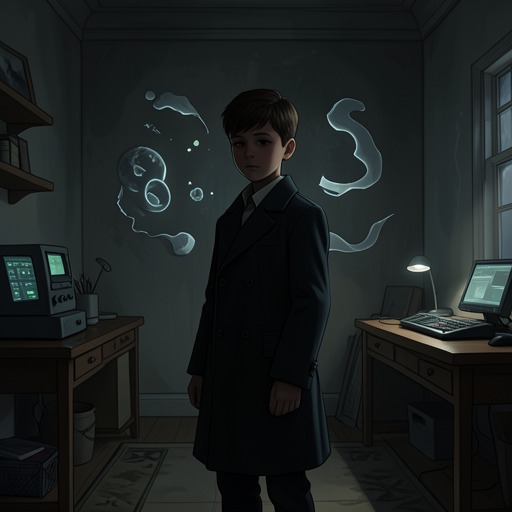
Terence Greene's enrollment in human school
The People UpstairsTerence Greene's enrollment in human school marks the moment when the Greenes' private strategy of concealment meets the public machinery of Earth life. His parents have chosen to raise him on Earth despite knowing that compulsory schooling, medical scrutiny, and the ordinary visibility of childhood would threaten the disguises that make their family appear human. School therefore represents both an opportunity for Terence to enter the society around him and a danger that may reveal what the family has spent years hiding.
Causes and Preparations
The immediate cause of the enrollment is legal rather than personal: when Terence reaches six, he must attend school because Earth law requires it. The decision had been foreseen from the beginning. Dan Greene had warned May Greene that keeping the child at home would work only while he was very young; by about six, he would need schooling, and examinations or other official scrutiny could expose him. A private tutor would not solve the problem, because the Greenes must remain inconspicuous, average, middle-class individuals in Washington Heights, and a tutor would itself attract attention while possibly requiring another person to learn their secret.
Terence's situation is especially precarious because he is both legally secure and physically concealed. Born in the United States of America, he possesses an authentic birth certificate and is technically a citizen of that country, making him the first Milotan on Earth who does not require forged papers. Yet Dr. Robinson has altered him so extensively that his survival depends on the continued use of face and hand masks and Milotan contact lenses. His Earth citizenship cannot make his body conform to Earth expectations, while the physical differences that would identify him on Earth also make him unsuitable for an uncomplicated return to Milotis: his color is wrong for Earth, but his fingers are wrong for Milotis.
Enrollment and the First School Day
May Greene enrolls Terence in a private day school because she wants him to receive the best limited educational advantages available on Earth. Boarding school is impossible, since it would remove him from the parents who supervise his disguise and protect the family secret. To avoid medical examination, May tells the principal that the Greenes are Christian Scientists. The explanation is accepted partly because the school fees are substantial, and the principal responds with understanding. The arrangement shows how class respectability and a carefully selected religious pretext can temporarily shield an alien body from institutional inspection.
The first day is an ordeal chiefly for May. She trembles while waiting to collect Terence, searching his childish mask for signs that the school has distressed him. His lenses prevent him from crying in the ordinary visible way, but she believes she can still read his condition. After they have driven for ten minutes in silence, she asks whether he liked school and whether he got on well with the other children. Terence answers that they were all right, giving no immediate indication that the day has produced a crisis.
That calm is deceptive. Terence begins comparing the people around him with the objects he has been taught to regard as necessary. He asks whether the other children wear face masks or lenses, then wonders whether the grown-ups do. When May explains that only the Greenes in the city wear them, he tests the claim against Mrs. Danko, asking whether the older woman’s visible face is her real one. The exchange turns the disguise from a private family routine into a social classification: Terence now understands that what he has assumed to be ordinary adult equipment is, in fact, unique to his household.
School as an Education in Difference
Before school, May and Dan had told Terence only that they came from a far-off place. They taught him both Milotan and English, instructed him never to speak Milotan in public, and kept him away from other children as much as possible. They knew he had to recognize his difference well enough to conceal it, but they postponed telling him why he was different because they could not yet trust his discretion. Dan wanted the truth disclosed early so that Terence would not identify with human society; May believed that he would discover soon enough that he was an alien.
School accelerates that discovery by giving Terence a stable population against which to measure himself. He is academically capable enough to keep pace with human children, although his parents deliberately hope he will not appear to be a prodigy. His Milotan development is unusual by Earth standards: he did not walk until two and did not speak until three, leading neighbors to regard him as backward. Even May, after spending ten years within Earth culture, partly absorbs that judgment and begins to think of him as retarded. At school, however, the issue is no longer merely delayed development. His body, language, and family customs are placed beside human norms every day.
The school also becomes a site where Terence's faith in human authority competes with his parents' secrecy. When he later asks about his origin, the possibility that he comes from Russia or China provides him with categories supplied by Earth education, not by Milotan knowledge. He eagerly suggests China as an explanation for the masks, then notices that Chinese people are yellow rather than green. Once Dan Greene says that the family comes from another planet and another solar system, Terence cannot immediately understand the revelation. His teacher, Miss Chase, remains more credible to him than his parents in matters of the world, and Dan and May decide that they cannot destroy a child's faith in his teacher simply to make their own explanation easier to accept.
Exposure and Institutional Exclusion
The decisive danger arrives with swimming lessons, which begin in Terence's grade. The Greenes had managed to make the private school appear genteel and only minimally alien, but they had not imagined that the curriculum would require Terence's body to be seen in circumstances where masks and lenses could no longer preserve the fiction. Terence returns home after the lesson and initially says that nothing happened, or not really. His difficulty in speaking and the long silence reveal that the event has already altered the family's situation.
He finally explains that the class had swimming lessons. May reacts with horror because the lesson has exposed the possibility she had refused to imagine: the school could place Terence unclothed or nearly unclothed before other people. Terence's response is not merely a report of embarrassment. He tells May that he is different, and the statement functions as an accusation. His parents have told him that he was different without explaining the nature or origin of that difference, leaving him to confront its consequences in public. The concealment intended to protect him has instead made the exposure feel like a betrayal.
The principal appears at the office doorway and coldly points out that May should have told her. May immediately resumes the role required by the human setting, presenting Terence's condition as something the family has been concealing out of habit rather than as evidence of an alien origin. The principal expresses sympathy but says that Terence cannot remain at the school after the horrible scene. The institution's response is framed as concern for his welfare, yet its practical result is expulsion and the demand that his condition be disclosed before he enters another school.
May answers by announcing that the family has been considering a move to the suburbs because Washington Heights is becoming too dangerous a neighborhood in which to raise a child. She plans to transfer Terence to a school where nobody will know him. The move is therefore both an ordinary parental relocation and another layer of clandestine protection. The principal insists that the authorities are friends who want to help, while May understands that official help would mean examination, classification, and the collapse of the disguise. Her polite thanks, delivered after the danger has passed, conceals her amusement at the gap between the principal's interpretation and the family's actual predicament.
Consequences and Revelation
The immediate consequence of enrollment is not assimilation but exposure. School forces the Greenes to confront the limit of their human cover: a birth certificate can establish Terence's civic identity, a religious explanation can defer medical examination, and masks can preserve appearances in ordinary encounters, but no such measure can guarantee privacy when a public institution controls a child's activities. Compulsory education makes concealment structurally unstable because it subjects the child to teachers, administrators, classmates, and bodily routines beyond his parents' control.
Yet the crisis also produces the strongest emotional closeness between May and Terence since his infancy. He clings tightly to her hand on the way to the car, and for half the journey he remains silent. Then he speaks to her in halting Milotan and asks her to tell him about Milotis, asking whether such a place really exists, where everybody is like them, or whether his parents invented it. The question confirms that the school experience has transformed an abstract family secret into a personal demand for origin and belonging.
May answers that Milotis is real and promises that she and Dan will tell him all about it at home. The enrollment thus ends with a reversal. The Greenes had sent Terence into human society hoping to preserve an inconspicuous life, but the school has taught him that he is visibly, bodily, and historically outside that society. At the same time, the institution that exposes his alienation directs him back toward the language and homeland his parents had deliberately withheld. Human schooling becomes the event that begins, rather than resolves, Terence's conscious confrontation with his Milotan identity.