Terence's enrollment in human school
The People UpstairsTerence's enrollment in human school is the decisive experiment in the Greenes' attempt to raise a Milotan child on Earth. It is not merely an educational milestone. Because Terence is Earth-born, possesses a genuine United States of America birth certificate, and is technically not even a Milotan, his schooling tests whether biological disguise and cultural upbringing can produce a usable human identity. The experiment initially appears successful, but the school's ordinary procedures eventually expose the limits of the family's concealment and force Terence to confront his alien origin as a personal accusation rather than a secret belonging only to his parents.
Compulsory Education and the Family's Dilemma
The school decision had been anticipated from the moment the Greenes chose to keep their child on Earth. Dan Greene warned May Greene that a child could remain at home under careful supervision only while he was small; at about six, he would have to attend school because the law required it. Medical examinations created a second danger. Even if Dr. Robinson's work allowed Terence to pass a superficial examination, the family would always be vulnerable to a more searching inspection. A private tutor was no safer: in Washington Heights, a tutor would make the Greenes less inconspicuous, and bringing another person into the home could reveal their secret.
Terence's legal position sharpened rather than solved this dilemma. He had been born on Earth in the United States of America and therefore held authentic citizenship and an authentic birth certificate, unlike his parents, who had altered their Milotan names into close Earth equivalents and lived under the discipline of covert identities. Yet formal citizenship could not make his body ordinary. Dr. Robinson had altered him so extensively that his future appeared confined to the work of his parents, unless the Milotan Bureau accepted the usefulness of an Earth-born agent. School thus placed a supposedly legitimate citizen inside institutions that could still treat his physical difference as a defect or deception.
The Private-School Experiment
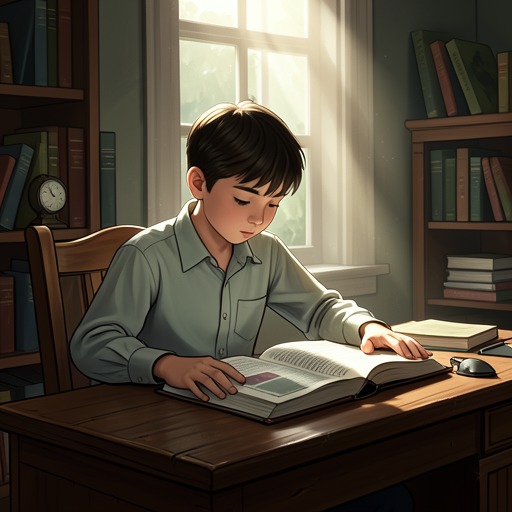
When Terence was six, May enrolled him in a private day school, choosing the best limited educational opportunity available while rejecting boarding school as impossible. On Milotis, Terence's developmental equivalent was that of an Earth four-year-old, but Milotan children learned quickly; May expected him to keep up without displaying the conspicuous brilliance that would have made him dangerous. He was self-possessed and unusually adult in manner because he had spent most of his time with adults, not because he was an extraordinary genius. This moderation was part of the disguise: academic competence could help him blend in, while prodigious achievement would draw attention.
May protected the arrangement through a socially recognizable explanation. She told the principal that the Greenes were Christian Scientists and that Terence was not to undergo medical examinations. The principal's graciousness was aided by the size of the fees, which made the school unusually accommodating. The exemption illustrates how the family's cover depended not only on masks and lenses but also on class position, money, and the willingness of institutions to convert a questionable circumstance into a respectable religious exception.
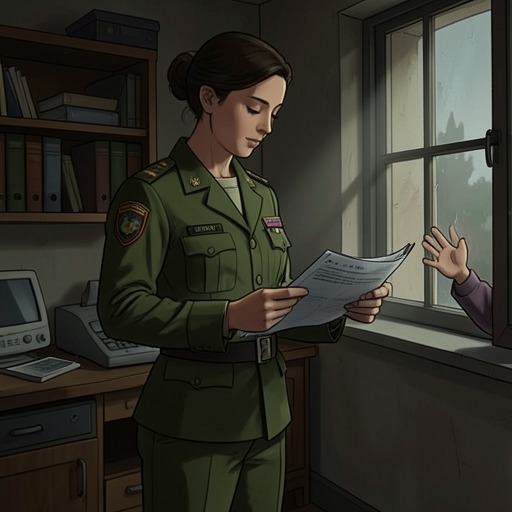
The first day became an ordeal for May more than for Terence. She trembled while waiting to collect him and searched the child's mask for signs of distress. The contact lenses prevented him from crying in the ordinary visible way, but she believed she could still read his condition. After ten minutes of silence in the car, she asked whether he had liked school. Terence answered that it had been all right, and he gave the same restrained assessment of the other children. His composure suggested that the immediate social trial had not yet harmed him, but his next question revealed that he had already begun comparing himself with his classmates: they did not wear face masks or lenses.
Exposure Through Ordinary Schooling
The danger came not from an exceptional investigation but from a routine part of the curriculum. Terence eventually encountered swimming lessons, which began in his grade. The lesson required a degree of bodily exposure that the family's genteel private-school setting had not seemed likely to impose. When May asked what had happened, he struggled to explain that swimming lessons had taken place. Her horror arose from the sudden collision between Earth custom and the physical reality she had spent years concealing. She knew that human beings appeared unclothed or nearly so before one another, yet she had never imagined that such a custom would expose her son.
Terence identified the injury in the simplest possible terms: he was different. In his statement, difference became blame. The masks had not merely protected him; they had separated him from the other children and left him without an explanation that he could use. May had believed that she had told him he was different, but he understood that she had not told him enough. The swimming lesson transformed an abstract family secret into a social fact visible to the school, while his accusation redirected responsibility toward his parents: his alienation existed because they had withheld the truth and constructed the condition in which he had to live.
The principal's reaction made the school an institutional rather than merely interpersonal antagonist. She had learned what the family had concealed and told May that Terence could no longer remain at the school. May immediately resumed the role of the anxious, embarrassed mother, saying that the family had become so accustomed to concealing Terence's condition that she had failed to anticipate the exposure. The principal softened, expressing sympathy and insisting that the authorities wanted to help. Beneath that language of assistance lay exclusion: the school would not retain Terence, and the proposed help depended on the family identifying and reporting what was wrong with him before enrolling him elsewhere.
Consequences for the Greenes and Terence
May answered by presenting the expulsion as a reason to move to the suburbs. Washington Heights, she said, had become too dangerous a neighborhood for raising a child, and Terence could be transferred to a school where nobody knew him. The explanation preserved the appearance of ordinary parental choice while concealing the real cause. It also extended the Greenes' strategy of camouflage: relocation could erase local suspicion, but it could not remove the structural pressures created by compulsory education, examinations, and communal scrutiny.
The episode nevertheless produced an unexpected intimacy between May and Terence. He clung to her hand on the way to the car, and she had not felt so close to him since he was an infant. The school had failed as a means of ordinary assimilation, but its failure broke the emotional distance created by years of secrecy. In the car, Terence asked in halting Milotan whether Milotis truly existed and whether everyone there was like them. He wondered whether his parents had invented the planet merely to explain his difference. May confirmed that Milotis was real and promised that she and Dan would tell him about it at home.
The enrollment therefore ends by producing the very revelation that the Greenes had postponed. The child who was intended to become a native-born Milotan agent has begun to ask where he belongs, not what profession he will enter. His authentic Earth citizenship, human schooling, and outwardly ordinary behavior cannot prevent the body beneath the disguise from forcing an identity crisis. The private-school experiment demonstrates that assimilation is not secured by legal status, educational access, or technological concealment when ordinary institutions are organized around the assumption that bodies should be visibly and medically human.
Narrative Significance
As an event, Terence's enrollment marks the transition from domestic concealment to public testing. Before school, May and Dan Greene can regulate language, contact, clothing, and information within the household. Once Terence enters an institution governed by attendance requirements and collective routines, control becomes partial. The school supplies peers who can serve as a norm, teachers who can demand participation, and procedures that can expose the body despite the family's elaborate precautions.
The event also makes Terence's double formation visible. At home he speaks both Milotan and English, is warned not to use Milotan publicly, and is kept away from other children as much as possible. At school he must behave as a child among humans while concealing the physical signs that distinguish him. His question about masks and lenses shows that cultural assimilation has not erased his awareness of difference; instead, it has taught him to recognize himself through comparison with those around him. The swimming lesson then supplies the crisis through which he begins to claim knowledge of Milotis and to seek a community in which his body will not require explanation.