Terence's revelation of his alien origin
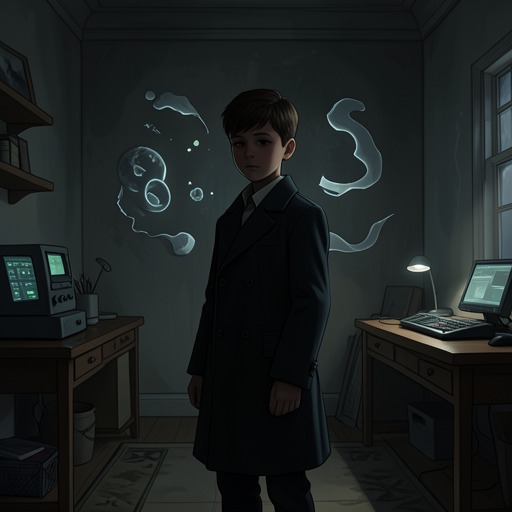
The People UpstairsTerence's revelation of his alien origin is the decisive rupture in the Greene family's long strategy of concealment. Raised on Earth under biological disguises and human customs, Terence has been treated as an Earth child while remaining physically and culturally tied to Milotis. The swimming lesson makes that divided existence impossible to sustain: when his concealed body is exposed, he understands that his parents have withheld not merely a fact about his appearance but the explanation of his entire life.
Causes and Background
The revelation grows out of a contradiction established before Terence's birth. Dan Greene and May Greene are humanoid agents from Milotis whose bodies have been altered for a lifetime assignment on Earth. Their adaptations include amputations, and returning home would no longer restore them to their original lives; they have become as monstrous on Milotis as they would appear in their natural forms on Earth. Dan therefore describes their problem not as a temporary inconvenience but as a permanent condition of exile, shaped by the irreversible demands of their work.
Their child intensifies that danger. Terence Greene is born on Earth in the United States of America, receives a genuine birth certificate, and is technically not even a Milotan in the ordinary bureaucratic sense. Yet his body remains Milotan. Dr. Robinson must fit him with small masks and lenses, and the Greenes must pay for replacements as he grows. The disguises make his legal status appear simple while making his physical existence precarious: he is an Earth citizen whose unaltered body cannot safely enter ordinary Earth institutions.
Dan and May understand that concealment cannot last indefinitely. When Terence is about six, the law requires him to attend school, and medical examinations threaten to expose what the family has hidden. Dan rejects keeping him at home with a tutor because the Greenes must remain inconspicuous, average, middle-class individuals in Washington Heights; an unusual arrangement would attract attention and might force them to reveal their secret to another person. May therefore enrolls him in a private day school, claiming that the family are Christian Scientists so that Terence will not be subjected to medical examinations. The school accepts the explanation partly because the fees are substantial.
At home, the Greenes speak both Milotan and English so that Terence will know both languages, but they warn him never to use Milotan in public. He is kept away from other children as much as possible, and his delayed development deepens the impression that he is backward. He does not walk until he is two or speak until he is three; even May, despite knowing the biological reason, becomes partly conditioned by the surrounding Earth culture and begins to think of him as retarded. His education is thus built on a double concealment: the parents hide his species from Earth, while the child himself is denied the knowledge needed to interpret his own difference.
What Happens
The immediate trigger is a swimming lesson. Terence tells May that nothing happened, or not really, but then explains with difficulty that swimming lessons have begun in his grade. The school has seemed genteel and only minimally alien to May, so she has not imagined that a compulsory activity involving the body could expose him so completely. The ordinary curriculum therefore becomes the instrument that defeats the elaborate system of masks, lenses, excuses, and restricted contact through which the Greenes have managed his childhood.
Terence responds with the accusation that gives the event its emotional force: he tells May that he is different. For him, the statement means more than physical variation. It means that his parents know the source of his alienation and have left him to encounter its consequences without the knowledge that might have made it intelligible. His words turn the family secret into a charge against May: she is responsible, in his eyes, for his being alien because she has made him live as though he were not.
The school principal appears at the doorway and coldly points out that May should have disclosed the matter. The institutional language of help and friendship cannot conceal the school’s exclusionary response. The principal says that Terence will not be allowed to remain, while also urging May to tell the authorities what is wrong with him before enrolling him elsewhere. Terence’s body is treated as a condition to be reported, managed, and removed, even though he has been born in the United States of America and possesses valid citizenship there.
May immediately resumes the role of the worried Earth mother. She apologizes, claims that the family have become so accustomed to concealing Terence’s condition that she never thought of the possibility, and accepts his removal from the school as though it were a reasonable accommodation. She says that the family have been considering moving to the suburbs because Washington Heights is becoming too dangerous for raising a child, and proposes transferring Terence to a school where nobody will know. Her performance converts the alien secret into the language of ordinary parental concern, allowing her to leave without openly surrendering the truth.
The Revelation to Terence
Outside the school, Terence clings tightly to May’s hand on the way to the car. The physical contact restores a closeness she has not felt since he was an infant, but it also follows the moment when the human disguise has failed. His dependence is therefore not merely comforting; it marks the beginning of a more honest relationship between mother and child, one in which he can finally ask what the concealed signs of his body mean.
After remaining silent for half the journey, Terence speaks haltingly in Milotan and asks May to tell him about Milotis. He wants confirmation that there really is a place where everybody is like them, and he asks whether his parents have invented it merely to explain his difference. His questions show that the revelation is not created from nothing at the school. He has already gathered enough evidence from language, masks, and his parents’ behavior to suspect that the public account of his identity is false; the swimming lesson has simply made the suspicion urgent.
May confirms that Milotis exists and tells him that she and Dan Greene have not been making it up. She promises to explain everything when they reach home. Her answer is both an admission and a postponement. The central lie has ended, but the complete history of Milotan identity, espionage, adaptation, and exile has not yet been given to him. The revelation thus unfolds in stages: first the recognition of difference, then confirmation of the alien homeland, and only afterward the promised family account.
Consequences and Aftermath
The event changes Terence’s position within the family. Before it, he is the protected object of a dangerous concealment, equipped with masks and lenses and trained to avoid public mistakes. After it, he becomes a conscious participant in the secret. He can speak Milotan to his mother, ask about Milotis, and interpret the bodily evidence that has previously been managed on his behalf. His alien identity is no longer only something done to him by Dr. Robinson’s medical alterations or by his parents’ decisions; it becomes knowledge that he can use to understand himself.
The revelation also revives the original strategic problem that preceded his birth. Dan and May had considered returning to Milotis, but their adaptations made reintegration impossible, and they had feared that Earth law, schooling, and medical examinations would eventually expose the child. Their decision to keep Terence on Earth was therefore a gamble against institutions that could not recognize his situation. The school’s response proves the danger they anticipated, while the family’s plan to move and transfer him shows that concealment has not ended; it has merely shifted location.
May’s final gesture points beyond the private family scene. She places a hand on the steering wheel and pats the plastoskin covering Terence’s small, mutilated hand, then says that the family will send a beam to Milotis telling them all about him. The message will report not simply a birth but the existence of a Milotan born on Earth, one who has a bona fide Earth birth certificate and does not fit neatly into either society. Terence’s revelation therefore becomes an interplanetary communication and a possible turning point in the larger Milotan project, connecting the child’s intimate discovery with the secret-agent network that has been preparing for an eventual expansion on Earth.
Narrative Significance
The revelation exposes the limits of legal and cultural assimilation. Terence is formally an American citizen by birthplace, speaks English, attends an Earth school, and has been raised according to Earth customs; nevertheless, a swimming lesson makes his body legible as alien, and the institution responds by excluding him. His citizenship cannot protect him from a social order that treats visible difference as a defect requiring disclosure. Conversely, his connection to Milotis is also incomplete: the Greenes’ altered bodies and Terence’s Earth birth leave the family unable simply to return to the world from which they came.
The scene also turns the masks into more than medical equipment. They have allowed Terence to pass, but they have not given him a coherent identity. Their failure produces knowledge through the body before it produces explanation through language. The accusation that he is different gathers together the physical, familial, linguistic, and political consequences of the disguise. What the parents call protection has become, from Terence’s perspective, exclusion from his own history.
At the same time, May’s response reveals the mixture of love, strategy, and institutional calculation governing the family. She has endured the expense of the disguises, protected Terence from examinations, and maintained the household’s cover, yet she also immediately performs a false explanation before the principal. Her later confirmation of Milotis is genuinely intimate, but it arrives only after public exposure has made continued silence impossible. The event is consequently neither a simple confession nor a clean liberation. It is the moment when Terence learns the truth while the family remains trapped in the practical necessity of hiding it from everyone else.