The Greenes reveal Milotis to Terence
The People UpstairsThe Greenes reveal Milotis to Terence as the decisive disclosure that converts his childhood unease into knowledge of his alien origin. Until this point, Terence has been raised on Earth under masks, altered contact lenses, bilingual discipline, and a carefully managed explanation that his parents came from a distant place. The revelation confirms that his difference is not a defect or an eccentric family circumstance: he and his parents belong to another world, and his apparent Earthly life rests on a secret that can no longer remain entirely private.
Causes and Background
From birth, Terence’s identity has been divided between biological reality and public appearance. Eight months after May Greene’s pregnancy, he was born in the United States of America and received a genuine birth certificate, making him legally an American citizen even though his body was Milotan. The distinction was unusually sharp: he was the first Milotan on Earth who did not require forged papers, and, technically, he was not even a Milotan in the legal sense created by his birthplace. Yet the biological facts remained dangerous. Dr. Robinson fitted him with small masks and lenses, while the family bore the expense of maintaining a disguise that had to change as he grew.
The parents’ own bodies made the danger permanent. Their adaptations, including amputations, had been designed for a lifetime assignment on Earth; they were made to pass among terrestrials but could no longer easily be adapted back. Dan Greene understood the practical cost of exposure and the narrow social conditions required by their work. The family had to appear inconspicuous, average, and middle-class, and Terence’s education could not be replaced by a private tutor without making the household conspicuous or exposing the secret to another person. The Compulsory School Attendance Law therefore made disclosure an eventual necessity even before Terence understood why.
May Greene and Dan Greene did not agree about its timing. Dan Greene argued that Terence should be told as soon as possible so that he would not identify too completely with terrestrials. May Greene insisted that there was time and that he would discover soon enough that he was an alien. Their hesitation was not merely parental caution. Terence had to know enough to conceal his masks and lenses, but they could not yet trust his discretion with the full explanation. They were therefore trying to produce a child who could function inside Earth society while preventing that society from becoming the measure of his entire identity.
What Happens
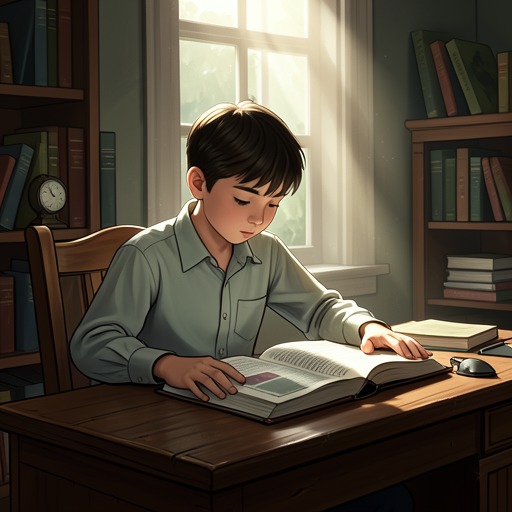
The disclosure is postponed even after Terence enters school. At six, he is enrolled in a private day school, where May Greene tells the principal that the family are Christian Scientists so that Terence will not undergo medical examinations. He performs adequately because Milotan children learn readily, although his slow walking and speech had already encouraged neighbors to regard him as backward. His parents speak both Milotan and English at home and warn him never to use Milotan in public, while keeping him away from other children as much as possible.
The immediate pressure comes from a swimming lesson. The lesson begins in Terence’s grade, and the ordinary school activity threatens the elaborate concealment that masks and lenses had preserved. Terence returns shaken, telling May Greene that he is different, and his words carry the force of an accusation: his parents have made him alien without giving him the knowledge needed to understand what that means. The school principal, having become aware of the problem, confronts May Greene and tells her that she should have disclosed the matter earlier. The institution that had accepted the family’s religious explanation now treats Terence’s concealed condition as grounds for removing him.
May Greene responds by maintaining the earthly role expected of a worried mother. She says that the family has become accustomed to concealing Terence’s condition and announces that they may move from Washington Heights to the suburbs, where he can attend a school in which nobody knows him. She also allows the principal to believe that the authorities could help if properly informed, while privately taking amusement in the principal’s sympathy. The episode shows that the revelation begins not in a safe family setting but under institutional pressure, when Terence’s body has become visible to people outside the household.
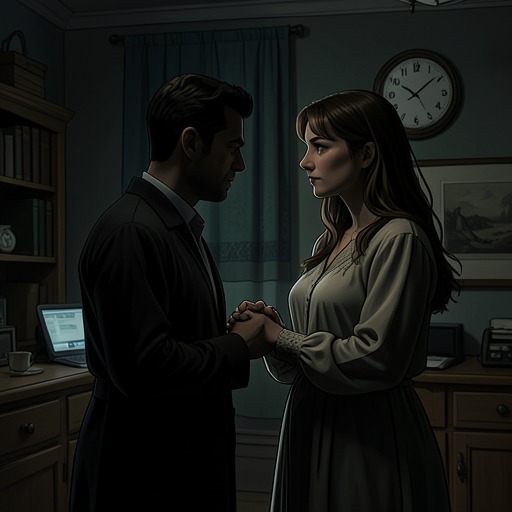
The parents wait a couple of weeks after this crisis because Terence is getting along well in school and they do not want to interrupt that progress immediately. At last, reluctantly, Dan Greene asks whether Terence has been wondering where his parents came from. Terence answers promptly that they came from Russia. When Dan Greene denies this and says that their home is farther away, Terence guesses China and connects the possibility with the masks he wears. He notices that Chinese people are yellow rather than green, attempting to fit the family’s appearance into the categories his school has supplied.
Dan Greene then states the truth: they come from another planet in another solar system. He explains that the stars Terence sees in the sky include the one from which they came. Terence grins and assumes that his father is joking. When Dan Greene insists that he is serious, Terence appeals to the authority of Miss Chase, who has taught that other planets contain no people and that space travel does not exist. Dan Greene answers that Miss Chase does not know everything, but both parents realize that they cannot simply destroy a child’s faith in his teacher. Terence’s earthly education has given him a framework that directly contradicts his family’s reality, and the parents must reveal the truth without making him abandon every trusted source at once.
Immediate Consequences
The conversation does not produce instant comprehension. Terence initially responds with disbelief, and his reliance on Miss Chase shows how thoroughly Earth’s categories have shaped him. He has been born on Earth, taught in an Earth school, and told only that his parents came from a far-off place; although he is biologically Milotan, his social world has made him partly terrestrial in language, habit, and allegiance. The disclosure therefore creates a conflict between two kinds of knowledge rather than simply adding a new fact to his education.
The earlier school confrontation gives the revelation an emotional urgency. Terence’s cry that he is different comes before he knows the name of the difference, while the later disclosure supplies the missing geography and history. What had appeared to him as a personal failing or parental betrayal becomes evidence of a larger world. His masks and contact lenses are no longer unexplained burdens, and the family’s warnings about language and public behavior become intelligible as survival measures rather than arbitrary restrictions.
The revelation also changes May Greene’s relationship with her son. After the principal’s interview, Terence clings tightly to May Greene’s hand on the way to the car, and she feels a closeness with him that she has not experienced since he was an infant. The physical gesture follows a scene in which his difference has been exposed as a problem, but it briefly turns that difference into a bond between mother and child. Terence’s dependence does not erase the accusation against her; instead, it makes the disclosure intimate, painful, and necessary.
Terence’s Request for Milotis
For half the journey, Terence remains silent. Then he speaks to May Greene in halting Milotan and asks her to tell him about Milotis. He wants confirmation that the planet really exists and asks whether his parents had invented it merely to explain his situation. His question marks a movement from passive disbelief to active inquiry: he is no longer only receiving an astonishing claim but testing it in the language his parents have taught him privately.
May Greene answers with a regretfully triumphant smile that Milotis is real and promises that she and Dan Greene will tell him about it at home. Her response contains both victory and regret. She has finally succeeded in making the truth available to him, but the success has come through a humiliating school crisis and the collapse of the protective secrecy that structured his childhood. The family can now begin to describe the world from which they came, yet Terence must also begin to reckon with the fact that the place he has been taught to conceal is part of himself.
Narrative Significance
The event crystallizes the story’s central problem of divided identity. The Greenes judge the same body by two incompatible standards: Terence must look human on Earth, while his concealed form belongs to Milotis. Dan Greene’s image of hands that have the wrong color for Earth and the wrong number of fingers for Milotis captures the family’s condition as a permanent mismatch rather than a simple journey between two homes. Terence inherits this mismatch in a particularly unstable form because he is Earth-born, legally a citizen of the United States of America, yet raised by parents whose mission depends on preserving Milotan difference.
The disclosure also exposes the limits of institutions that claim to classify and protect. Birth records make Terence an Earth citizen; school attendance rules force him into public life; medical examinations threaten to reveal him; and the school principal interprets concealed difference through the available language of illness or abnormality. None of these systems can recognize a child who is simultaneously native to the society by birth and alien to it by biology. The Greenes’ deception is ethically complicated, but the surrounding institutions are equally unable to offer a category in which Terence can safely exist.
Finally, the scene shifts the story from parental management to Terence’s own consciousness. Before the disclosure, his parents decide what he may know, what he may say, and how closely he may approach other children. After it, he asks about Milotis himself, using Milotan to seek an account of the place where everybody is like him. The revelation does not resolve his divided allegiance; it gives that division a name, a language, and a history. Its decisive consequence is therefore not that Terence learns he is an alien, but that he begins to view both Earth and Milotis as possible standards against which his life will be measured.