The Greenes' decision to raise Terence on Earth
The People UpstairsThe Greenes' decision to raise Terence on Earth is the turning point that converts a secret-agent marriage into a dangerous experiment in biological disguise, cultural assimilation, and colonial strategy. What begins with May Greene's unexpected pregnancy becomes a choice to make a child both a family member and a potential instrument of Milotan infiltration: Terence Greene will be born on Earth, educated among humans, and expected to move through Earth society without the mistakes that lifelong outsiders might make.
Causes and Background
The decision arises from an impasse rather than confidence. May Greene tells Dan Greene that she is going to have a baby, although the Bureau had sent them to Earth on the assumption that she was sterile or past childbearing. Their assignment had been intended to last a lifetime, and the adaptations that made them pass as human included amputations; returning to Milotis would not restore them to their former selves. They had become, in their natural state, as monstrous to Earth as their altered bodies would be on Milotis. Repatriation therefore promised dishonorable discharges, blame for failing to take precautions, and a home to which they could no longer properly adapt.
Dan initially sees the pregnancy as a professional disaster. Their work requires them to remain inconspicuous, average, middle-class individuals, and he has grown accustomed to spending the rest of his life on Earth despite disliking secret-agent work and feeling no real affection for the natives. He also understands that May loves him deeply and would obey him if he demanded an abortion, which makes the choice intimate as well as political. May refuses Dr. Robinson's discreet offer to terminate the pregnancy because she has wanted a child all her life; accepting it would mean surrendering the first possibility she had thought permanently closed.
The practical alternatives appear almost equally impossible. May imagines keeping the child at home and having Dr. Robinson make masks in successive sizes, but Dan points out that the plan would fail when the child reached about six and compulsory schooling began. Medical examinations would create another danger, while a private tutor would itself attract attention in Washington Heights and require either an unusually trusted local or another Milotan to be brought into the secret. The question of whether they can keep the child is therefore inseparable from the question of whether they can continue their assignment.
The Native-Born Agent Plan
May changes the meaning of the pregnancy by treating it as evidence for a new strategy. Milotis already has thousands of secret agents scattered across Earth and expects their numbers eventually to reach hundreds of thousands and then millions, although Dan estimates that organizing the operation will take centuries. Those agents undergo years of indoctrination and still live in constant fear of making a revealing mistake. A child born within Earth culture, May argues, would not merely imitate the natives: the child would be part of that culture and could not commit the same kinds of culturally foreign errors.
Her proposal is consequently larger than a private plan for concealment. If the Bureau on Milotis could be shown that Earth-born children were more economical and more rapidly produced agents than conventionally trained infiltrators, young married couples could be sent to Earth specifically to bear children there. Millions of native-born agents might then be created with less training and greater cultural fluency. May hopes that proving the plan would also secure forgiveness for her and Dan, turning what the Bureau would call negligence into an unforeseen contribution to Milotan expansion.
Dan identifies the central danger immediately: a child raised among humans might identify with them. The Milotan objective is ultimately hostile, and a child who becomes one of Earth's social crowd before reaching maturity might acquire loyalties incompatible with the mission. He nevertheless accepts May's proposal because they have nothing to lose. The decision is thus made under coercive circumstances, but it also contains a calculated wager: the Greenes will risk their assignment and their child's allegiance in the hope that his divided origin will serve Milotan power.
Birth and Domestic Consequences
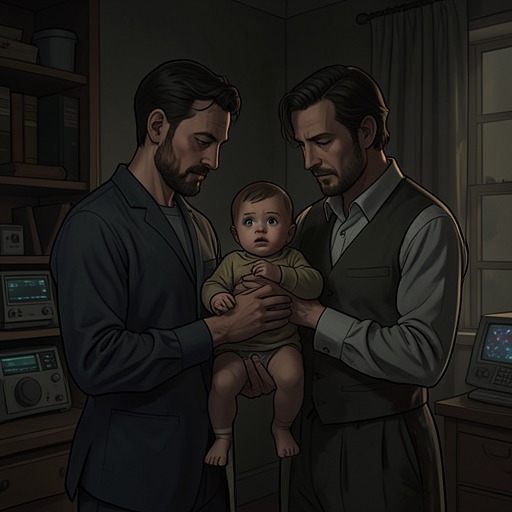
Eight months later, with Milotan gestation roughly matching terrestrial gestation, Terence Greene is born in the United States of America. Dan and May had changed their Milotan names into the closest possible Earth equivalents and used those names even in private to avoid a public mistake, but Terence has no second name. His Earth birth gives him a genuine birth certificate and actual citizenship, making him the first Milotan on Earth who does not require forged papers. In technical terms, he is not even a Milotan, a legal and biological paradox that complicates the Bureau's intended categories from the moment of his birth.
Dr. Robinson equips the baby with small masks and contact lenses in a laboratory unusually complete for a New Jersey general practitioner. Because Milotan children grow more slowly than terrestrial children and mature later, the disguises can last longer than they otherwise might, but they remain expensive. The Greenes can scarcely afford them. The plan that is supposed to make Milotan infiltration cheaper begins by imposing a private financial burden on the family.
Parenthood also reorganizes the Greenes' labor. Milotan babies howl like terrestrial babies and have the same unpleasant physical needs, although on Milotis robots would have handled their care. On technologically inferior Earth, May must perform the work herself while Dan continues his job. The loss of her income is a serious blow because their Earth salaries were intended only to supplement allowances from the Milotan government, while life on an alien planet is exceptionally costly. The family gives up not merely luxuries but eventually necessities: Dan abandons the tobacco imported from Milotis, May loses the repackaged delicacies from home, and the household begins cutting back wherever it can.
May's daily care also becomes a discipline of concealment. She takes Terence into the Earth sun, exchanges evasive pleasantries with neighbors who watch the building from perambulators and deck chairs, and eventually stops carrying him to the roof at night to see the distant bright sun of Milotis because curiosity from the neighbors has become too dangerous. The child is therefore raised between two skies, but even the small gestures that might connect him to his birthplace must be sacrificed to the appearance of ordinary Earth life.
Education, Exposure, and Immediate Aftermath
As Terence begins speaking, the Greenes tell him only that they come from a far-off place. They use both Milotan and English at home, warn him never to speak Milotan in public, and keep him away from other children as much as possible. Dan wants the truth disclosed early so that Terence will not identify with humans, while the parents also need him to understand enough about his difference to conceal his masks and lenses. Their educational method is therefore contradictory from the beginning: they preserve Milotan language while suppressing Milotan identity, and they prepare him to pass without giving him the knowledge that would explain what he is passing as.
At six, Terence must attend school because the law requires it. May places him in a private day school, claiming that the Greenes are Christian Scientists so that he will not undergo medical examinations. The school is chosen as the best limited opportunity available on Earth, but the choice exposes the contradiction at the heart of the plan: the child must enter human institutions to acquire the cultural belonging that will make him a successful agent, while every institutional inspection threatens to reveal his body.
The danger finally arrives through swimming lessons, which begin in Terence's grade. The disguises that can survive ordinary social contact cannot survive the requirement that children expose their bodies. Terence tells May that he is different, and the accusation turns the biological secret into a family grievance: his alienation is now experienced as something his parents have imposed upon him. The principal expels him after the resulting scene, while May performs concern and conceals her amusement, announcing that the family may move from Washington Heights to the suburbs and transfer him to a school where nobody knows him. She is even urged to tell the authorities what is wrong with him before enrolling him elsewhere, an appeal that shows how easily human sympathy becomes surveillance.
The immediate emotional consequence is unexpectedly intimate. Terence clings tightly to May's hand on the way to the car, and she feels closer to him than at any time since he was an infant. After half the journey in silence, he asks in halting Milotan whether Milotis truly exists and whether everyone there is like them. The plan has not yet produced the obedient native-born agent May imagined; instead, the first major exposure drives Terence toward knowledge of his origin and toward the mother who has made that origin a burden.
Significance of the Decision
The decision combines parental love with instrumental reasoning without allowing either motive to remain pure. May's longing for a child makes her reject Dr. Robinson's offer, yet she immediately interprets the pregnancy as a possible solution to Milotis's strategic problem. Dan's reluctance is not indifference to May or Terence; it reflects his awareness that the child may become human in allegiance and that the family's ordinary comforts are already dependent on secrecy. Their affection makes the experiment possible, while the experiment continually subjects that affection to calculation.
The event also separates formal citizenship from lived belonging. Terence possesses an authentic birth certificate and citizenship in the United States of America, but he cannot receive the ordinary protections or routines associated with childhood without risking discovery. Compulsory education requires him to enter school, whereas medical examinations and swimming lessons make that entry unsafe. His legal inclusion therefore coexists with bodily exclusion, and the family's claim to ordinary middle-class life depends on invoking a religious identity that exempts him from scrutiny.
Most importantly, the decision turns biological difference into a proposed technology of colonization. The Greenes hope that a child born on Earth will be cheaper, faster, and more reliable than a trained infiltrator, but the same upbringing may give him an identity that resists Milotan purposes. Terence's birth is consequently both the experiment's first success and its first destabilizing flaw: he is legally native to Earth, biologically Milotan, culturally divided, and increasingly capable of asking who has the right to define what he is.