The Greenes' decision to keep the child on Earth
The People UpstairsThe Greenes' decision to keep the child on Earth is the pivotal domestic and political choice in the story: an unexpected pregnancy becomes both a refusal to surrender a long-desired child and a proposed test of a new method for Milotan infiltration. May Greene and Dan Greene do not simply decide to raise Terence Greene in a foreign society; they gamble that a child born within Earth culture can become a more effective agent than adults permanently marked by adaptation, while accepting that the experiment may separate Terence from Milotis in every meaningful sense.
The Crisis Behind the Decision
May Greene reveals the pregnancy after Dr. Robinson has examined her, making clear that the condition is organic but not an illness. Her announcement overturns the premise on which the couple had been assigned to Earth. The Bureau had apparently sent women believed to be sterile or past childbearing, and May had accepted the post partly because she thought motherhood was no longer possible. Her pregnancy therefore exposes a failure of the precautions expected of secret agents and threatens the Greenes with disgrace and forced return to Milotis.
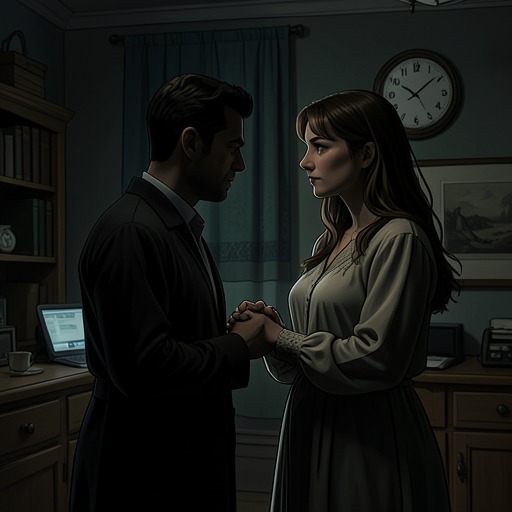
The immediate alternative is especially severe because the couple cannot simply resume their former lives. Dr. Robinson offers to terminate the pregnancy and keep the matter from the authorities, but May refuses. She has wanted a child throughout her life and will not exchange that hope for professional safety. Her refusal also turns the question into a conflict within the marriage: she knows Dan could make her comply because of her love for him, yet she directly asks whether he wants her to get rid of the child. Dan admits that the prospect alarms him, not because he lacks affection for her, but because he had adjusted himself to spending the rest of his life on Earth and feared the consequences of an official return.
From Family Hope to Strategic Proposal
May first imagines concealment as a practical household problem. Dr. Robinson could make masks of successive sizes, allowing the child to be kept at home during infancy, but Dan points out that such an arrangement would fail when the child reached about six and was required by law to attend school. Medical examinations would create another danger. A tutor would not solve the problem: a private tutor would make the Greenes conspicuous in Washington Heights, and bringing an outsider into the apartment would risk exposing their secret. Their assignment depends on appearing to be inconspicuous, average, middle-class individuals, not a family whose unusual educational arrangements invite investigation.
May's decisive move is to ask why the child cannot attend school under a religious pretext. The Greenes can claim to be Christian Scientists and therefore object to doctors and medical examinations. Dan considers this implausible, but May argues that the possible punishment at home would be no worse than the punishment already awaiting them if their pregnancy were reported. The difference is that keeping the child offers a chance for Terence, whereas returning guarantees the loss of the future she has finally been given. Her hope changes the meaning of the concealment plan: what began as an attempt to hide a dangerous anomaly becomes an argument for allowing the child to live among Earth people.
May then enlarges the proposal beyond her own family. Milotis already has thousands of secret agents scattered across Earth and expects that number to grow into hundreds of thousands and eventually millions. An agent born within Earth culture, she reasons, could avoid the slips that reveal adults who are imitating a society rather than belonging to it. If the Greenes could prove this to the Bureau, the authorities might forgive their failure and adopt a policy of sending young married couples to bear children on Earth. Native-born agents would be cheaper and faster to produce than agents who required extensive disguise and adaptation, turning Terence from a private liability into evidence for a possible expansion of the entire infiltration program.
Dan Greene's Objection and Reluctant Consent
Dan identifies the danger that May's strategic enthusiasm leaves aside: a child raised among Earth people might come to identify with them. Milotan intentions toward Earth are ultimately hostile, so a successful cultural attachment would undermine the purpose for which Terence is being raised. Dan observes that intelligent life-forms are gregarious while still primitive and that a child remains in that condition for a long time; Terence might become part of the Earth crowd before he matured enough to understand or accept Milotan purposes.
Yet Dan cannot find a decisive reason to reject May's plan. The couple have already lost the safety of their original assignment, and their adaptations make either direction of travel irreversible. They are human-shaped agents only through radical bodily alteration; returning to Milotis would leave them as monstrosities there, just as their natural bodies would appear monstrous on Earth. Their hands, for example, have the wrong color for Earth and the wrong number of fingers for Milotis. With no secure restoration of their former status available, Dan concludes that they have nothing to lose by trying. His consent is therefore both practical and mournful: he accepts the plan without sharing May's happiness about it.
Terence Greene's Earth Birth and the Cost of Keeping Him
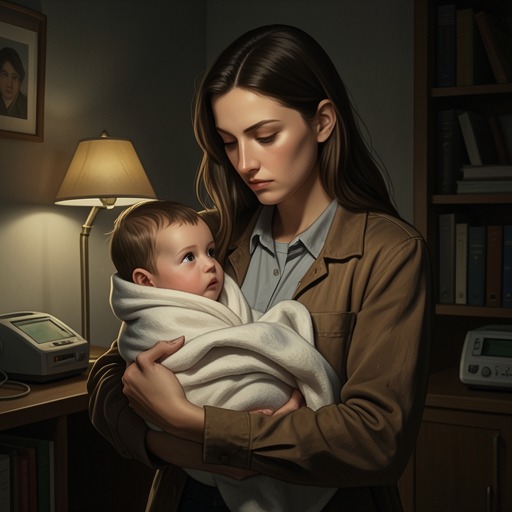
Eight months later, Terence Greene is born on Earth. Unlike his parents, who changed their Milotan names to the closest possible Earth equivalents and practiced using them even in private, Terence has no second name to betray him. He is born in the United States of America, holds a genuine birth certificate, and is technically not even a Milotan. The decision thus produces a striking legal paradox: the child is biologically connected to Milotis and intended as part of its covert project, but his formal citizenship and documentary identity belong to Earth without forgery.
That legal advantage does not remove the physical danger. Dr. Robinson fits the baby with small masks and contact lenses, and the disguises must be replaced as he grows. Milotan children grow more slowly than terrestrial children because Milotans live about a third longer and mature later, but the equipment remains expensive. The Greenes can scarcely afford it, and May's decision to stay home with the baby costs the family her income. Their salaries from terrestrial jobs were meant to supplement allowances from their own government, yet life on an alien planet is so costly that the loss becomes serious.
Keeping Terence also forces the couple to absorb every ordinary burden of Earth parenthood. On Milotis, robots would have handled a baby's physical needs; on technologically inferior Earth, May performs the labor herself while Dan continues working. The family first gives up luxuries, including Dan's specially imported near-tobacco and May's repackaged Milotan delicacies, and eventually begins cutting necessities as well. The infiltration experiment is therefore financed not by abstract state resources alone but by May's unpaid care, Dan's continuing employment, and a household steadily narrowed by the child's needs.
Schooling, Exposure, and the Decision's Consequences
The plan requires more than disguising Terence's body. The Greenes speak both Milotan and English at home so that he will know both languages, warn him never to speak Milotan in public, and keep him away from other children as much as possible. At six, however, compulsory attendance makes school unavoidable. May chooses a private day school rather than boarding school and tells the principal that the family are Christian Scientists, using their supposed religious objection to medical examinations to protect Terence from scrutiny. His first day passes without visible disaster, but the arrangement depends on the school accepting a false explanation and on Terence surviving encounters for which the disguise was never designed.
The decisive exposure comes through swimming lessons, which begin in his grade. The school setting that May had considered genteel and minimally alien suddenly requires Terence to reveal his body. He tells May that he is different, and the statement functions as an accusation: his parents have made him alien and failed to explain the full consequences. The event shifts the value at the center of the original decision. What May experienced as a chance to preserve her child and perhaps rescue the Greenes' standing becomes, from Terence's perspective, an imposed identity that has left him unprepared for public humiliation.
The principal consequently expels Terence from the school. May immediately turns the institutional rejection into another layer of cover, saying that the family had already considered moving to the suburbs because Washington Heights was too dangerous for raising a child. She agrees to transfer him somewhere nobody will know, while the principal urges her to tell the authorities what is wrong with him in advance. May's gratitude is deliberately theatrical; she has managed to preserve the disguise even while the school treats the concealed body as a problem requiring disclosure.
The decision reaches its most consequential point when Terence finally asks whether Milotis and his parents' account are real. May confirms that they have not invented the place and promises to tell him everything at home. She then prepares to send a beam back to Milotis reporting all about him. The child has become at once a son, a legally documented Earth citizen, a physically disguised alien, and a reportable result of the Bureau's possible new strategy. The choice to keep him on Earth therefore succeeds in preserving his life and creating an unprecedented agent, but it also ensures that Terence's belonging will remain contested between the culture that raised him and the planet where he was born.