The swimming-lesson exposure of Terence's alien body
The People UpstairsThe swimming-lesson exposure of Terence Greene's alien body is the decisive rupture in the Greenes' attempt to raise a Milotan child as an inconspicuous Earth-born citizen. A school swimming lesson makes the disguises that have protected Terence since birth impossible to maintain, exposing the bodily difference his parents had taught him to conceal without explaining its origin. The episode produces two revelations at once: the school sees a supposedly damaged human child, while Terence begins to understand that he is an alien whose parents have kept the central fact of his identity from him.
Causes and Background
The danger had been built into Terence's life from the beginning. Milotan physiology did not match human appearance, so Dr. Robinson fitted the infant with small masks and lenses, and the family relied on continuing alterations as he grew. Dan and May Greene understood that this arrangement could work only while Terence remained under close supervision. Dan had already rejected the idea of keeping the child permanently at home or hiring a tutor: compulsory schooling would begin when Terence was about six, and medical examinations would create further opportunities for discovery. A private school could be persuaded not to examine him because May presented the Greenes as Christian Scientists, but that explanation could not make every ordinary school activity safe.
The school itself represented the compromise at the center of Terence's upbringing. He was born on Earth, in the United States of America, and possessed a genuine birth certificate rather than forged papers; technically, he was not even a Milotan. Yet his legal status did not make his body human, and the disguise that enabled his formal belonging also marked the limits of that belonging. May enrolled him in a private day school because she wanted the best education available while keeping him at home each night, where the family could monitor his appearance and speech. The concealment was therefore not a single lie but a daily system of masks, lenses, restricted social contact, and carefully controlled explanations.
The parents had also delayed telling Terence why he was different. They taught him that the family came from a far-off place and spoke both Milotan and English with him at home, warning him not to use Milotan in public. Dan argued that the truth should be disclosed before Terence began identifying with Earth people; May believed there was still time, reasoning that he would discover his alien nature soon enough. The swimming lesson proves the cost of that delay: Terence learns about his difference through humiliation and accusation rather than through a prepared explanation from his parents.
What Happens
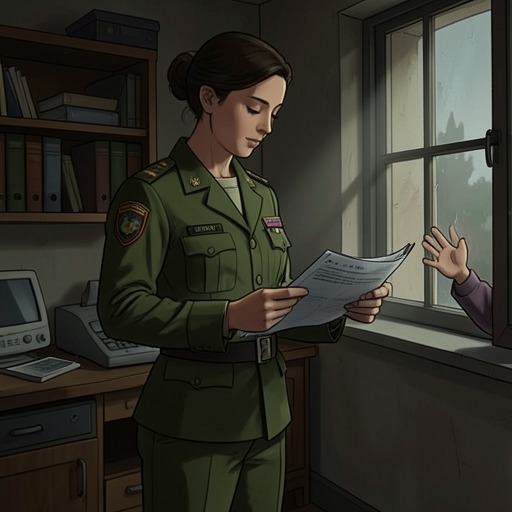
The immediate crisis begins with a phone call to May Greene from the school in the middle of the afternoon. Dan is away at work, leaving May to confront the institution alone. She arrives to find Terence crumpled on a bench in the anteroom, his contact lenses opaque with tears. He recognizes her arrival but shows no relief, and when she asks whether he is all right, he can offer only a dull, uncertain response. His distress is not the result of an injury in the ordinary sense; it comes from what the school activity has made visible.
After a long silence, Terence explains that the class has begun swimming lessons. The lesson requires the removal or failure of the coverings that normally make him appear human. His body is no longer a concealed private fact but a spectacle encountered within an ordinary school routine. For May, this is a horror she had not imagined even after years of adapting to Earth customs. She knows that Earth people appear unclothed or nearly unclothed before one another, yet she had not expected such a practice to confront her son directly. The supposedly genteel school has crossed the boundary that the family relied upon to preserve its secret.
Terence immediately converts the exposure into a charge against his mother. He tells her that he is different, and the statement carries the force of an accusation: she and Dan are alien, he is alien, and his parents are responsible for leaving him to discover this in public. May replies defensively that she had told him he was different, but the incident demonstrates the inadequacy of that partial truth. Knowing that one is unusual is not the same as knowing that one belongs to another planet, and Terence's confusion arises from the gap between those two kinds of knowledge.
The principal then summons May into her office and reproaches her for failing to disclose that the boy was a freak when he was enrolled. She claims that, had she known, she would never have allowed him to swim with the other children. Her response reveals both the school's exclusionary logic and its dependence on categories it believes it understands: Terence is not treated as an alien because the possibility of alien life lies outside the principal's assumptions. He is instead made into a medical and social abnormality whose presence should have been declared in advance.
Misrecognition and Containment
The principal's interpretation rapidly shifts from personal deformity to Cold War paranoia. She concludes that the boy's condition proves public claims about fallout from bombs and imagines that authorities have concealed mutations in order to continue the arms race. May realizes that the school's inhabitants are so confined within familiar explanations that they can absorb an impossible body without questioning the limits of their worldview. Russia, mutation, radiation, and governmental concealment are acceptable explanations; life and science beyond Earth are not.
This misrecognition saves the Greenes from immediate exposure. May suppresses her relief and performs grief, suggesting that Terence may have been affected by radiation because she was past the usual age of childbearing and doctors had initially thought he was a tumor. The principal responds with sympathy toward a family supposedly harmed by medical intervention and nuclear danger. May's performance succeeds because the principal's prejudices supply the cover: she does not need to know the truth when a familiar human disaster can be made to explain the evidence.
The protection is nevertheless conditional. The principal says that Terence cannot remain at the school after the scene that has occurred. May accepts the expulsion and proposes moving from Washington Heights to the suburbs, where the boy can attend another school without being known. The family's secret survives, but only by requiring another relocation and another layer of deception. The school is not persuaded that Terence belongs; it merely agrees that his exclusion can be managed as a private family misfortune.
Consequences and Aftermath
The incident exposes the practical weakness of the Greenes' long-term strategy. They had planned for Terence's schooling, medical scrutiny, language use, and public behavior, but they could not fully control the ordinary institutions through which a child becomes socialized. Their careful investment in disguise had made legal birth and school admission possible, yet the same disguise became conspicuous when a routine activity demanded that the body be seen without it. The event thus turns an apparently successful adaptation into evidence of its fragility.
For Terence, the emotional consequence is more important than the school's administrative decision. After May tells him to leave, he clings tightly to her hand all the way to the car, creating a closeness between them that she has not felt since he was an infant. The physical contact follows a moment in which his body has been publicly rejected; it restores, however briefly, a bond that his mother's concealment had damaged. His dependence is no longer merely that of a child needing care. He is seeking an explanation and a place in a family history that has been withheld from him.
During the drive home, Terence begins speaking haltingly in Milotan and asks May to tell him about Milotis. He wants confirmation that the planet exists and that there are people there who resemble him; he also asks whether his parents have invented the place merely to explain his difference. May answers that Milotis is real and promises that she and Dan will tell him everything at home. The swimming lesson therefore becomes the trigger for Terence's revelation of his alien origin, even though the public event itself is misunderstood.
The family then prepares to send a beam to Milotis reporting what has happened and telling the Bureau about Terence. The incident has failed to expose the child's true nature to Earth, but it has succeeded in ending the period during which his parents could postpone a direct account of his identity. What was intended as a protective secret becomes the subject of an interplanetary report, and Terence moves from being a carefully disguised child to being a conscious participant in the question of where he belongs.
Narrative Significance
The swimming lesson is a collision between legal identity, social recognition, and embodied difference. Terence is an actual citizen of the country where he was born, yet the school can revoke his practical access to ordinary childhood as soon as his body fails to conform to human expectations. The event shows that citizenship papers and institutional membership do not guarantee acceptance when belonging is judged visually and physically.
It also reverses the direction of knowledge in the story. Before the lesson, Dan and May possess the truth and manage Terence's partial ignorance; afterward, Terence understands that their account of his difference has been incomplete. The principal's false explanation protects the family from one kind of discovery, while the child's direct experience produces the more consequential discovery inside the family. The failure of the Earth community to imagine Milotans becomes, ironically, the condition that allows Terence to begin imagining Milotis as home.