Washington Heights
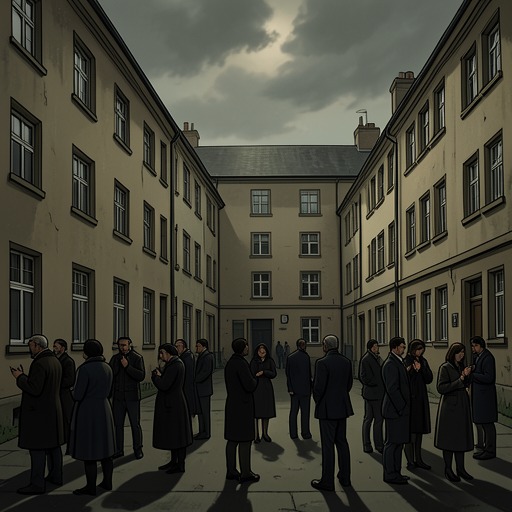
The People UpstairsWashington Heights is the domestic and social ground on which the Greenes attempt to pass as an average middle-class family while carrying out a covert mission for Milotis. It offers anonymity through its crowded routines and conventional expectations, yet its neighbors, schools, laws, and economic pressures repeatedly test the family’s human disguise. The neighborhood therefore functions not merely as a backdrop but as an instrument of exposure: the more completely the Greenes try to belong there, the more Terence Greene is forced to confront what belonging costs.
A Cover Built on Ordinary Life
Washington Heights is presented as the kind of place where inconspicuousness is itself a survival strategy. Dan Greene insists that he and May Greene must remain “inconspicuous, average, middle-class individuals,” and specifically argues that employing a tutor would attract notice in Washington Heights. A tutor would also require the presence of an outsider in their apartment, creating another possible breach in the secret. Their residence and social position must therefore remain bland enough to pass without explanation.
The apartment’s conventional furnishings reinforce this strategy. Its brown monotones and tweedy textures resemble the department-store modern style promoted by women’s magazines a decade earlier, creating an almost complete surface of banality. Beneath that surface, however, lies an emotional impression of alienness that a casual visitor would not consciously identify. The only person with frequent access to the apartment is the superintendent, whose continual rage at tenants, landlord, and life makes him incapable of registering such subtle undertones. Washington Heights thus protects the Greenes partly through noise and indifference: its ordinary social disorder screens a secret that would be conspicuous only to an unusually attentive observer.
Neighbors as Surveillance and Camouflage
The neighborhood’s residents form a persistent social presence outside the Greene home. During May’s daily outings with Terence, she must exchange evasive pleasantries with neighbors gathered in daylight around perambulators and deck chairs. Even a nighttime trip to the roof, where she once showed Terence the distant bright glimmer of Milotis, becomes too risky when the neighbors grow curious. The same community that surrounds the family with ordinary companionship also creates a permanent gauntlet of observation.
The neighbors’ suspicions begin earlier than May and Dan realize. Terence Greene reports that Mrs. Gottesmann and Mrs. Schultz have guessed that the family comes from Russia because the parents are so guarded about their origins. May is startled to learn that the Greenes have been suspected all along, but she also recognizes the usefulness of the suspicion. A false Russian explanation provides camouflage for the genuine truth, allowing the family’s evasiveness to be interpreted as political or national secrecy rather than extraterrestrial identity.
The neighborhood’s judgments also shape Terence’s childhood. Because he does not walk until he is two or speak until he is three, residents assume that he is backward. May is angered by the judgment but gradually becomes conditioned by the surrounding culture herself, sometimes thinking of Terence as retarded despite knowing that his development is normal for a Milotan child. Mrs. Danko’s muttered suspicion of a “Changeling,” accompanied by a gesture against the evil eye, comes close to naming the truth while remaining dismissible because the old woman is regarded as irrational. The neighborhood can therefore misrecognize the Greenes in ways that both wound them and protect them.
Domestic Cost of Remaining There
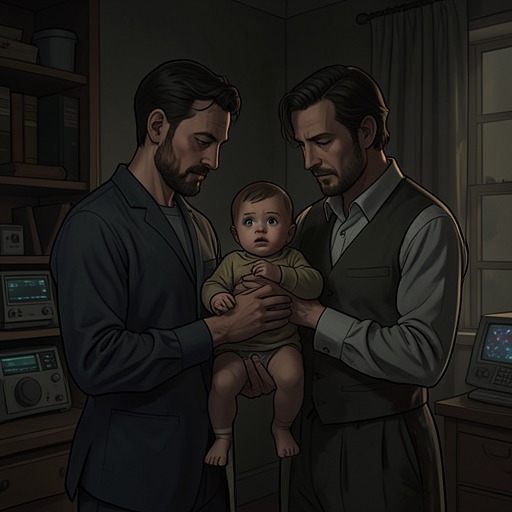
Washington Heights is also a place of material constraint. Terence Greene’s birth changes the Greenes’ carefully balanced household economy: May must stay home with the baby while Dan Greene continues working, and the loss of her income is a serious blow because their Earth salaries were supposed only to supplement allowances from their own government. Life on an alien planet is expensive, and the family cannot preserve the comforts associated with their former life on Milotis.
The sacrifices move from luxuries to necessities. Dan gives up the specially imported substance that serves as his tobacco, while May loses the delicacies from home that are repackaged on Earth as Rice Krispies and Coca Cola. Eventually they must cut down on necessities as well. The local environment imposes not only financial burdens but also unfamiliar forms of care: on Milotis, robots would have tended the baby’s physical needs, whereas Earth customs require May to perform the labor herself. Her daily care of Terence, like the family’s broader performance of middle-class normality, becomes part of the price of remaining in Washington Heights.
That price is emotional as well as economic. May spoils Terence because she feels guilty that motherhood has not brought the pleasure she expected. At times she wonders whether he was worth the trouble she and Dan have undertaken and whether refusing Dr. Robinson’s earlier offer was sentimental. Her remorse then leads her to give Terence things he wants even when they are not good for him. The neighborhood’s ordinary family life supplies the standard by which May measures herself, while the hidden reality of Terence’s alien body makes ordinary parenthood difficult to inhabit without guilt.
School, Exposure, and the Limits of Concealment
The decisive pressure on the Washington Heights setting comes from the compulsory attendance of human school. Dan initially rejects the idea of sending Terence because the law requires school at about age six and because medical examinations could reveal the inadequacy of even Dr. Robinson’s disguises. Yet May argues that school may offer the child a chance to remain on Earth, and the family eventually accepts the risk. Terence’s enrollment turns the neighborhood’s private suspicions into an institutional danger.
At school, the concealment depends on masks, altered features, and contact lenses, all of which Dr. Robinson has fitted to Terence’s body. When Terence asks whether the masks are connected with being Chinese and observes that Chinese people are yellow rather than green, his question exposes the unstable logic of the disguise. He can understand that he is visibly different, but he has not yet been given the knowledge needed to interpret the difference. The family’s vague explanation that they come from far away leaves him caught between Earth’s categories and the concealed reality of Milotis.
Swimming lessons finally make the disguise untenable. May has learned enough about terrestrial customs to know that humans may appear unclothed or nearly so, but she has never imagined that Terence would have to expose his body to them. After the lesson, he tells her that he is different, and the statement functions as an accusation: his alien condition is also her fault for making him different and then withholding the explanation. The principal’s presence at the office door confirms that the private family secret has become a school matter, and Terence can no longer remain in the Washington Heights school.
May responds by performing the role of an embarrassed, protective mother. She accepts the transfer and says that the family has already considered moving to the suburbs because Washington Heights is too dangerous for raising a child. Her claim has a practical purpose: another school must not know the truth in advance, and the family needs to relocate the problem rather than explain it. The principal urges her to tell the authorities what is wrong with Terence, believing them to be friends who want to help. May’s polite gratitude conceals her amusement at the institution’s confidence in its own benevolence.
Threshold of Belonging
The departure from Washington Heights marks a reversal in the location’s meaning. At first, its ordinariness makes it an ideal cover; later, its neighbors and public institutions become forces that expose the family’s inability to fit the categories they enforce. The same setting that allowed the Greenes to present themselves as average middle-class residents also teaches Terence to judge his own body against human standards.
Yet the school crisis produces an unexpected intimacy. Terence clings to May’s hand all the way to the car, and she has not felt so close to him since he was an infant. The neighborhood has failed as a secure home, but its failure briefly reunites mother and son around their shared vulnerability. During the drive, Terence asks in halting Milotan whether Milotis truly exists and whether there is a place where everyone is like them. His question transforms Washington Heights from a permanent home into the threshold from which his concealed origin can finally be acknowledged.
May confirms that Milotis is real and promises that she and Dan will tell him about it when they return home. The promise gives the location a final, paradoxical significance: Washington Heights is where Terence is legally and physically Earth-born, but it is also where the pressures of human normality lead him toward the community from which his parents came. Its apparent banality has contained the family’s secret, financed their precarious survival, disciplined their parenting, and ultimately forced the first open movement toward Terence Greene’s alien identity.