plastomask
The People UpstairsThe plastomask is a thin artificial face used by the Greenes to conceal their Milotan appearance on Earth. More than a disguise, it is the practical infrastructure of their assumed identity: it allows Dan Greene and May Greene to occupy human jobs and social spaces, permits their child to be raised under a human cover, and simultaneously creates an expensive, fragile dependency. As the child grows and enters school, the mask shifts from an almost invisible protection into evidence of difference, culminating in the swimming lesson that exposes Terence Greene’s body and precipitates his removal from school.
Appearance and Function
The plastomask is described as silk-thin and removable. May Greene can peel it from her face, then remove her Milotan contact lenses, revealing that the human-looking surface is an external construction rather than her natural appearance. The mask works together with the lenses: the former supplies the visible facial disguise, while the latter conceal the alien eyes. Dan Greene’s ordinary-looking Earth appearance does not eliminate the need for such concealment, because his light-green skin and restrained maroon pupils would otherwise identify him as nonhuman. The device therefore standardizes the couple’s public bodies, making their difference legible only when the technology is removed or disrupted.
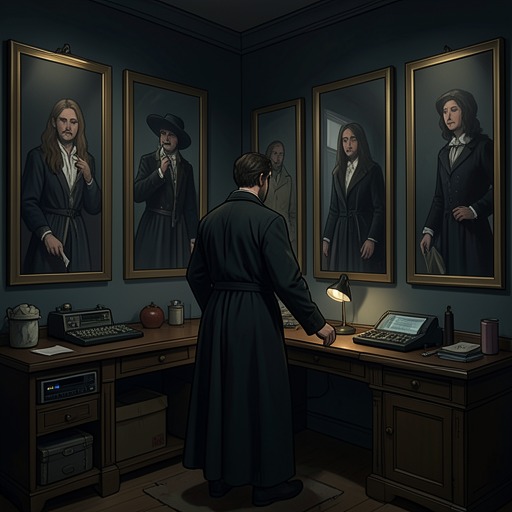
The Greenes also adapt ordinary Earth objects to support the disguise. May’s dyed Earth-style hair and a terrestrial hairbrush subtly altered for her needs show how thoroughly concealment enters domestic routine. The modified brush is deliberately non-Milotan, since artifacts from their home planet cannot be left lying around. The plastomask belongs to this same material system: it is not an isolated gadget but part of a household organized around suppressing every visible sign of origin.
Pregnancy and the Child’s Disguise
May’s unexpected pregnancy turns the plastomask from an adult espionage accessory into a problem of biological inheritance. When Dr. Robinson confirms that she is going to have a baby, the Greenes initially face the prospect of returning to Milotis in disgrace. Their assignment had assumed that May was sterile or past childbearing, and returning would mean bureaucratic blame, loss of their post, and the consequences of bodies adapted for a lifetime on Earth. The possibility of keeping the child depends partly on Robinson’s medical discretion and partly on the manufacture of masks in changing sizes.
May proposes that Robinson make little masks for the baby and replace them as the child grows. The plan promises a way to preserve both the pregnancy and the family’s cover, although the expense would force the Greenes to give up other luxuries. Dan recognizes that the device might work while the child remained small and could be kept at home, but he also sees its limits. Compulsory schooling, medical examinations, and other public encounters would eventually test whether the disguise could withstand institutional scrutiny. The plastomask can imitate a human surface; it cannot guarantee a human life history.
Eight months later, Terence Greene is born on Earth, in the United States of America, with a genuine birth certificate and legal citizenship. Dr. Robinson fits the baby with small masks and lenses in his unusually complete laboratory. Terence’s slower growth, resulting from the longer Milotan life span, gives the family additional time, but it does not remove the financial burden. The disguises remain expensive while the Greenes are already strained by May’s loss of income and the high cost of living on an alien planet. His infancy is therefore sustained by an apparatus that is medically ingenious, economically punishing, and necessary to the family’s survival as agents.
Schooling and Material Exposure
The mask becomes especially consequential when Terence Greene must enter human society. The Greenes speak both Milotan and English at home, warn him not to use Milotan in public, and keep him away from other children as much as possible. At six, however, compulsory attendance makes private concealment insufficient. May enrolls him in a private day school and claims that the family belongs to the Christian Scientists, using the group’s refusal of medical examinations to protect him from scrutiny. The large fees purchase a measure of institutional cooperation, but they cannot remove the ordinary activities through which children are observed.
After Terence’s first day, May searches his childish mask for signs of distress. The image makes the object’s emotional function plain: for her, it is a surface on which she looks for reassurance that her son has passed safely through the human world. Terence, meanwhile, notices the difference between his own equipment and the uncovered faces of the other children. He asks whether they wear face masks or lenses, and then wonders whether the teachers do. His questions show that the disguise has become part of his earliest understanding of normality: the mask hides his body from others while teaching him that his own experience is unlike theirs.
The decisive failure occurs during swimming lessons, which begin in Terence’s grade. The plastomask and lenses can preserve his appearance in ordinary clothing, but swimming requires the school to confront his body rather than merely his face. Terence returns crumpled on a bench, his contact lenses opaque with tears, and explains with difficulty that the class had swimming. He then tells May that he is different, turning the mask’s concealed secret into a personal accusation against his parents. The incident demonstrates that the object does not simply fail mechanically; it fails socially, because a human school has routines that the disguise was never designed to accommodate.
Exposure, Repair, and Aftermath
The school principal treats Terence’s concealed body as a condition the parents should have disclosed. She tells May that he cannot remain at the school and urges her to inform the authorities when enrolling him elsewhere, insisting that they want to help rather than harm the family. May answers with practiced politeness while planning to move from Washington Heights to the suburbs and transfer Terence to a school where nobody knows him. The proposed solution is not acceptance but relocation and renewed concealment.
After the confrontation, Terence clings to May’s hand on the way to the car, and their physical closeness recalls the period when he was an infant. Halfway home, he asks in halting Milotan for the truth about Milotis and whether such a place really exists, where everyone is like them. May confirms that his parents had not invented it and promises that she and Dan will tell him everything. She pats the plastoskin encasing his small, mutilated hand and says that they will send a beam back to Milotis about him. The ending places the mask beside the first open transmission of his identity: the material covering remains on his body, but the secret it was meant to protect is no longer confined to the family.
Narrative Significance
The plastomask embodies the tension between biological difference and social recognition. It makes the Greenes’ Earth assignment possible, yet its very necessity exposes the hostility of the systems around them: the Milotan Bureau demands successful concealment, the school assumes an unmodified human body, and the family must absorb the cost of satisfying both demands. Dr. Robinson’s masks can be resized, but they cannot adapt the school’s rules, the expectations of childhood, or Terence’s emerging questions about belonging.
The object also turns disguise into an inherited condition. Dan and May choose the assignment as adults and understand the risks of maintaining a false human appearance; Terence is born into the apparatus without choosing it. For him, the mask is at once protection, burden, and evidence that his parents have withheld an essential account of his origin. Its apparent transparency lasts only while social life remains superficial. Once swimming removes the possibility of keeping the body unseen, the plastomask changes from a tool of successful assimilation into a sign of the truth it can no longer contain.