
Seeing, Surveillance, and the Missing Record
The PeripheralThis thread explores how cameras, analytics, secrecy, and gaps in recorded evidence shape what characters can know, showing that greater surveillance does not automatically produce truth or accountability.
increasing Bearing strength in each event
 decreasing
Bearing strength in each eventdecreasingThe Watcher’s Assignment
The Watcher’s Assignment
Paid to Observe
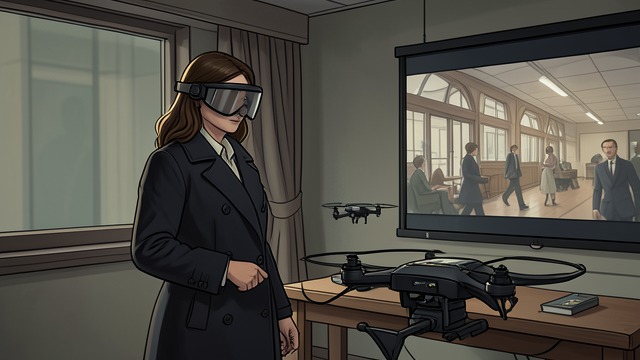
Flynne Fisher’s job is to patrol a building with a quadcopter and push paparazzi drones away. The assignment turns watching into paid labor: she is not meant to interpret the inhabitants’ lives, only to maintain a perimeter and report what appears.
Yet the camera gives her access to scenes that would otherwise remain private. She sees rooms change, robots prepare a gathering, and people approach a window. The job’s narrow purpose cannot contain the broader meaning of what the camera reveals.
Seeing Is Not Knowing
The opening arrangement separates observation from understanding. Flynne can see more than she is authorized to act on, and she cannot tell whether the images belong to a game, a test, or a real world. The camera supplies detail but not context, establishing a central problem: visibility is not the same as knowledge.
The Missing Capture
The Missing Capture
A Witness Without a Record
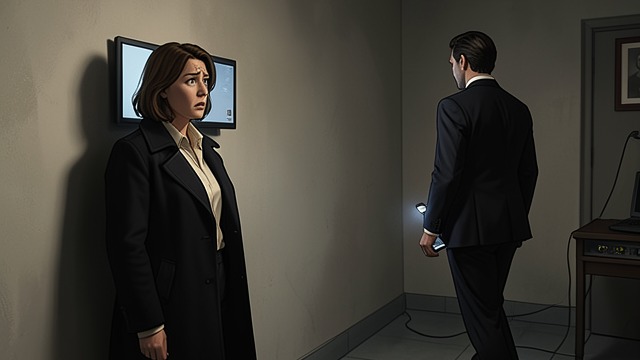
After seeing the woman killed, Flynne asks why the security company cannot simply review the footage. She assumes that a camera job must leave a record, but Wilf Netherton and the others have no usable capture of the decisive event.
The absence turns technical surveillance into an investigative problem. Flynne remembers a sequence that cannot be independently checked through the expected channel, while those responsible for the platform must rely on her account and whatever traces their systems can recover.
Evidence and Vulnerability
The missing record does not make the murder less real; it makes the witness more vulnerable. Flynne becomes valuable precisely because she saw something that the recording systems did not preserve. The novel separates evidence from truth: a person may know what happened while lacking the institutional proof needed to make that knowledge secure.
The Protocol of No Record
The Protocol of No Record
Privacy as an Arrangement
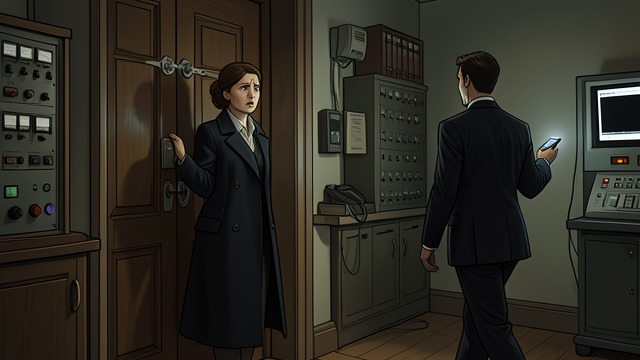
Aelita West’s gathering operated under a protocol that prohibited recording. Her residence and its systems did not preserve an ordinary account of who attended or what happened. The absence was deliberate, protected by a temporary quasi-diplomatic agreement rather than by a simple failure of technology.
The arrangement demonstrates that privacy is not merely a personal preference. In this society it can be bought or granted through influence, and those who possess it can create a space where evidence is absent by design. Flynne’s camera, assigned to watch the building, cannot overcome the rules governing the event.
Secrecy and the Investigation
The protocol creates an investigative vacuum around Aelita’s disappearance. Ainsley Lowbeer must reconstruct what happened from people, anomalous traces, and the behavior of systems that may have been silenced. The case exposes the tension between a world that watches constantly and institutions powerful enough to decide when watching must stop.
The Aunties’ Inference
The Aunties’ Inference
Patterns Instead of Certainty
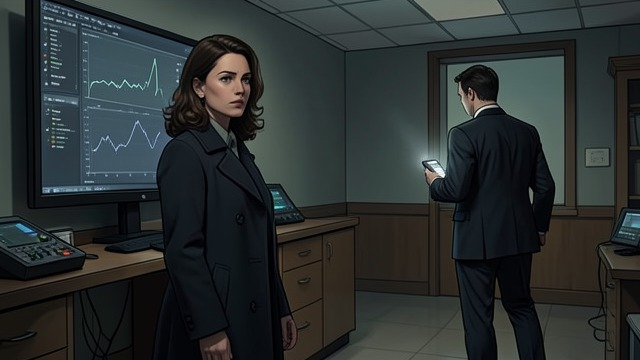
Ainsley Lowbeer relies on the Aunties, long-developed algorithms that sift enormous amounts of data and identify behavior that departs from statistical norms. They can notice suspicious movements and infer what people may be listening for, even when no single message states the truth plainly.
But their power is not omniscience. Lowbeer describes an ocean of information whose decision points can only approximate certainty. The systems produce leads, patterns, and probabilities; investigators still need to interpret them and establish what can be proved.
The Limits of Prediction
The Aunties complicate the assumption that more data yields perfect knowledge. Their analyses may identify likely suspects, but they do not replace the judgment required to distinguish inference from evidence. Lowbeer’s caution is significant because she knows how easily a powerful institution can mistake a plausible pattern for an established fact.
A Message Hidden in Noise
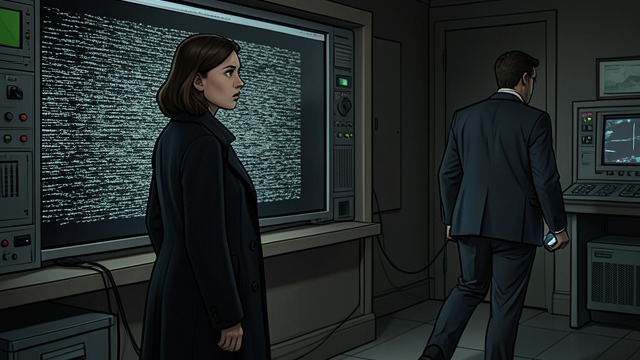
A Message Hidden in Noise
Communication Under Surveillance
At Daedra West’s gathering, personal communication devices are prohibited and attendees are closely monitored. Ainsley Lowbeer arranges a covert channel through Flynne’s installed cognitive bundle, so that a message can reach her as static in the body rather than as a detectable call or screen notification.
The solution makes surveillance both obstacle and instrument. The people investigating the crime must operate inside systems designed to observe them, using a method whose form is difficult for the security environment to recognize.
Knowledge Requires Trust
Flynne must still recognize the man and decide when to signal. A hidden channel cannot replace her judgment, just as the Aunties cannot supply proof without human interpretation. The episode suggests that under pervasive surveillance, knowledge depends not only on gathering information but on preserving a trustworthy path through which it can be communicated.
At the beginning of Flynne Fisher’s first tower patrol
After Flynne Fisher witnesses the attack on the tower’s balcony
When Lev Zubov and Ainsley Lowbeer discuss Aelita West’s disappearance
After Aelita West’s disappearance becomes a formal investigation
As Flynne prepares to identify the killer at Daedra West’s gathering
