“The jackpot”
The Peripheral“The jackpot” is the name for a long, cascading social and ecological catastrophe that kills about 80 percent of the population over roughly forty years. Its decisive significance is that it is not a sudden apocalypse but an accumulated consequence of human activity—and, in the novel’s split chronology, a future that Flynne Fisher’s world may partly avoid or ameliorate.
Meaning and historical structure
Wilf Netherton explains the jackpot to Flynne as “no one thing”: it has no clear beginning or end and is better understood as a climate than as a discrete event. That distinction rejects the familiar apocalypse pattern of one spectacular disaster followed by survival amid ruins. The catastrophe unfolds through interacting pressures, each serious in itself and made worse by the others.
The name also depends on which timeline is being discussed. For Wilf, the jackpot is the history that has already shaped his world; for Flynne, it is a possible future. Their connection does not send information into an unchanged past: when the initial connection is made, the timelines fork, and the people in Flynne’s world are no longer headed along the same path. The past in her world remains its own history, even as knowledge from Wilf’s future becomes consequential there.
Causes and course
Wilf describes the catastrophe as anthropogenic: people caused it without necessarily understanding the damage or intending its full extent. Excess carbon drives worsening climate conditions, while earlier generations fail to respond effectively even after the problem is known. Flynne recognizes that the future he describes resembles dangers already familiar in her own time, but his account makes clear that these are not isolated warnings. They are parts of an escalating, systemic crisis.
The consequences accumulate rather than arriving as one event. Drought, water scarcity, crop failures, the loss of honeybees and other keystone species, the disappearance of apex predators, declining antibiotic effectiveness, and a succession of serious diseases all contribute. There is no single pandemic that explains the deaths, nor a comet strike or nuclear war: the devastation comes from multiple stresses entangled with climate change and with the scale and effects of human presence.
The catastrophe kills approximately 80 percent of those alive over about four decades. Flynne’s immediate response is to question what such a number can mean when its subject is another person’s past and her own possible future. The distance between the statistic and its human consequence is part of the explanation’s force: the scale is almost impossible to comprehend, yet it describes the world that Wilf has inherited.
Aftermath and unequal survival
The jackpot does not distribute its consequences equally. Wilf tells Flynne that the very rich may not have suffered as badly as others: as the population falls, the survivors who retain wealth own more of what remains, while continual crisis creates continual opportunities. The catastrophe that destroys lives also consolidates privilege, helping produce the order from which Wilf’s London emerges.
At the low point, a radically reduced population means less carbon is being emitted. The towers built afterward absorb some of the carbon still produced, as well as housing the wealthy. To the survivors, this can look like the bullet has been dodged; Flynne identifies the grim measure of that apparent recovery, asking whether the bullet was the 80 percent who died. The return of stability therefore does not undo the human cost or amount to an uncomplicated rescue.
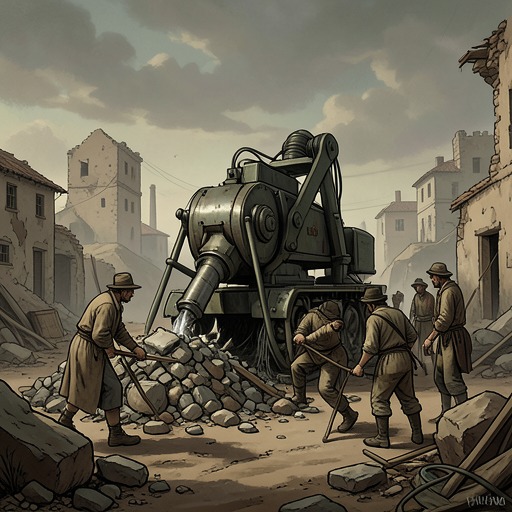
London rises early in the recovery and never entirely falls. Assemblers arrive later, after the die-off, and perform work that includes excavating and cleaning buried rivers, maintaining the city, and constructing the towers and the ordered districts Wilf calls shards. The automated urban landscape that Flynne encounters is thus not a separate marvel: it is part of the material aftermath of catastrophe and of the systems built by those who survive it.
Divergence and attempted prevention
Wilf’s explanation turns the jackpot from background history into an immediate political stake. Ainsley Lowbeer knows both the history of her own world and the hidden history of Flynne’s; in the history that produced Lowbeer’s world, President Felicia Gonzales is assassinated before completing her second term. Lowbeer regards that assassination as a pivotal turn toward the deeper jackpot.
Because Flynne’s timeline has diverged, its future is not yet settled. Wilf says the divergence can be steered only broadly, without any guarantee of the result. Lowbeer’s aim is therefore not to promise that the jackpot can be stopped outright, but to ameliorate it and avoid reproducing the system that emerged in her continuum. Preventing Gonzales’s assassination is treated as a necessary step toward that limited goal.
The term’s recurring use holds catastrophe and agency together. Wilf initially names the decades-long disaster that has already happened to him; Flynne then carries that knowledge back into a world whose future remains open to some extent. Later, the possibility of a jackpot is still expressed as a near-future warning in her world, while Coldiron’s effort to manage the influx of future technology is shaped by the fear that too much change at once could destabilize it. The word consequently refers both to a specific historical catastrophe and to the uncertain process by which one continuum might approach, diverge from, or partly mitigate another’s history.