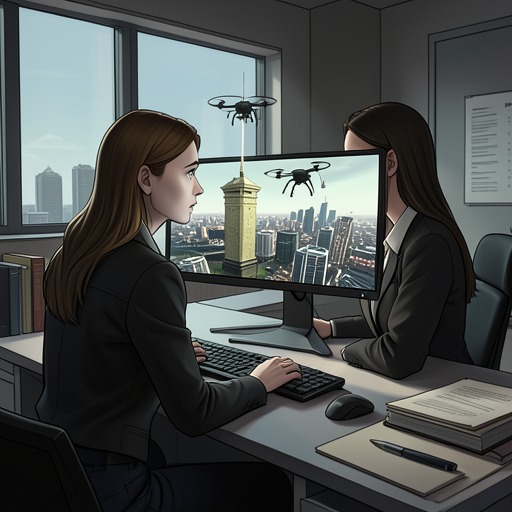
Aelita West killed in stub
The PeripheralAelita West’s killing in the Stub is the moment Flynne Fisher’s remote observation becomes an encounter with a real murder. While piloting a surveillance copter in a future London, Flynne sees a man and a woman on a balcony, then watches a bronze-black device attack them. The woman dies, and Flynne later identifies her as Aelita from a photograph. The killing overturns the assumption that the distant world is merely a game and becomes the central fact behind Flynne’s subsequent account and investigation.
Causes and Background
Flynne sees the attack during a shift spent operating a remotely controlled copter from the hot darkness of a trailer. The target building’s exterior offers little warning: amid flat squares and rectangles filmed over with condensation, the bronze-black object stands out as perfectly dry. It changes shape, becoming flat and angular, with its twisting legs turned into brackets. Its position is centered above the fold-out balcony one floor below.
The woman and a man are at the railing, facing the river. In Flynne’s later account, the man is in his early thirties, with dark hair and some beard, and wears a brown bathrobe. The woman is beside him, with his arm around her; because she cannot see his face, she does not know what he knows. Flynne recognizes, in retrospect, that he understands she is about to be killed. The man’s apparent intimacy with the woman thus sits alongside his foreknowledge of the attack.
The Attack
As Flynne moves closer to get an image, the device opens along a narrow vertical seam and ejects something too small to see clearly. It strikes at the copter’s forward camera in a rapid series, damaging the image and threatening to blind the surveillance feed. Flynne pulls back, drops three floors, and lets the gyros catch the copter; the attacker appears to have disappeared. She then moves left and rises again, continuing to watch from above.
The man takes the woman’s hands and covers her eyes. He kisses her ear and says something Flynne cannot hear; she later guesses that he said “Surprise.” He turns toward the building, apparently expecting what comes next. When the device splits open again, more of the tiny attackers emerge. The man looks up and sees the copter, but does not stop or turn back. Flynne tries to ram his head with the copter; he ducks and catches himself on his hands, then quickly gets inside. The door vanishes behind him as the opening becomes a smooth, polarized sheet of glass.
The woman turns after the man’s movement and opens her mouth. One attacker enters, and she freezes. More follow. As the attackers continue their assault, the balcony railing retracts and the woman falls backward. Flynne follows her downward in the copter, but cannot save her. By the time the falling figure reaches the thirty-seventh floor, where Flynne had first noticed the device, the woman’s clothing is all that remains visible. Flynne pulls up before the twentieth floor and hangs in the copter’s slack, overwhelmed by sorrow and disgust.
Identification and Aftermath
Flynne’s first telling establishes what she saw but not the victim’s identity. Later, she explains that she had seen the same woman before, at a party, and then again after the party had ended, in different surroundings. During the later encounter the woman was in pajamas, with another person present whom Flynne could not see. At the balcony, Flynne could see the woman and the man, but could not read the man’s expression from the woman’s position beside him.
When Wilf Netherton shows Flynne a matte print of a headshot from Aelita’s website, Flynne recognizes the woman and nods. The image is from more than seventy years before Wilf’s world, in a past that no longer quite matches the history that produced it. The identification connects the attack to Aelita West and turns Flynne’s disturbing visual memory into evidence relevant to the investigation.
Significance
The attack hinges on the gap between what Flynne can observe and what she can prevent. She can move the copter, change altitude, and attempt to intervene, but the attackers can damage its camera, and the man’s knowledge gives him time to escape while the woman remains exposed. Remote access grants Flynne a view of the scene without giving her the power to stop it.
That imbalance also breaks the protective distance of play. In the trailer, after witnessing the woman’s death, Flynne says, “Just a game,” but the phrase cannot contain what she has seen. The victim’s later identification as Aelita confirms that the scene was not an anonymous simulation or a harmless spectacle. It was a killing in the Stub, observed from afar and carried forward into Flynne’s dealings with Wilf and the investigation of Aelita’s fate.