Aelita West’s murder and disappearance
The PeripheralAelita West’s murder and disappearance is the unresolved crime that makes Flynne Fisher a witness in an investigation crossing between her native continuum and a future London. Flynne remembers seeing something that seemed to consume Aelita, but cannot give a clear account of the scene; investigators likewise cannot determine what she witnessed. The uncertainty is not a reason to dismiss her testimony: someone has apparently tried to kill her at home, presumably because she may have seen the perpetrator or an accomplice.
The Killing and Its Uncertain Witness
The murder first reaches Flynne as an accusation against someone else: she is told that Americans are saying Wilf Netherton killed Aelita. That allegation does not settle what happened or establish who was responsible. Instead, the investigation reveals how little can yet be known, even by the people trying to reconstruct the event.
Ash tells Flynne that she may have witnessed Aelita’s sister’s murder. Flynne reacts with alarm and asks whether the scene was real. When Netherton questions the qualification, Ash explains that Flynne saw something, but there is no evidence showing exactly what. Flynne’s own fragment is brief: she says that it “Ate her up.” The phrase conveys the force of what she remembers without supplying a stable, complete account of the killing.
Ash connects this gap in knowledge to Flynne’s presence in London. She is there through a peripheral: a remotely operated body that is physically present in the future even though Flynne herself remains in her own continuum. Ash suggests that this unusual embodiment may help explain why the investigators cannot establish exactly what Flynne perceived. The technology makes the encounter possible, but does not make her memory transparent or turn an uncertain impression into conclusive evidence.
A Witness Made Vulnerable
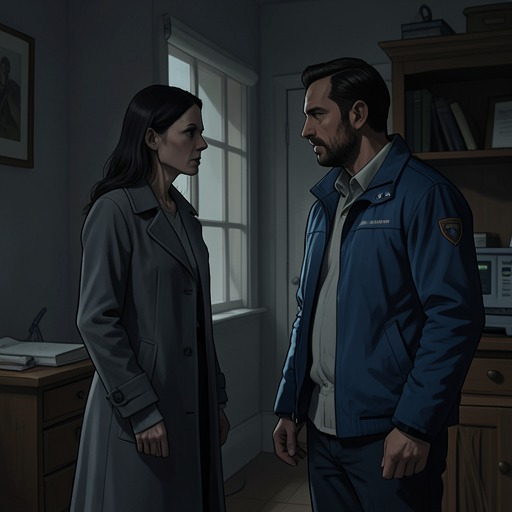
When Ainsley Lowbeer speaks with Flynne, she gives a sharper account of the stakes. Flynne witnessed a homicide and saw the face of someone who might have been either the perpetrator or an accomplice. Lowbeer also tells her that unknown people have since attempted to have her murdered in her native continuum, presumably because they know she is a witness. The threat makes the unresolved sighting consequential: the investigation has not established what Flynne can identify, but someone may believe her knowledge is dangerous.
Flynne accepts a role as a witness rather than withdrawing from the inquiry. She tells Lowbeer that she needs someone who will back her up when she returns home and explains what is happening. She then asks whether Lowbeer is pursuing whoever sent the gray knapsack-like device to kill Aelita, as well as the person who brought Aelita onto the balcony. Lowbeer confirms that she is. Flynne offers to testify if the case reaches trial, adding that she would do so in any event. Her commitment is made despite the uncertainty surrounding her memory and the danger already directed at her.
The Investigation and Its Wider Stakes
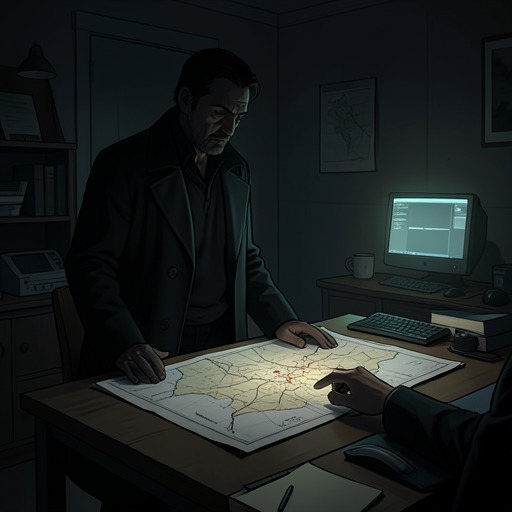
The murder does not remain a private mystery. In the future London investigation, Flynne’s account links the uncertain killing to a possible accomplice and to an attempted attack on Aelita. The distinction between what she saw and what investigators can prove remains central: her testimony is potentially important, but neither the identity of the responsible person nor the precise sequence of events is resolved in these scenes.
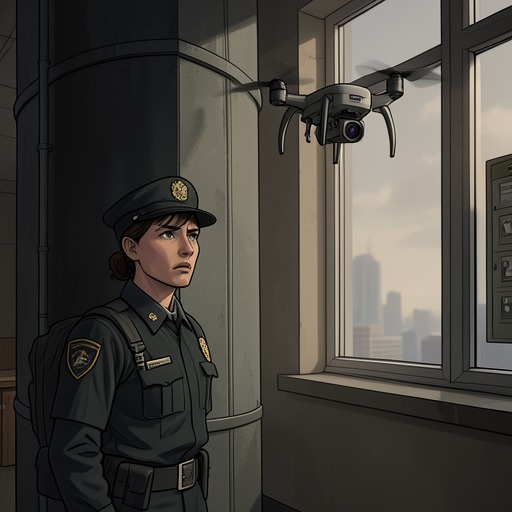
In Flynne’s home continuum, security is already organized around the possibility of violence. At her family’s property, Reece describes a twenty-drone network, with twenty more in reserve, monitored by three men covering separate parts of the grounds. That detail does not establish a connection between the drone deployment and Aelita’s murder; it shows the heightened security surrounding Flynne’s household as the investigation and other threats converge on it.
The surrounding political landscape further complicates the meaning of protection. Macon warns Flynne that state police, Homes, another federal agency, or the Marines might come after her side, and says that lawyers are needed because fighting such forces would be useless. He notes that Homes has finally gone to Pickett’s property after an explosion brought attention to a place it had largely ignored. Later, Macon reports that large Homes convoys are headed toward town, while a substantial detachment is already near what remains of Pickett’s estate. These developments belong to the wider conflict around Flynne and her community, not to established evidence identifying Aelita’s killer; their proximity shows how the murder investigation unfolds amid competing claims to security and authority.
Unresolved Disappearance and Narrative Significance
The available evidence leaves Aelita’s fate after the killing unresolved. Flynne’s account suggests a horrifying event, while Lowbeer’s questions and the investigation’s search for a responsible person keep open the distinction between witnessing the homicide and understanding how it occurred. The case’s central clue is also its central limitation: Flynne may have seen a face, but the scene remains incomplete in her memory and unverified by the investigators.
That incompleteness drives the plot. Aelita’s murder draws Flynne into an inquiry conducted across radically different circumstances of embodiment and power; the apparent attempt on Flynne’s life turns her uncertain recollection into a matter of immediate personal danger. Her choice to testify gives the investigation a witness willing to stand behind what she can say, without pretending to know more than she does. The murder therefore remains both a crime to be solved and an absence around which the characters’ knowledge, fears, and actions gather.