Burton Fisher
The PeripheralBurton Fisher’s wartime training, family loyalties, and facility with remote systems make him both a protector and a target. A former Marine associated with Haptic Recon, he uses the tactical habits acquired in service to secure his family’s property and respond to danger. His story also attends to the cost of that service: the haptics that once guided him leave behind phantom sensations, and later violence puts him in hospital. Even while recovering, he continues to work through remote bodies and keeps his bond with Flynne Fisher at the center of his decisions.
Identity and Background
Burton served in the Marines during roughly the same period as his brother Leon Fisher served in the Army. His own Haptic Recon service involved tattoos that communicated instructions about when to move, stop, or perform a fighting maneuver, along with direction and distance. After the tattoos were removed, the haptics sometimes seemed to glitch, producing phantom traces of their signals. He was allowed some disability for this, though he did not want to keep returning to have the remaining marks removed.
The family’s Airstream trailer by the creek is linked to both childhood and Burton’s return from service. When Flynne, Burton, and Leon were young, they used it as a fort; it had previously been occupied by their veteran uncle. After Burton’s discharge, it stood empty except for a large wasp nest. Leon regarded the 1977 Airstream as valuable, although the uncle had covered it in aging white expansion foam to stop leaks and insulate it. The trailer’s patched surface, and the marks left on Burton’s skin by the removal of his haptics, place the material residue of family history beside the residue of military service.
Military Skills and Security Work
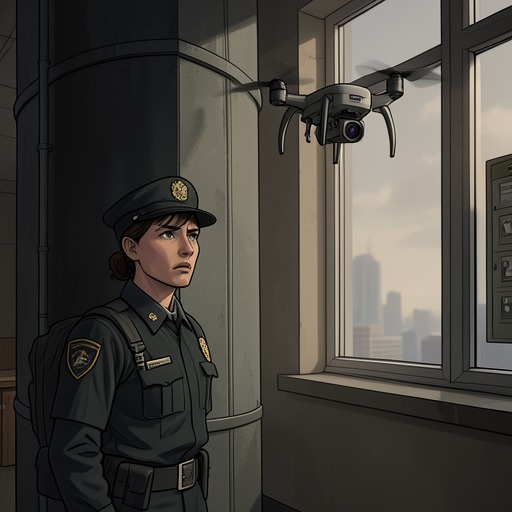
Burton’s tactical ability is not limited to direct combat. He is very good at drone games, a skill connected to Haptic Recon 1, and he and Leon maintain a system of twenty drones above the family property, with twenty more rotated in as replacements while the others recharge. From her bed, Flynne watches them trace a Celtic knot through the app on her phone. The orderly pattern offers reassurance, but it also reflects a real security operation: Burton’s gaming expertise has become part of how the family watches over its home.
His wartime reputation also affects how others read him. Reece, a former soldier who admires Burton, comes to the family property carrying a compact bullpup rifle. Flynne understands that Burton’s experience is unusual even among soldiers: Reece had served in a special unit, but less specialized than Haptic Recon. In her view, Burton’s skill combines the Corps’ emphasis on speed, intensity, and decisive action with a separate, patient ability to observe. She associates that second quality with hunting and providing food, something Burton has always been good at.
Burton’s family uses his military skill as a resource, but it does not make him invulnerable. When Flynne learns that someone has placed an eight-million-dollar hit on him through a snuff board out of Memphis, Burton can report the threat but has no name for the person behind it. The danger shifts his expertise from a profession into a defense of his own household, and draws Flynne into the practical and moral consequences of that defense.
Family Responsibility and Strategic Judgment
Burton’s security work is also a family obligation, although he does not always explain its full scope to Flynne. When Shaylene questions why he is not present during a discussion about Homes, Flynne answers that it is Burton’s arrangement and says he is occupied helping Leon deal with the media after Leon wins the lottery. That explanation is partly true, but it conceals other pressures surrounding the family. Burton’s absence therefore reflects the increasingly tangled division of labor in which his siblings manage public attention while he remains connected to security decisions.
He later explains to Flynne that he does not think the people pursuing her are Builders or Homes; he believes they want her back in their game and are seeking Easy Ice, which is why they have Macon construct interface equipment. His assessment turns the threat from an abstract danger into a contest over valuable gaming assets. Burton also recognizes that Flynne’s assets have become expensive enough to attract people from Clanton. Rather than treating the situation as inexplicable, he urges her to trace the financial incentive. His tactical habit of moving past confusion toward the question of what an opponent stands to gain gives Flynne a way to reason about forces operating across their unequal worlds.
Burton’s approach is neither purely aggressive nor merely technical. Flynne sees in him both the military ideal of acting quickly under imperfect conditions and what she calls a right way of seeing: the capacity to observe and interpret before acting. She contrasts this with Conner’s more direct orientation toward speed and force. Burton’s judgment thus joins combat training to a practical attentiveness that Flynne associates with hunting, and it shapes the way he helps her understand danger without claiming that he can control every outcome.
Relationships and Conflict
Burton’s connection to Flynne is protective but not simply reassuring: he is both her brother and the person whose security decisions increasingly shape her exposure to danger. When she enters a peripheral in London, he presses her about whether she went outside the house or only into the back garden and a virtual quad, then points out how few people she saw in a city as large as Europe’s biggest. His questions reflect the same practical attention with which he assesses threats at home, while showing that he is trying to understand what her remote experience means in concrete terms. In another encounter, Ash greets Burton as Mr. Fisher and notes that he has met Ossian; the exchange places him among the people and artificial bodies involved in the expanding operation, not merely at its defensive edge.
The bond also appears through small acts of care. After Conner is brought back from the shower, Macon helps him dress and carries him to his bed; Burton, meanwhile, changes into new camouflage trousers and quietly asks Flynne to step outside with him. Later, when she sees Burton unconscious after the attack, Conner asks whether he is all right, and she can only repeat what the hospital has said. The question makes plain that Burton’s danger is not his alone: his condition concerns the people around him, while the family’s efforts to protect one another cannot guarantee that anyone will come through unharmed.
Injury, Recovery, and Continuing Work
Burton’s exposure to violence becomes concrete when a gunfight leaves him unconscious and in need of hospital care. Before the ride, Griff has him wear protective armor; a bullet ricochets near his feet, and a fragment reaches his thigh despite the jacket’s protective lining. The incident interrupts a plan to visit Flynne’s mother and discuss moving her to safety, a plan Burton had been helping arrange. Flynne later gives Conner the limited update that the hospital has reported Burton is all right. The gap between that reassurance and his unconscious state underscores how little control the family has over the consequences of the threats they face.
Recovery does not remove Burton from the work. At Coldiron, Flynne sees him beneath a white crown, while Clovis explains that he is willing to work through a remote body and is glad to be out of his own. Conner likewise returns to work through a peripheral, coming back to his body mainly to eat and sleep. The arrangement makes Burton’s recovery part of a broader adaptation: remote embodiment allows him to remain active, but also separates work from the vulnerable body that must heal.
Burton’s enduring connection to Conner is visible in their sparring. They had practiced together before Conner’s injury and even before either enlisted, following private rules and relying on close observation and quick movement rather than elaborate exchanges. Now Conner fights through Lev’s brother’s peripheral, while Burton operates a resistance-training exoskeleton with a small remote body inside its bell-shaped head. The apparatus has human-looking hands in place of its earlier cartoon-like ones. Their familiar contest survives the altered bodies: the equipment changes, but their shared practice and competitive attentiveness remain recognizable.
By the time Flynne sees him again, Burton is using a small mobility cart and talking with Shaylene, who leans toward him from the edge of a desk. Janice observes that Shaylene seems to be falling for him, though she says they are waiting until his stitches have healed. The scene closes his recovery arc on an ordinary, relational note rather than a return to uncomplicated physical independence: Burton remains injured, but he is again among his family and friends, working and forming a new closeness.