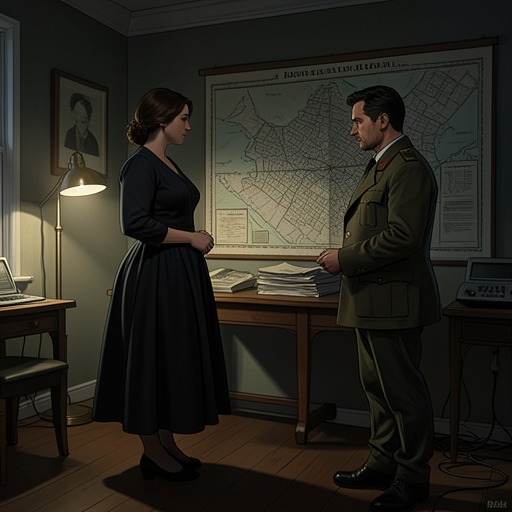
Corbell Pickett
The PeripheralCorbell Pickett is Clanton County’s presumed richest man, a former car-dealership owner, and a political broker whose influence helps sustain the county’s drug economy. Flynne Fisher initially remembers him as a distant figure from parades and local business; she learns that the respectable public image has long masked a system of profit and protection. His power is neither simply personal wealth nor public office: it comes from turning money into access, shaping how much attention authorities pay, and positioning himself between local actors and larger commercial interests.
Identity and Public Image
Flynne knows Pickett first through the last new-car dealership to close in the county, which bore his name. He is still assumed to be the county’s richest man, though she has rarely seen him: only a few times in town parades, where he rode with the mayor. Her childhood memory of him is bound up with the dealership and its new Tesla, an image of conspicuous success that seems to place him within ordinary civic life rather than at the center of local criminal power.
That impression is sharpened when Flynne sees him in her mother’s living room. Her mother has said rich people look like dolls, and Pickett’s carefully even tan and uniformly silver hair bring the observation back to mind. The polished appearance is not merely a mark of wealth; it contrasts with the unvarnished reality Flynne is beginning to understand. The man once associated in her memory with a parade and a car dealership has been present all along in the county’s hidden economy.
Power in Clanton County
Janice explains the connection between Pickett and the four men killed on Porter Road: Burton Fisher is paying Pickett to make the deaths lose official attention. The county might quickly lose track of the men in any case, but state police would maintain interest longer. Pickett, Janice says, has influence at the statehouse that can shorten that attention for a price. His service is thus not simply concealment after violence; it is the conversion of political access into a purchasable reduction of scrutiny.
Flynne’s disbelief reflects how effectively Pickett has been kept out of her everyday understanding. Janice tells her that family and friends have protected her by not mentioning him, so his name became easy to forget. She also states the broader basis of his power: nobody in the county can build even a gram of drugs without Pickett receiving a share. His influence is embedded in the local economy rather than limited to isolated favors. The money Burton pays him, carried over with Carlos in two shopping bags, is one concrete consequence of that arrangement.
Dealings with Flynne’s Circle
Pickett’s position becomes more direct when he sits down with Burton and Tommy Constantine in the Fisher home. He tells them that the people in the statehouse will not speak with them directly: the organization they have joined will have to deal through him. He also distinguishes the money already spent to gain an opening from the regular payments he says will be required to maintain it. The meeting recasts him as more than a local fixer. He claims a continuing intermediary role in the group’s access to state politics and in the costs attached to that access.
When Flynne enters, Pickett recognizes her as someone who has met the Colombian adventure capitalists. That detail places her knowledge and connections within his calculation of the arrangement. His fluent, persuasive delivery also carries the residue of his old commercials: Flynne recognizes the same carefully staged cadence, with each sentence building toward emphasis. The salesman’s public manner and the political broker’s demands are not separate performances; the former becomes a vehicle for the latter.
Pickett’s estate likewise unsettles Flynne’s expectations. Reece drives her past a guarded entrance and a long fence designed to resemble an old plantation, then turns into a less prominent gate where armed guards wait. The route and security detail establish that Pickett’s property is controlled and protected, even before Flynne understands the full circumstances of her arrival. In a later confrontation, Pickett says that people he is speaking with want him to kill her and would pay more than she can imagine for proof of her death. He asks why she is valuable. Flynne says she does not know why anyone would care about her or why Coldiron has joined forces with her group, and asks where his people are from. Pickett admits they have not told him. His threat therefore exposes both his willingness to act as an intermediary for dangerous interests and the limits of what he knows about them.
Disappearance and Political Aftermath
By the time Flynne asks her mother whether Pickett is dead, the answer is that he is missing. Her mother asks whether Flynne killed him, then whether she tried; Flynne denies it. The exchange registers how closely Pickett’s fate has become tied to the upheaval around Flynne and Burton, while leaving the circumstances of his disappearance and his ultimate fate unstated. Flynne can only concede that the events are probably connected to what she and Burton are doing.
Later, Homes personnel and vehicles gather in the region. A report relayed through Griff’s connections says that a substantial federal deployment is expected to deal with the armed remnants of Pickett’s multicounty drug empire. The accompanying account claims that authorities are presenting the empire’s dismantling as their achievement, rather than crediting Burton, Conner Penske, and Conner’s Veterans Affairs prosthesis. Pickett is not shown directing this response; the passage instead shows how his organization remains a public and political explanation for the operation, even while he himself is missing.
Significance
Pickett’s story gives institutional form to Clanton County’s corruption. His wealth rests not only on owning a successful dealership or accumulating money, but on collecting a share from drug production and selling access to state power. The same political influence that can dampen law-enforcement attention also makes him a necessary passage point for people seeking to do business in the region. He represents a local order where criminal profit and official influence are not opposites but mutually reinforcing resources.
The novel’s later reflection on ordinary human evil clarifies the force of this characterization. Flynne recalls her mother’s view that evil is not glamorous: ordinary, half-hearted badness becomes more consequential when it is given room to grow. Pickett’s trajectory fits that account. The public figure of the dealership and parade does not need to become an inhuman monster for his conduct to have far-reaching consequences; wealth, political connections, and routine self-interest are enough. His disappearance leaves the personal outcome unresolved, but the structures associated with him remain active in the region’s politics and in the efforts to define who ended his empire.