Ella
The PeripheralElla is Flynne Fisher’s mother, whose serious illness gives the family’s struggles an intimate, material stake: her treatment is expensive, and Flynne’s efforts to help her are among the reasons she becomes involved in events far beyond the household. Ella is not only someone others try to protect. She questions the danger gathering around her children, insists on remaining at home, and ends the story in markedly better health, no longer dependent on oxygen after Coldiron begins making her medication to order.
Illness and the Cost of Care
Ella’s illness shapes the family’s finances and Flynne’s motives. When Flynne asks Leon whether he has contributed toward their mother’s medication, he says he has put down eighty thousand dollars, adding that her latest biologic burns through the money. The exchange makes treatment a recurring expense rather than a single emergency: even a substantial contribution has to contend with a medication that consumes it.
Flynne’s concern for Ella also helps explain why she accepts involvement in a dangerous deal. In a conversation about whether that involvement makes Flynne a good person, she is reminded that she is not doing it to get rich, but to pay for her mother’s treatment. The comparison to cancer is explicitly corrected—Ella’s condition is not cancer—yet the point is the familiar pressure of trying to afford serious illness. Her care is bound up with practical necessity, not an abstract wish for wealth.
A Threat Enters the Home
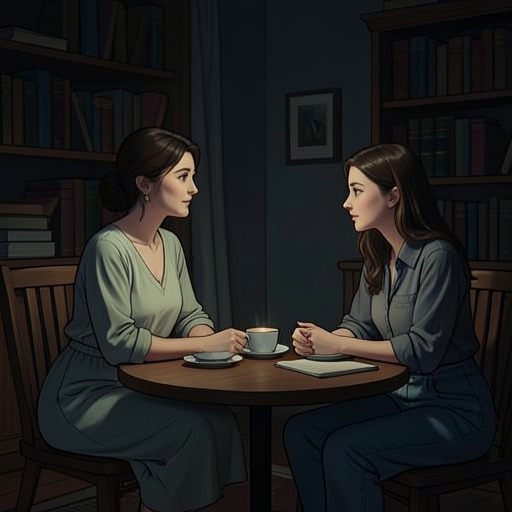
When Corbell Pickett arrives at the Fisher home, Ella is seated on the sofa while Burton Fisher is beside the fireplace. She has brought out the good china, a sign of the occasion’s formality, but Corbell’s presence makes the gathering more than an ordinary visit. Flynne, surprised to see someone like him in their living room, recognizes him from the Christmas parade. Ella, meanwhile, makes a courteous exit, asking Flynne to help her to bed and telling the others that she has known Corbell’s aunt, Reetha, through work.
In private, the courtesy gives way to anger. Ella bends to pick up her oxygen, turns it on, and fits its clear plastic prongs into her nose before quietly asking what Flynne and Burton are doing with Corbell. She is careful not to swear because she is seriously angry, and because he must not hear. The oxygen apparatus makes her vulnerability visible at the same moment that her questioning establishes her alertness: she may be sick, but she understands that something consequential has brought this man into her home.
Janice also tries to shield Ella from the tension outside the bedroom. She explains that she had been on Flynne’s bed, doing what she jokingly calls hate Kegels, because she did not want to stand where Corbell might see her and think she had overheard his business with Burton. After helping Ella put her hair up, Janice checks on her and tells her to take her medication. Ella answers that she is fine, though her sickness is showing. The scene sets ordinary acts of care—hair, medicine, a place to lie down—against the threatening business being conducted in the house.
Refusing to Be Sent Away
Later, Ella is propped against the chipped varnish of her bedstead, oxygen prongs in her nose, and insists that she is not going anywhere. She identifies the people who want her to leave: Leon, Lithonia, and Janice, though she believes Janice will not admit it. When Flynne asks where anyone expects her to go, Ella names Northern Virginia, with an expletive that conveys how plainly she regards the proposal.
Her refusal is not based on pretending the situation is safe. Ella says she knows only what she can see on the news and what she can pry from Janice and Lithonia. She asks whether everything happening is because of whatever Flynne and Burton are doing—the same activity that brought Corbell Pickett into her living room. Flynne answers that she supposes it is. Ella wants to know what that activity actually is, pressing her daughter for an explanation even though the available evidence has reached her only indirectly.
Flynne tells her there will be no move to Virginia: she is staying, and Flynne says she considered Virginia a nonstarter from the moment she heard of it. Ella then asks whether Flynne and Burton are about to make the economy crash. The question shows how she tries to connect the local upheaval she can observe with the larger danger she hears about, while Flynne’s response—asking who said that—leaves the suspicion unresolved in that exchange. Ella’s position remains clear: she will not be quietly removed from her home as a precaution.
Recovery and What Her Story Means
By the time Flynne’s community gathers again, Ella’s condition has changed. At the celebration, Janice embraces Flynne and says that she saved everyone, while Flynne credits Ainsley Lowbeer and the others. The scene places Ella within a network of family and community care rather than presenting her recovery as an isolated triumph. Later, Flynne goes to lunch with her mother, Lithonia, Flora, and Leon, who has moved into Flynne’s old room.
The concrete change is medical: Coldiron now makes all of Ella’s medications, customized for her, and she no longer needs oxygen. Earlier, the oxygen’s plastic prongs and the costly biologic had made illness a daily presence in the home; the ending reverses those details without suggesting that the preceding danger was imaginary or that the family’s care was unnecessary. Ella’s health improves through access to treatment, while the financial logic that once made her medication a burden is altered by Coldiron’s control of its manufacture.
Ella’s importance lies in the way the novel keeps large-scale schemes answerable to household consequences. Her treatment costs money; her illness changes what Flynne is willing to do; Corbell’s arrival forces the family’s danger into the living room; and the prospect of evacuation becomes a question Ella herself contests. Her ending offers material relief, not a claim that danger has vanished: she can remain at home without oxygen, and her story makes clear what the family’s battles have been trying to protect.