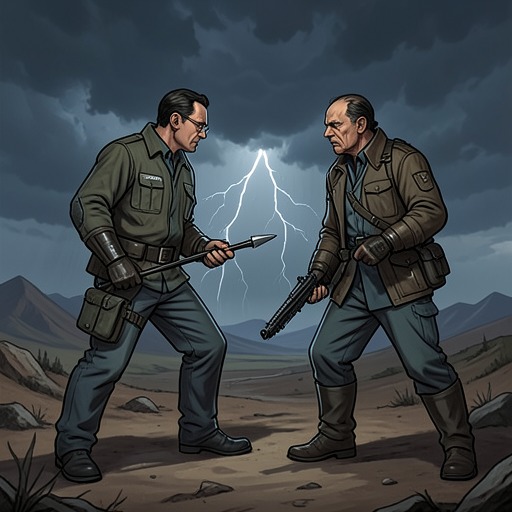
Felicia Gonzales
The PeripheralFelicia Gonzales is the president whose assassination becomes a pivotal turning point in the future history known to Lowbeer. The prospect of her death gives Flynne and her allies a concrete target in their attempt to alter that history: not to erase the Jackpot, which is already underway in their continuum, but to ameliorate its consequences and perhaps avoid the harsher social order that followed in Lowbeer’s world.
Identity and Historical Significance
In the history of Lowbeer’s world, Gonzales is assassinated before completing her second presidential term. Her killing is not presented as an isolated political crime: Lowbeer regards it as a tipping point into the deeper Jackpot, the prolonged disaster that reshapes society. That assessment makes Gonzales important both as a political leader and as the hinge between an earlier sequence of events and a more catastrophic historical course.
Gonzales is reelected, and her second term is interrupted by the assassination. The revelation surprises Flynne, who initially challenges the account when she hears that the president was killed. The conversation turns the future’s history into a specific and unsettling possibility rather than an abstract warning: a sitting president can die, and that death may help determine what follows.
The Assassination and the Divergent Timelines
Wilf explains that Lowbeer knows both the history of her own world and the secret history of Flynne’s. In the future from which Lowbeer comes, Gonzales’s assassination has already occurred and helped set the deeper Jackpot in motion. Flynne’s present, however, is not yet identical to that historical record. The two continuums have diverged, and Wilf says they will continue to diverge.
That divergence offers a limited opening rather than a promise of control. Wilf says events can be steered only in broad terms, with no guarantee of the result. The assassination is therefore both a known historical fact in Lowbeer’s world and a preventable future in Flynne’s. The distinction is central: the characters can act on what they have learned, but they cannot know exactly what a changed timeline will produce.
Prevention and the Limits of Intervention
Wilf describes the aim as ameliorating the Jackpot, not stopping it outright. Flynne’s continuum is already experiencing its own version of the crisis, and Lowbeer hopes that the system of her future can be avoided there. Wilf says that he shares her view that preventing Gonzales’s assassination is a necessary step toward that goal. The plan does not rest on certainty that the president’s survival will save the world; it rests on the belief that her murder helped set the historical disaster’s course and that preventing it may change what follows.
Later, Flynne asks about Gonzales after hearing that the president was killed. Lowbeer confirms that the assassination happened and says it set the tone. The brief exchange reinforces the event’s role as a precedent as well as a turning point: its consequences reach beyond the president herself, shaping the political atmosphere of the history the characters are trying to alter.
Later Contact and Continuing Consequences
In the later period described by Flynne, Gonzales is alive and visits her at home. She arrives by Marine One, landing on a concealed pad built with Coldiron technology that imitates more advanced technology from the future. The visits are usually informal: Gonzales and Flynne talk in the kitchen while Tommy sits in the living room with members of the Secret Service he likes. At other times, the meetings include more structured discussions with Brent and Griff about vaccine stockpiles, phage factories, and climate concerns.
Flynne first meets Gonzales shortly after Vice President Ambrose has an embolism. The visits carry an awkward personal undertow because Gonzales speaks of Wally—Ambrose’s familiar name—with what seems to Flynne like genuine, painful fondness. Flynne also knows that Ambrose died, having seen footage of her own state funeral and heard Griff explain the events that led to it. Gonzales’s survival thus belongs to a changed history, but the earlier assassination remains present as the future the characters sought to prevent; the new timeline does not make its costs or uncertainties disappear.
Narrative Role
Gonzales links historical knowledge to political action. Her assassination is first disclosed as a fact of Lowbeer’s world, then identified as a possible intervention point in Flynne’s, and finally contrasted with her later visits as a living president. These shifts make her a measure of divergence between the continuums: the same figure can be a murdered leader in one history and a continuing participant in another.
The account also keeps the limits of historical intervention in view. Gonzales’s survival matters, but neither Wilf nor Flynne’s later experience establishes that changing this event guarantees a better future. Her story gives the characters a reason to act and a concrete way to imagine history changing, while the uncertainty around the Jackpot prevents that intervention from becoming a simple or assured rescue.