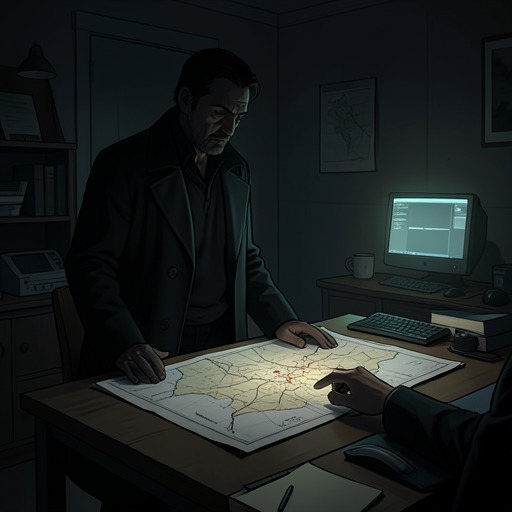
Flynne Fisher–Ainsley Lowbeer alliance
The PeripheralFlynne Fisher and Ainsley Lowbeer’s alliance joins a witness from the Stub to a powerful investigator in future London, making Flynne’s judgment central to a political struggle she cannot fully see. Lowbeer recruits her to identify Aelita West’s killer and help secure the conditions for action against the forces threatening Flynne’s world; in return, she equips and protects Flynne, while insisting that the partnership depends on Flynne’s unwillingness to cross certain lines.
Recruitment and Unequal Knowledge
Lowbeer’s approach begins with a material offer whose purpose is initially obscure. Flynne is told that files concern a piece of hardware and that she will be paid handsomely for arranging it, but the person explaining the arrangement cannot say what the hardware does. The exchange makes the alliance’s defining imbalance visible from the outset: Flynne is asked to participate before she has a full account of the machinery or interests surrounding her.
That machinery becomes more legible through the telepresence technology linking the Stub to London. Flynne first mistakes the interface for a game controller; she then finds herself receiving input from an anthropomorphic drone, a telepresence avatar that need not be consciously controlled. Ash explains that Macon’s device is imperfect but functional. The distinction between an apparent game and a remote body helps make Flynne useful to people whose world she cannot physically enter, while also underscoring how little the local vocabulary tells her about the technology’s actual reach.
Lowbeer’s recruitment is explicitly directed toward helping Burton and, as she adds, Flynne herself, though Jackman had not mentioned Flynne. The arrangement gives Flynne a place in an operation already in motion without pretending she has been briefed on its full design. Their later collaboration retains that tension: Lowbeer needs Flynne’s participation, but she also manages what Flynne is allowed to know and when.
The Investigation and Its Stakes
When Flynne meets Lowbeer in the green-and-gilt room, the encounter is both personal and strategic. Lowbeer receives her at the double doors and asks after the protection being arranged for Flynne’s mother. She also notes that Netherton is pleased with the cognitive bundle and confirms that Flynne has been shown the guns. The weapons are contingency measures, not a declaration that violence is inevitable: one is for Flynne, while the other may be for Conner or Burton, and Lowbeer hopes none will be needed. She explains their presence as a response to the crude thinking behind the conflict.
Lowbeer then lays out the larger contest. Coldiron and Matryoshka are racing to gain control of Flynne’s world through financial events occurring in fractions of a second. Coldiron is not winning, and neither is Matryoshka by much; Lev is working on Coldiron’s behalf with a brilliant but makeshift apparatus, while Matryoshka appears to have access to a more powerful state financial apparatus. Lowbeer wants to stop that advantage and enable Coldiron’s dominance, which may in turn make it possible to prevent Gonzales’s assassination.
The route to that political intervention runs through Aelita’s murder. Lowbeer says she cannot act without proof, or a reasonable facsimile, identifying the killer. A powerful person must have an interest in Matryoshka, she reasons, and may have offended or threatened another powerful party; evidence about Aelita could give Lowbeer leverage with that rival. The investigation is therefore not only a search for an answer about Aelita. It is also the evidentiary hinge on which a larger struggle over the Stub’s future and a possible assassination-prevention effort turns.
Lowbeer makes Flynne’s specific task plain: she and Netherton must succeed at Daedra’s event, where Flynne is expected to identify the man on the balcony. Flynne recognizes how much the broader plan has been concentrated in that moment. The scale of the political and financial contest stands in sharp contrast to the immediate human task assigned to her: recognize one person and report what she sees.
Communication, Trust, and Ethical Limits
To support Flynne during the event, Lowbeer explains that the newly installed cognitive bundle in Flynne’s peripheral includes a communications platform that the event’s security bubble will not detect. Lowbeer’s voice will reach Flynne as what she calls “static in your bones.” This hidden channel makes the alliance operational under surveillance, but it also means that Flynne enters the gathering with Lowbeer present in a way its security cannot register.
The partnership is not based on complete disclosure. Flynne tells Lowbeer that she wants to know a great deal while receiving very little in return. Lowbeer’s answer is that Flynne must remain focused on the moment. When Flynne asks who is included in Lowbeer’s “we,” Lowbeer answers, “You and I, my dear,” and pats her hand. The gesture names an intimacy of cooperation without removing the unequal distribution of information: Lowbeer sets the scope and timing of what Flynne is told, while Flynne has to act within those limits.
A more consequential basis for trust emerges when Flynne refuses the use of a chemical weapon. Lowbeer says that this refusal is why she was pleased, because she may need Flynne, going forward, to be exactly the person who would not use it. The alliance thus rests on more than access to a remote body or Flynne’s ability to identify a suspect. Lowbeer treats Flynne’s moral restraint as an operational quality: a safeguard against the means being allowed to overwhelm the purpose of the investigation.
Consequences and the Alliance’s Reach
The alliance also changes what Flynne can do through her peripheral. When Ash tests the newly installed cognitive bundle, Flynne unexpectedly delivers a sophisticated account of why Daedra West’s art matters. Ash had hoped for a more colloquial response, and cautions Flynne not to let it run on, but the episode shows the bundle shaping not only communication but expression. The technology that carries Flynne into London also complicates the distinction between her own voice and the capacities made available to her.
By the later confrontation, Flynne is armed and openly demands action against Homes, asking who she must kill to stop the organization from using drones against people in the Stub. Lowbeer reports that Sir Henry’s death has deprived Flynne’s competitor of an advantage comparable to the one Lev and Lowbeer afford Flynne’s side. She had acted as soon as Sir Henry arrived, assuming he would prove guilty; the resulting shift in influence allowed Homeland Security to withdraw and rescind its orders. Lowbeer says that buying a sufficient share of Hefty Mart’s parent corporation appears to have been part of the price, though she does not yet know the details.
That outcome clarifies the alliance’s practical character. Flynne contributes identification, presence, and a refusal to accept the proposed chemical attack; Lowbeer converts information and political leverage into protection and institutional decisions. Their cooperation does not erase the distance between the Stub and London, nor does it give Flynne equal command of the plan. It makes that distance traversable, while keeping Flynne’s judgment—not merely her usefulness as an interface—at the center of what Lowbeer says she needs.