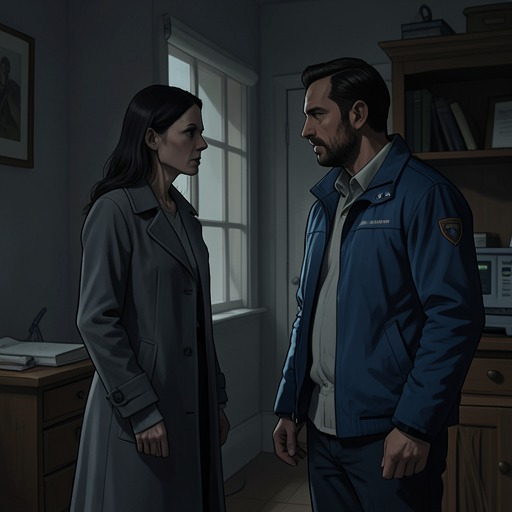
Flynne Fisher—Wilf Netherton
The PeripheralFlynne Fisher and Wilf Netherton form a cross-temporal working relationship through conversation, remote technology, and urgent practical requests. Their first exchange is wary: Wilf seeks information about Flynne’s shifts and what she witnessed, while she is still trying to understand whether the experience is a game. As the contact develops, he asks her to arrange confidential fabrication of an unfamiliar device, and she becomes a crucial link between his world and the local people able to make it. Their cooperation crosses a divide in time and technical knowledge, but never erases the difference between them; the same equipment can be described as a game controller, a telepresent interface, or an anthropomorphic drone, depending on who is explaining it.
First Contact and Uneasy Recognition
Wilf’s first direct approach to Flynne comes through a phone call. He appears on her screen in a room of pale, glossy surfaces, behind an old-fashioned monitor, dressed in a high black turtleneck. His setting seems so unlike hers that she wonders whether it is Colombian, while his English voice confirms that he is one of the people Burton had mentioned. Wilf addresses her as Miss Fisher; she gives him her first name, then hears him repeat it and identify himself as Wilf Netherton, sounding surprised. The small exchange establishes both the distance and the possibility of recognition: she is not simply a substitute operator to him, even if his opening questions frame her through the work she performed for Burton.
Wilf explains that he wants to speak with her because she had been substituting for her brother on his last two shifts. Flynne’s response is not immediate trust but a question: is this a game? The label captures the gap between her experience and his account of it. Wilf is asking for information about an operation that, to Flynne, has arrived through something resembling play; she has to decide whether to describe what happened before she has a settled explanation for what she was doing. When he asks her to help, she says she is not sure she should trust him, yet begins recounting how the first shift started in the back of a van, with her emerging through a hatch and the controls on override. Her account makes the conversation more than an interview: it is the first working exchange in which her firsthand observation becomes useful to Wilf and his associates.
From Witness to Collaborator
Wilf’s questions focus on what Flynne saw. After hearing her describe the first shift, he asks her to explain an event during the second. She answers with a concrete clue: the backpack. The brief reply redirects their conversation from the unfamiliar mechanics of the shifts to a specific witnessed event. In this early phase, Wilf depends on Flynne’s local, embodied experience; she can report what appeared before her, even while the people contacting her possess a broader technical context she lacks.
The work later becomes reciprocal and practical. During a phone call, Wilf asks Flynne to arrange for something to be printed quickly, competently, and confidentially. He says the contractor may find the job challenging, but that technical support will be provided. Flynne does not claim authority over the work; she says Wilf would have to speak with Burton. Wilf agrees, while insisting that the conversation with her must happen immediately because the matter is urgent. His request places Flynne between the distant client and the people who can carry out the fabrication, and her answer marks the limits as well as the value of her role: she can connect the parties, but her brother is part of the decision and the technical operation.
When Flynne asks what the files concern, Wilf calls them a piece of hardware. He admits that he would not know how to explain what it does, and offers handsome payment for arranging its production. The exchange reveals an important asymmetry in their collaboration. Wilf can transmit files and promise technical support, but his own explanation does not make the object intelligible to Flynne. Their relationship advances not because every uncertainty has been resolved, but because they can negotiate around it: he states the need, she brings the request to Burton, and the work proceeds through a network of people with different kinds of knowledge.
Technology as a Shared but Unsettled Language
The pair’s communications are repeatedly mediated by devices whose names and purposes shift with the speaker. When Wilf calls again, Flynne answers to find his face in a small pink frame. He begins by recalling that she had mentioned having drones, then asks for printing work. The familiar medium of a phone call lets them resume their exchange, but it also carries a request whose technical significance Flynne cannot yet judge. The connection is personal in its directness and institutional in what Wilf needs from her.
Their different understandings are especially visible in Flynne’s recollection of the interface. She protests that she had been told it was a game controller; the correction is that it is a telepresent interface requiring no hands. The distinction is not merely vocabulary. “Game controller” places the object within an experience she can recognize, while “telepresent interface” identifies it as equipment for remote embodiment. Flynne’s question exposes the mismatch between the explanation she received and the function she has been made to perform. At the same time, the device is what allows her to participate in an operation far beyond her immediate surroundings.
That distance becomes bodily and unmistakable when Flynne wakes in an unfamiliar form. She sees hands that are not hers, notices a face reflected in a steel canister, and hears a voice that does not sound like her own. Ash tells her she is accessing input from an anthropomorphic drone, or telepresence avatar, and warns her not to try to consciously control it while it is being recalibrated. The equipment is Macon’s device, imperfect but working. In this episode, the arrangement connecting Flynne to Wilf’s side of the story is no longer an abstract game-like experience: it gives her input through a remote human-shaped body, while another participant explains the technical process. The scene sharpens the central condition of the collaboration: Flynne can act across distance, but the nature of that action is explained to her by people with knowledge she does not yet share.
Limits, Trust, and the Wider Alliance
Flynne’s cooperation with Wilf does not amount to uncomplicated allegiance. Her initial suspicion remains part of the relationship’s foundation: she tells him that he does not seem like someone she should particularly trust, then helps him anyway. The trust required is provisional and task-specific. She can give an account of what she witnessed, help route a request to Burton, and work with unfamiliar equipment without fully understanding the world behind it. The narrative gives those practical acts more weight than any declaration of confidence between the two.
Their arrangement also depends on other people. Burton is the person Flynne says Wilf must consult about the printing job, and Macon’s imperfect device is part of the technical infrastructure that enables remote embodiment. Ash explains how Flynne is receiving input, while Wilf’s questions and requests connect her experience to a larger investigation and project. The relationship is therefore not a sealed pair: it is a point of contact in a wider network, with Flynne’s local knowledge and access complementing the resources and technical explanations available to Wilf’s associates.
A later encounter gives the alliance an explicit protective dimension. A man tells Flynne that he is there to help Burton and her, though Jackman had not mentioned her. His appearance and remark show that assistance around the Fisher family can arrive through arrangements that Flynne did not initiate and does not entirely understand. It broadens the pattern established by Wilf’s calls: people from outside her immediate world may be acting on behalf of her household, but that does not make their purposes transparent to her. The line is not a substitute for Wilf’s own actions; rather, it underscores the increasingly interconnected field in which Flynne and Wilf’s cooperation operates.
Narrative Significance
The relationship’s development is told through a sequence of communications and practical thresholds rather than through a single moment of complete disclosure. A phone call introduces Wilf as a visually strange but recognizably English-speaking stranger; questions turn Flynne into a witness; an urgent printing request makes her an intermediary; and the telepresence apparatus converts remote access into an embodied experience. Each step changes the stakes of their contact without making the underlying difference disappear.
The devices function as shared tools but not as shared meanings. Flynne’s “game controller” and Wilf’s language of hardware, drones, and technical support belong to different explanatory worlds. The interface lets her take part before she fully grasps its operation, while Wilf relies on the observations she can provide. Their alliance thus joins knowledge that neither possesses alone: Flynne’s direct experience of the shifts and Wilf’s access to the people and systems that frame them. Its significance lies in that unfinished translation. The connection is real and consequential, but it remains negotiated through questions, corrections, requests, and equipment that is still being recalibrated.