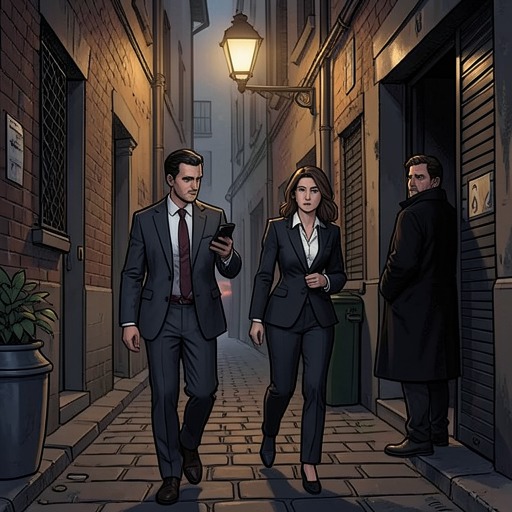
Flynne was kidnapped and rescued
The PeripheralFlynne Fisher’s kidnapping and rescue mark a sharp reversal from her ordinary movements around Clanton to captivity inside Corbell Pickett’s estate, then to a coordinated escape by Burton Fisher and Macon. The abduction makes Pickett’s political reach physical: Reece says he had no choice, Flynne is delivered under armed guard, and her captors bind her to a table. Her rescue, built around Squidsuits, earplugs, and Burton’s tomahawk, reveals how quickly her family and allies can turn the same hostile terrain into an exit route.
Causes and Background
Pickett’s power in the county is not news to Flynne so much as a truth her community has kept out of her sight. Janice explains that Burton has been paying Pickett to make the four men killed on Porter Road disappear from official attention. Pickett’s influence reaches beyond local law enforcement: he can use his connections at the statehouse to shorten the State Police’s attention for a price. Janice also punctures Flynne’s memory of Pickett as a conspicuous local businessman who once owned a Tesla dealership and rode with the mayor in a Christmas parade. In the county’s drug economy, Janice says, nobody builds even a gram without Pickett getting his share. Flynne’s shock comes partly from recognizing that family and friends have protected her by never mentioning him.
That protection has limits. Burton’s money has bought a measure of cover for the earlier killings, but it has not removed Pickett’s ability to act against the Fisher family. When Flynne is at Edward’s, Janice tells her that she is at Flynne’s house looking after her mother. Flynne gets up to return, hears several gunshots as she opens the door, and turns back in alarm. The account places the kidnapping amid a widening danger around her family, without establishing that the shots are part of Pickett’s abduction plan.
Abduction and Captivity
Later, Reece is driving Flynne while she is tied to the car seat with zip ties. She protests, and he gives her no immediate explanation. When he finally says Pickett made him do it and that he had no choice, his fear becomes as revealing as his confession: Flynne understands that Reece is frightened too. His compliance presents Pickett’s authority not as a distant reputation but as a power that can compel people who have known Flynne for years.
The journey is made more isolating by the measures taken to prevent contact and tracking. Reece puts Flynne’s phone in a Faraday pouch. Meanwhile, Lev reports that the phone and the tracker in Flynne’s stomach traveled together toward the nearest town before turning north, after which the phone’s signal disappeared. The vehicle then exceeds speed limits on rough roads. The tracker keeps the people looking for Flynne from losing her location altogether, even as the blocked phone signal suggests that someone is deliberately cutting off one line of contact.
Reece brings her through Pickett’s grounds without turning in at the first gatehouse. At a less prominent entrance, two armed men in camouflage and helmets wait beside a golf cart. Flynne has stopped trying to talk to Reece because it makes his driving worse, and she is unwilling to risk a crash on a dark county road. She passes wrecked cars left unrepaired, a sign of the county’s inability to maintain even its roads, while wondering whether people in those vehicles might once have been in a situation like hers. Reece then cuts the tie fastening her to the seat and tells her to get out. His hand on her head as she exits feels startlingly intimate precisely because she cannot remember him ever touching her before.
The armed men take over. One attaches what Flynne guesses is a dog-training leash to the ties around her wrists; the other watches the gate close. They transport her in a cart marked CORBELL PICKETT TESLA along a rough gravel lane to the back of Pickett’s house. Under floodlights, the property joins incongruous images of wealth and industrial use: a factory-like addition, a McMansion, sheds, machinery under tarps, and swimming pools. Flynne is led past rows of tall white plastic tanks into a concrete room with a heavily worn steel-topped table bolted to the floor. A screw eye is fixed at its center. Her captors fasten her joined wrists to it with a blue Homes zip tie, leave the lights on, and bolt the door behind them. The room’s improvised restraint turns the kidnapping into confinement engineered around her body, not merely a threat delivered at a distance.
The Rescue
While held in the room, Flynne sees the door and listens for signs of what may be happening outside, hoping her mother is safe and that Lithonia remains with her. Macon is working remotely: he tells her he is capturing the situation, then directs her to stand. As she plants her palms on the table, the bolt rattles and the door opens. A Squidsuit enters, its camouflage making the wearer look like a roiling, distorted image. Macon identifies it as cuttlefish camouflage, the kind Burton and Conner used in the war.
The apparent attacker carries Burton’s tomahawk. Its specially notched head is used to cut the blue restraint at Flynne’s wrists, while a gloved hand offers two orange earplugs on a string. Burton drops under the table and comes up beside her; together, he and Macon get a Squidsuit over her. The suit first imitates the room’s light and then Flynne’s face, while Burton fastens it around her from the feet upward. Macon tells them to get out. Burton swings Flynne over the table and pulls her toward the door, where she sees a blurred foot beside a guard’s holstered pistol and blood on the concrete. The rescue is quick and practical: cut the tie, disguise the escapees, and leave before the guards can stop them.
Outside, the camouflage itself becomes a problem. Burton’s suit is too close to the part of Flynne’s that she is meant to see through, and their overlapping patterns produce a disorienting feedback of hexagons. Burton brakes the ATV and opens the suits near Flynne’s neck. He tells her, “Easy Ice,” then warns her to keep the earplugs in because it might get loud. Conner appears nearby in shadow, but the figure is not Conner: it is a constructed decoy, an oddly lumpy body wearing a Gonzales mask. Carlos steps around it with a bullpup rifle. He takes Flynne’s Squidsuit and helps Burton dress the figure in both suits, arranging them to avoid the visual feedback that had disoriented Flynne and Burton. The decoy becomes difficult to distinguish from the shadow around it, turning the camouflage into a way to misdirect pursuit as well as hide the rescuers.
Escape and Significance
Burton drives Flynne away from the house, past Pickett’s golf course and out through a gap opened in the estate’s white fence. Beyond the property, they reach the road and speed up. About half a mile on, Tommy waits beside his large white car, wearing a Sheriff’s Department helmet and a black jacket. He asks Flynne whether she is all right and whether anyone hurt her. Her answer is cautious rather than triumphant: she guesses she is all right. The reunion confirms that the escape has carried her beyond the estate, but does not erase the shock of being taken and restrained.
The episode’s shift from presumed security to abduction and back to escape makes control of movement its central stake. Flynne’s phone is shielded, her wrists are tied, her route is chosen by her captors, and the Homes tie fixes her to a bolt in the table. Against those constraints, the tracker preserves a means of locating her, Macon coordinates from outside the room, and Burton’s equipment becomes a tool for breaking out. The same technology that disorients the rescuers also conceals them; the same estate that traps Flynne contains a fence that can be opened. In the later conversation at dinner, Burton describes something on a scale of twelve on a war-crimes dial that stops at ten. The remark gives the escape a grim afterimage: getting Flynne out does not make the violence around her small or safely concluded.