Flynne’s peripheral
The PeripheralFlynne’s peripheral is an anthropomorphic telepresence body through which Flynne Fisher can enter and act in a remote setting without physically leaving home. Its first activation makes that arrangement bodily and uncanny: Flynne encounters another face, voice, range of vision, and physical form, then gradually learns to inhabit the device. It is not merely a remote camera or a game controller, but a human-shaped interface whose capabilities and limitations affect both the work being done and the people who encounter it.
Design and Purpose
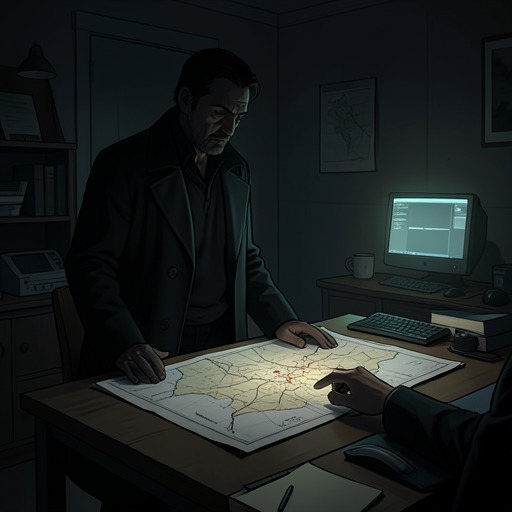
The peripheral is introduced through an initially misleading explanation. Flynne had been told the device was a game controller, but Macon clarifies that it is a hands-free telepresent interface. The hardware is presented as a piece of equipment to be shipped and arranged for payment before its function is made clear, reflecting the gap between the people handling its logistics and those who understand how to operate it.
When Flynne connects, Ash identifies the body as an anthropomorphic drone and a telepresence avatar. It can be controlled remotely, but its design also allows it to function without constant conscious direction. Ash explains that the device is not perfect, though Macon’s equipment works; the first connection therefore depends on a provisional, collaboratively adjusted technology rather than a seamless transfer.
The peripheral has a physical form substantial enough for Flynne to inspect and inhabit: a taller body, a face reflected in a polished steel canister, hands she recognizes as not her own, and a padded ledge on which the body had been lying. Flynne later notices that its body is not identical to hers. In the toilet-shower room, she finds a black shirt, a bra she had not known it wore, breasts slightly larger than her own, and a small mole above the left collarbone. Its hair has been cut with attention to appearance. These details establish a designed body with a particular presentation, not a transparent or anatomically neutral endpoint.
First Connection and Recalibration
Macon and the others prepare Flynne for the first connection by having her lie down, close her eyes, and count down. A pop marks the transition, but it does not immediately feel like a clean arrival. The room seems to reverse around her; the ceiling appears higher, her stomach turns, and a woman’s face is close and blurred. Flynne discovers that the hands she sees are not hers, and the voice she hears speaking is not her own. Her first response is alarm at the bodily mismatch and the strange range of color.
Ash explains that Flynne is receiving input from an anthropomorphic drone and advises her not to try to control it consciously. The body is being recalibrated, with Macon’s imperfect device already working well enough to establish the link. Flynne’s first experience is thus neither a simple visual feed nor an effortless inhabitation: she must orient herself to a body whose sensory information and physical dimensions differ from her own.
The mismatch is particularly strong in vision. Ash identifies the peripheral as a tetrachromat, with a wider range of color vision than Flynne has, and says the settings are being adjusted. Flynne reports that the colors had hurt before recalibration; afterward, they feel more normal. Touching the new face with both hands gives her an uneasy sense of touching herself through something that is not quite there. The system’s sensory settings matter because the remote body does not simply reproduce its operator: its capacities must be brought into a workable relation with hers.
Ash also explains the physical strain of the transition. Flynne has flooded the peripheral’s adrenal system, and Ash says a first-time user cannot be spared the full disturbance except by being kept prone, with eyes closed and an empty stomach. Flynne is sweating after the connection. The avatar’s body therefore registers an intense reaction even as its operator crosses into it, making the interface a physiological as well as informational channel.
A Body That Flynne Inhabits
The peripheral’s face changes meaning when Flynne begins to operate it. Ash had explained that, under artificial-intelligence control, its face looks human because it is programmed to register changing micro-expressions; without that activity, the body becomes a distinctly disturbing object. When Flynne supplies her own micro-expressions, the face is no longer simply hers, but it becomes recognizably expressive in a different way. Wilf Netherton notices that Flynne has completely altered the peripheral’s body language: it is inhabited, and its face seems somehow to be hers.
The change is visible to others, not only felt by Flynne. Netherton backs down the narrow corridor, unwilling to turn his back on the small cabin where she has arrived. He experiences the transformation as something strange and unsettling, while the peripheral’s former artificial animation provides a point of contrast: an AI’s programmed expressions and Flynne’s own expressions animate the same body differently. The device does not erase the distinction between its operator and its manufactured form; instead, it makes that distinction perceptible through gesture and expression.
Flynne’s inspection of the body further complicates the idea that it is simply a copy. The clothes, slightly different proportions, and mole give her grounds to distinguish it from her own body, and the difference is comforting to her. She also wonders whether it needs to urinate, then reasons that it does not, since she herself does not; Ash has told her that it drinks water but does not eat. These questions make the avatar’s bodily status practical and specific: it has some bodily functions and requirements, but not the ordinary needs Flynne automatically associates with a person.
Uses and Consequences
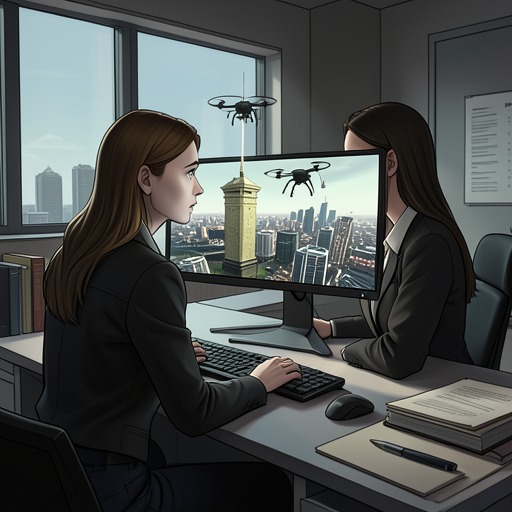
The peripheral gives Flynne access to encounters and work beyond her immediate surroundings. She can speak with people in the remote setting, recognize Netherton, and communicate with Macon and Ash through a body present there. At one point she sees a white-haired woman among a crowd of black hats, while Ash’s flying device creates turbulence that makes the pedestrians reach for their hats even though they cannot see it. The scene places the peripheral within a wider field of remote and partly invisible technologies: some effects are perceptible to bystanders even when their cause is not.
Ainsley Lowbeer introduces herself to Flynne through a private communication channel, identifying herself as a Detective Inspector of the Metropolitan Police. Lowbeer asks whether Flynne is satisfied with her peripheral and says she chose it herself on short notice because she felt it had a certain poetry. The exchange makes clear that the avatar is not only a technical convenience: its selection is also a decision made by someone with institutional authority, and Flynne’s access to this body brings her into consequential contact with that authority.
The peripheral’s usefulness also crosses into the immediate danger and collaboration surrounding Flynne’s family. A later explanation of her presence describes her as there to help Burton and, indirectly, the speaker, while acknowledging that Jackman had not mentioned the speaker to her. The body makes this remote participation possible, but it does not by itself settle who is entitled to direct Flynne’s involvement or how much she has been told. It is an interface that enables cooperation while leaving questions of knowledge, consent, and responsibility in human hands.
Significance
Flynne’s peripheral works as a meeting point between different understandings of technology. Macon’s side can treat it as a device to build and connect; Ash can explain its sensory and bodily operation; Lowbeer can choose it and use it as an access point to a private exchange; and Flynne experiences it through the immediate facts of pain, balance, touch, and unfamiliar anatomy. The same object is equipment, avatar, and body, depending on who is using it and what the encounter requires.
Its first connection also exposes how little of embodiment can be reduced to a screen image. Flynne must adjust to a different color range, a different height, unfamiliar hands, and a face whose expressions become her own without becoming physically identical to her. The peripheral enables her to cross distance, but the crossing is not frictionless or immaterial. Its most consequential effect is to make remote presence tangible: the machine is shaped by Flynne’s actions, and other people respond to it as a body inhabited by her.