Future London's automated social order
The PeripheralFuture London's automated social order is defined by a striking mismatch between a highly engineered, carefully maintained city and the apparent absence of ordinary public life. When Netherton shows Flynne views of London, greenways, restored rivers, and floating islands reveal a city reshaped by technology, while the crowds she expects to see turn out largely to be historical simulations. The city is not simply empty: it is selectively populated, with machines and artificial scenes doing much of the work of making public life visible.
Urban design and engineered nature
In an aerial feed, London appears through a foggy midmorning panorama, its angular shard-like towers set across a densely built city. Greenways and deep new forests interrupt the compacted urban fabric, while glass roofs cover some of the rivers that have been cleansed and excavated. In the Thames, floating islands have been rearranged, their revolving blades better positioned to harvest the river’s force. The view presents environmental restoration not as a return to an untouched past but as deliberate, technical redesign: water, vegetation, architecture, and energy systems have all been incorporated into a managed landscape.
The feed gives Flynne a view of this infrastructure from above, but it also exposes how partial such a view is. She sees so few people that she asks where everybody is. Ash explains that at this altitude people would be difficult to notice, then directs attention toward the City and Cheapside, where a crowd comes into view. The transition from apparent emptiness to a busy street does not resolve the question so much as change its terms: the crowd is present as spectacle, but not as evidence of a normally inhabited city.
Automation and the public realm
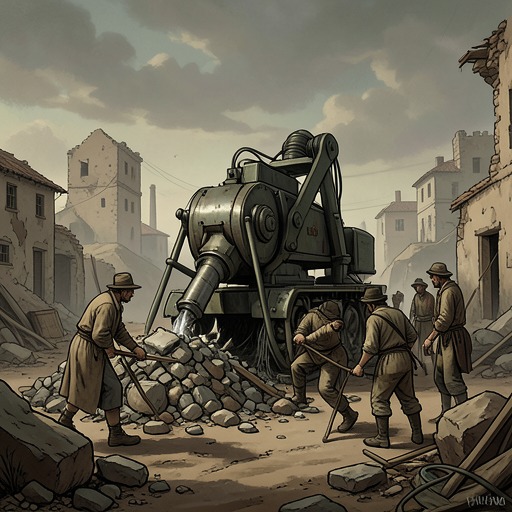
The ordinary streetscape is staffed and serviced by a mixture of automata, homunculi, and occasional people, either physically present or operating through peripherals. One shop window contains a Michikoid in riding clothes folding scarves. The scene makes automation part of everyday commerce rather than a single dramatic intrusion: artificial workers perform recognizable retail tasks amid a city whose public life is already difficult to read at a glance.
Flynne notices both the lack of people and the scarcity of traffic. Netherton’s response separates what she sees from what she assumes she sees: the city has systems and activity, but the visible signs of a densely lived-in present are limited. Ash’s explanation that the elevated view conceals people offers one qualification, yet the later reveal at Cheapside makes the deeper distinction explicit. Many apparent inhabitants are not human residents at all.
Cheapside as historical simulation
At Cheapside, the view shifts to a crowd identified as an 1867 “cosplay zone.” The street is filled with horse-drawn cabs, carts, and drays, while men in tall hats hurry past painted signs advertising boots, china, lace, insurance, and plate glass. Children dart between the horses, sweeping their droppings with short brooms. The scene is rendered with enough social and material detail to resemble a functioning historical street, but Netherton knows that its apparent laborers, merchants, and animals are simulacra.
Netherton’s own childhood memories complicate the scene. His mother had brought him to these shops, and he had been fascinated by the hand-painted signs and the bustling street. He also remembered the children’s desperate work and the dark courts into which boys ran with handcarts. The historic display had once seemed entirely real and had even frightened him, although he understood that the children were not real. His recollection shows how simulation can retain the sensory force of lived reality even when its artificial status is known; it also links the city’s curated history to an earlier, personal experience of being led through the same streets by his mother.
Visibility, history, and the limits of the illusion
Netherton explains to Flynne that the scene is built from period media. Scarcely anyone in it is human; the people who are human are tourists or schoolchildren being taught history. The illusion works better at night, he says, while also admitting that it is less annoying then. That remark gives his response a personal edge: the historical spectacle is not merely an educational reconstruction but a familiar irritation, shaped by memories of his childhood visits and his subsequent distaste for the period.
The horses sharpen the gap between historical display and contemporary life. When Flynne asks whether they are real, Ash confirms that they are not, adding that horses are now rare and that society has generally done better with domestic animals. The detail makes the historical street’s most obvious living presences part of its fabrication. Future London can reproduce the visible bustle of an earlier city, but the reproduction depends on the very absence of the people and animals that once sustained it. Its automated order thus offers not a seamless continuation of history but a contrast between engineered present, managed nature, and convincing yet knowingly artificial past.