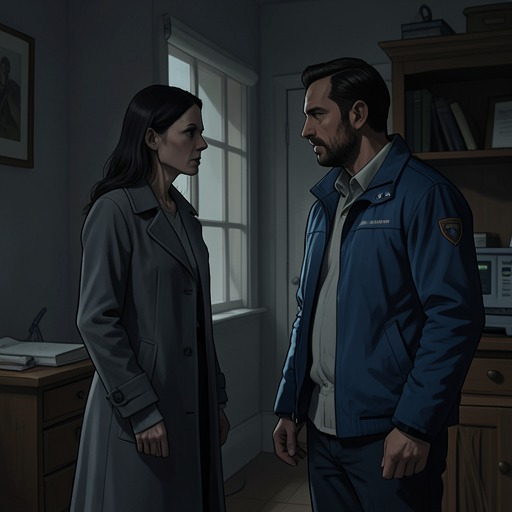
Gobiwagen
The PeripheralThe Gobiwagen is Lev Zubov’s family’s Mercedes land-yacht, built to tour a Russian oligarch around the Gobi Desert and kept inside a garage rather than driven on the road. It becomes an improvised household and operational space: its cabins shelter remote-controlled bodies, its upper cupola serves as Wilf Netherton’s sleeping quarters, and its desk and communications equipment connect him to Flynne Fisher. The vehicle’s polished luxury is inseparable from its odd confinement, and the contrast between its grand design and Flynne’s plain description of it as a camper makes it a revealing interior of the novel’s unequal worlds.
Design and Setting
The Gobiwagen is introduced as a large Mercedes land-yacht, an extravagant vehicle designed for touring the Gobi. Netherton explains that it is in a garage and speculates that it may have had to be taken apart to get inside. Its immobility is central to the object’s strangeness: a vehicle conceived for travel occupies a fixed place among Lev’s father’s collection of restored cars, beneath arches that brighten in response to movement.
The surrounding collection makes the Gobiwagen part of a larger display of inherited excess. Netherton imagines how Flynne might see the rows of pre-Jackpot cars under the purpose-built arches: chrome, enamel, stainless steel, and enough Italian leather to cover two tennis courts. He doubts that the collection would impress her. The vehicle’s luxury is thus presented not simply as a collection of materials, but as an environment whose meaning changes with the observer’s experience of wealth and place.
Inside, the Gobiwagen functions less like an ordinary car than a compact, multi-level residence. It has three sleeping cabins, a desk, a bar, and an upper glass-walled cupola with gray leather upholstery. A narrow stairway folds out of laser-cut veneer, while the upper compartment includes a hydrotherapeutic tub that can also serve as an observation cupola. The interior’s intricate fittings accommodate rest, work, and movement between levels, even as its unusual arrangement makes the vehicle difficult for newcomers to categorize.
A Place for Bodies and Care
The Gobiwagen’s rear cabin is used to house a peripheral associated with Flynne. Lev directs that it be placed there, covered with a sheet if that would help, after explaining that it needs to recline and exercise. Netherton leads the peripheral up the gangway and into the smallest cabin, lowers a narrow bunk from the wall, and instructs it to sit, lie down, and sleep. The scene turns the cabin into a practical care space while drawing attention to the uncertain distinction between a person and a body operated remotely.
The vehicle also accommodates Conner Penske’s peripheral. Ash tells Netherton that Flynne’s peripheral is in the rear cabin and Conner’s in the master cabin, then takes him upstairs to the cupola. Later, Netherton finds Conner’s peripheral left on the master bed with its arms spread and ankles together. The different cabins give the remote bodies separate places within the vehicle, making the Gobiwagen a temporary domestic setting for several people who are not all physically present in it at once.
Netherton’s own use of the vehicle repeatedly shifts between sleep and work. After taking him into the cupola, Ash tells him that the Medici has given him something to help him sleep and that he will be called for breakfast. He sleeps deeply, wakes, and is later urged to sleep again after helping Ash with Ossian Murphy. The Medici’s effects make the Gobiwagen a setting for managed recovery as well as shelter; Netherton’s rest is repeatedly arranged around the needs and interventions of others.
Changing Names and Viewpoints
When Flynne arrives, she recognizes the place from an earlier encounter but finds it smaller than she expected. She goes to the window rather than taking Netherton’s offered seat, peers out at Lev’s father’s cars, and asks whether they are in an RV. When he does not understand, she supplies the term camper, or recreational vehicle, and observes that his office is in one. Her comparison with having come from a trailer gives the vehicle a different social scale from the one implied by its materials and ownership.
The exchange is more than a difference in vocabulary. Netherton initially describes the interior through its unusual Mercedes design, while Flynne identifies its functional resemblance to a camper. Later, she tells him that Conner calls it an RV, and Netherton reminds her that she had used that name first. The recurring renaming makes the same enclosed space legible from contrasting reference points: aristocratic automotive extravagance to one observer, a recognizable kind of trailer-like room to another.
Work, Communication, and Seclusion
The Gobiwagen serves as Netherton’s office as well as accommodation. He sits at the desk facing black mirrors that once displayed data belonging to Lev’s grandfather’s expanding empire. The now-dark surfaces preserve the impression of a former corporate command center, even as the vehicle has become part of Lev’s household and a place where Netherton handles present work. Its inherited furnishings and contemporary communications overlap without fully erasing the older function suggested by the desk.
Remote communication extends the vehicle beyond its physical enclosure. Ash gives Netherton a headband and emulation software so he can visit Flynne at low resolution, and he later speaks to her through a Wheelie Boy interface while sitting at his desk in the Gobiwagen. When Flynne has to call her mother, their connection ends; Netherton returns to the open bar carrying two glasses, and the bar’s door slides shut as Lev’s sigil appears. The small sequence links mediated intimacy, interruption, and the vehicle’s carefully controlled fittings without turning the Gobiwagen into a simple instrument of communication.
The vehicle remains a base amid the broader movement of the plot. Netherton sleeps in its cupola, uses its toilet, and repeatedly returns to it while the people around him arrange departures and responses to danger. At one point, he is trying to sleep on a granite bench in the imagined setting of Daedra West’s voice mail before waking again on the Gobiwagen’s leather cushions, with the garage dark around him. Later, he glances up at the vehicle while asking when they will leave and starts toward its gangway to use the toilet. The land-yacht’s recurring presence offers a fixed interior in a narrative of shifting bodies, remote encounters, and urgent movement; its extravagance is also the physical residue of the family wealth that Netherton’s work inhabits.