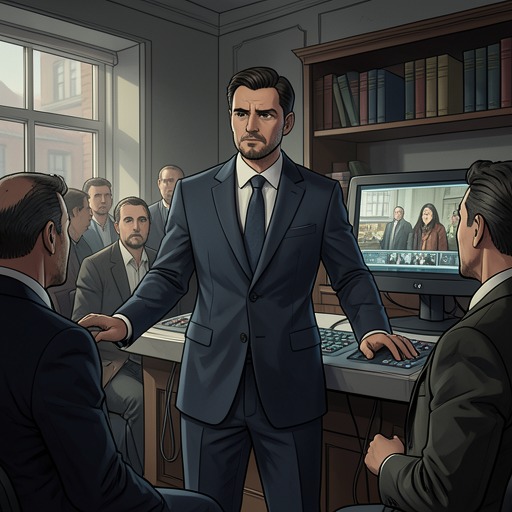
Macon
The PeripheralMacon is a local technical fixer whose skill with improvised electronics and equipment helps connect Flynne Fisher’s community to the remote technologies used by the people around Coldiron. He is not simply a repairman: his judgment makes unfamiliar systems usable, while his work on devices and specialized printing places him inside a collaboration whose scale and consequences exceed the local problems he first solves.
Identity and Working Life
Macon works independently rather than as an employee. At a Hefty Mart snack bar, he has a regular table at the far end, away from the payment counter, which serves as his office. The arrangement reflects the practical value of his expertise: he troubleshoots problems for the local management, including failures in inventory tracking and the store’s shoplifter blimps, matters that the chain’s headquarters in Delhi cannot readily address. In return, he can use the table and charge snacks and drinks to an open tab.
His work is therefore embedded in everyday local infrastructure rather than a formal technical department. When Flynne needs help with her phone, she asks for Macon and says he should contact her. Their easy greeting at the snack bar leads directly into his diagnosis that the phone has been bricked. The episode establishes the pattern of his role: a malfunctioning object becomes a problem he can take up, explain, and potentially make useful again.
The narration offers a few physical details—Macon is lighter-skinned than Edward, somewhat freckled, and has striking greenish-brown eyes, one partly hidden behind his Viz. But the stronger mark of his characterization is his practical fluency. He can discuss a device in ordinary terms, then distinguish its actual components and provenance when someone misunderstands what has been built.
Improvisation and Technical Judgment
Macon’s work often depends on adapting what is already available instead of fabricating an entire system from scratch. When the origin of a piece of equipment is questioned, he clarifies that it was not fabricated for the project: it was surplus bought through eBay, legally obtained, and made usable with a servo interface and circuitry. That distinction matters to him. The result may look like a purpose-built technology, but its functioning depends on identifying suitable parts and integrating them.
The same approach shapes a larger build. Macon describes a project assembled with redundancies and obvious workarounds: the team has been paid to construct something for which the real plans already exist, but must approximate those plans using available components, printed parts, and modified components that can themselves be printed on. He and his colleague remove their Viz devices during the explanation, a small act of professional courtesy that accompanies a serious exchange about the work. The account presents Macon as technically capable without suggesting that he possesses the original design or complete understanding of the system: his strength lies in making an imperfect, workable version from the materials at hand.
That facility extends from repairing a phone to specialized equipment and the construction of a telepresence avatar. When Flynne is introduced to the remote body, she is told that Macon’s device is not perfect but works. It receives input from an anthropomorphic drone, and the user is advised not to try to control it consciously while it is being recalibrated. Macon’s contribution is thus a functional interface between a local builder’s approximations and a system whose operators and purpose lie beyond the snack-bar scale of his earliest work.
Flynne, the Gift, and the Remote Body
Macon’s connection with Flynne includes more than technical service. He wants to impress her and offers her something he regards as beyond the reach of money: a polt, a gift that had sounded to him like a ghost story when Lev Zubov first explained it. Macon says he had someone give it to Aelita West. The gift acquires a social life beyond the act of giving: Aelita’s secretary later cancels a lunch planned for the following day in the Strand, where Indian food had been reserved, and reports that Aelita wanted to learn more about her polt. Macon’s gesture therefore links his attempt to impress Flynne with Aelita’s interest in the technology.
His hands-on support for Flynne’s access to a remote body makes this exchange concrete. At the Fisher home, Macon appears at the kitchen door with a fluorescent-orange device for measuring her head, its thin sticks and ring resembling a piece of hunting equipment more than a laser instrument. The measurement is part of fitting her to the system. Later, as she prepares to use it, the instructions describe her lying on a bunk with her head at a comfortable angle, wearing the controller and closing her eyes; the people assisting her will remain present if she needs them.
Flynne initially understands the equipment as a game controller. That description captures one familiar form of the device, but not the larger reality: she is receiving input from an anthropomorphic drone, a telepresence avatar. The difference between the casual label and the remote embodiment marks the gulf between Macon’s local, comprehensible piece of hardware and the new experience it enables. His device is not perfect, yet it is good enough to let Flynne cross that gulf.
Collaboration and Wider Stakes
Macon works alongside Edward and, in later scenes, with Ash and other participants in the Coldiron operation. At the Fisher property, he and Edward are busy at the back of the Tarantula, with their toolkits lined up on a pale blue tarp beside it. The equipment and organized work area suggest a shared, hands-on practice: Macon is part of a team that services and prepares machinery, not an isolated inventor working alone.
His responsibilities also grow with the operation. He prints a new phone for Burton, the same kind as Flynne’s, and explains that Ash wants Burton to acclimate and exercise more, with training sequences available through the peripheral’s cloud AI. This is a support task, but it shows how Macon’s work is incorporated into a broader process of adaptation: he supplies the device, while Ash’s plan uses its software and training capacity to prepare its user.
Macon also recognizes that developments in the local economy are entangled with events beyond it. He contrasts the local scale, where Pickett is no longer the county’s biggest money, with the much stranger macroeconomic picture: unsettled markets, anxious people, and rumors circulating since Burton returned from Davisville. He attributes the disturbance to what his side and its opponents are doing. His observation gives him a perspective broader than the immediate technical task, even though he does not claim to understand all the forces at work.
Confidential Work and Narrative Role
The barn where Macon and Edward live is built to look as old as the old house, at least from the outside, but it serves as a place for their most specialized printing. Some of the work is kept there because Coldiron needs to prevent it from getting out too soon. Industrial espionage has been recognized as a major concern from the beginning: the enterprise depends on knowing how to do things that others do not know how to do. Macon’s printing work is consequently both a productive capability and a point of vulnerability.
The barn’s concealed, old-fashioned exterior sits against the novelty of the technology produced within it. That contrast makes Macon’s role emblematic of the operation’s method: advanced capabilities do not arrive as a clean break from ordinary life but are built, printed, repaired, and protected in existing local spaces. The future-facing work can be hidden in a barn while its early effects are already visible in phones, training systems, and Flynne’s remote embodiment.
The project is still at the beginning of a technological surge, and the policy around it is to pace the introduction of new capabilities rather than bring too much in at once. The scale of what may follow remains uncertain even to those guiding the program. Macon’s contribution is grounded in what can be made to work now: a phone, a modified component, a functioning controller, a carefully protected print. In that way, his practical competence gives the larger technological transformation its material foothold, without making him its sole planner or master.