Milagros Coldiron SA
The PeripheralMilagros Coldiron SA is a Colombian security firm whose corporate identity conceals a shell-company arrangement in the Stub and whose name connects Burton Fisher’s paid work to the far more consequential interventions of Lev Zubov and Wilf Netherton. It first appears to Flynne Fisher as the organization behind an apparently game-like security job; later, it becomes the invented employer under which Netherton makes contact with her. The company’s importance lies in that double role: it is both a usable local cover and a thin administrative surface over a business operating across radically different worlds and levels of knowledge.
A security employer in the Stub
Burton identifies the company to Flynne by pointing to its name on a display and explaining that it is who they are working for. When she asks about the Medellín mark on the paperwork, he identifies the business as a security firm. The juxtaposition makes the job legible to her in familiar terms: there is a named employer, a company document, and paid work. Yet Burton also calls the work a game, leaving Flynne with two descriptions that do not quite fit together. The corporate label offers a practical explanation without disclosing what the work actually entails.
The arrangement has tangible value to the Fishers. Burton tells Flynne that ten thousand dollars will be hers, and says he has been doing the work for two weeks, with Sundays off. That sum and schedule place Milagros Coldiron SA within the family’s immediate economic reality, rather than presenting it first as an abstract multinational concern. At the same time, the company’s security designation gives the job a formal frame while the participants’ understanding of its nature remains incomplete.
The documents themselves hint at the boundary between recognizable business and concealed operation. Burton shows Flynne a long slip printed with characters and symbols and warns that scanning or typing it outside the designated window would put them out of work. The instruction makes the work dependent on a controlled interface and a rule against taking its material elsewhere. The company is thus introduced not simply through a name, but through restricted information and an unfamiliar workflow that Flynne cannot independently inspect.
A shell corporation and a borrowed identity
In the future-side operation, Milagros Coldiron is not a substantial Colombian security business in any ordinary sense. Lev Zubov has registered it in both the Colombia and Panama of the Stub. Each registration consists of a few documents and several bank accounts, managed through a law firm in Panama City. Netherton understands that he is about to present himself as an executive of Milagros Coldiron SA, based in Medellín, even though the company is largely imaginary and he knows little about the country whose corporate identity he is borrowing.
The shell’s usefulness is precisely its capacity to look like a plausible employer without requiring a corresponding, fully developed organization. A name, registrations, accounts, and professional management provide enough outward structure for Netherton to act under its authority. The contrast between that formal scaffolding and the company’s declared unreality makes the corporate identity a tool: it lends an unfamiliar intervention the appearance of ordinary commercial business.
The name also travels between people who understand it differently. For Burton and Flynne, Milagros Coldiron SA is the employer behind paid security work. For Netherton, it is the identity he must perform when he speaks to Flynne from another time. For Lev, it is an entity he has deliberately assembled from paperwork and accounts. The same organization therefore operates as employer, cover, and instrument of coordination, while none of those roles gives Flynne a complete account of the forces behind her job.
Contact across worlds
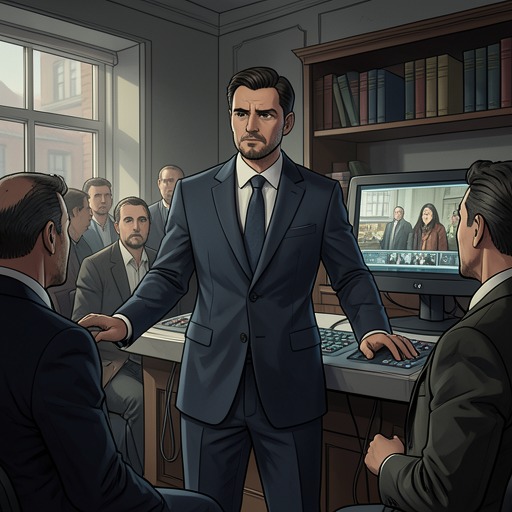
Netherton’s first approach to Flynne makes the company’s cover visible. She answers a call from a man who introduces himself through the Milagros Coldiron identity, seated behind an old-fashioned monitor in a room with pale wood and a marble-look desk veined with imitation gold. Flynne has to correct the formality of being addressed as Miss Fisher, telling him to call her Flynne. Their exchange is personal in its surface details, but the employer he represents is a constructed corporate persona rather than a straightforward explanation of who he is or why he has reached her.
The larger working arrangement becomes apparent through the gap between what the company calls its work and what its agents actually encounter. When Flynne asks what a proposed piece of hardware does, the response is that the speaker cannot explain it, though she will be paid well to arrange it. Elsewhere, Flynne objects that she had been told the interface was a game controller; it is clarified as a hands-free telepresent interface. Her first experience of the remote body is more startling still: she finds herself perceiving through an anthropomorphic drone, a telepresence avatar, while Ash explains that Macon’s device is imperfect but functional. These exchanges do not make Milagros Coldiron the maker of the technology. They do show how security work under its banner becomes an interface between local participants and unfamiliar equipment whose operation they do not fully control.
The cross-world arrangement depends on mediated, partial knowledge. Lev explains that his own involvement began through a relative in Los Angeles, and that access to the system is by invitation: someone must tell a newcomer about it and explain how it works. The corporate structure helps the work pass through ordinary-looking channels, but it does not dissolve the information asymmetry. A local worker can be paid and assigned tasks without knowing the server’s location, what it is, or whose it may be; even people closer to the operation speak in terms of rumor and incomplete understanding.
Corporate cover and the politics of information
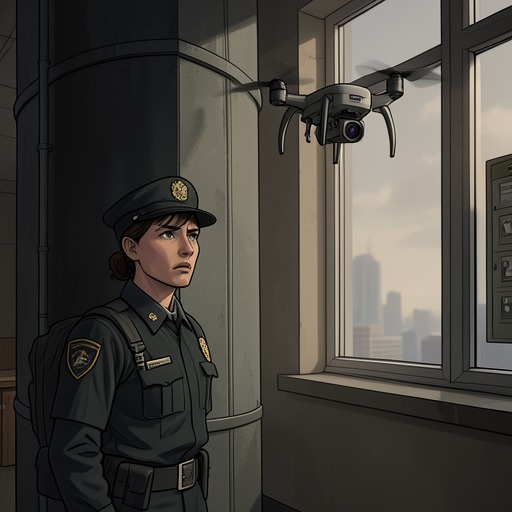
Milagros Coldiron’s fictional corporate presence sits within a book in which observation, secrecy, and the handling of records determine who can act and who can be held accountable. Flynne’s security shifts involve watching a building from a copter while fast-moving, dragonfly-like paparazzi devices return to hover and dart away. Their presence makes the working environment one of competing observation: Flynne is on watch, while other machines watch the building for reasons she cannot establish. The company’s security label describes her position, but does not guarantee that she knows the purposes or limits of the broader surveillance around her.
That tension sharpens when Ainsley Lowbeer says she is investigating the disappearance of Aelita West and asks Lev and the others to explain their relationships to the missing woman and to one another. Lev objects that there were to be no recording devices; Lowbeer agrees that none are present but says that she possesses court-certified recall admissible as evidence. The episode distinguishes the absence of a recording device from the absence of an official record. Milagros Coldiron’s shell paperwork offers one kind of controlled legibility, while Lowbeer’s recall represents another: a means of making conversations evidentiary without conventional recording.
Aelita’s gathering had likewise been held under a temporary, quasi-diplomatic protocol: nothing was to be recorded by Aelita’s systems, Edenmere Mansions, or Flynne’s drone, and news organizations and freelancers were kept away. Flynne’s job had, in part, been to enforce that separation. Against this background, Milagros Coldiron belongs to a wider structure in which organizations mediate access, surveillance, and knowledge. The company gives its personnel an operational identity, but secrecy and incomplete understanding persist around the work.
Reach and limits of the organization
Milagros Coldiron’s name recurs in contexts where the company’s local security face cannot account for the scale of the activity. When Wilf calls Flynne after she has mentioned the drones, he opens a channel between the Stub and the future-side network. Later, Flynne is told that someone has been sent from Washington, that Reece took her, and that Lowbeer took over from Ash; the same account describes Griff’s possible use of government resources to find her and Clovis’s role in looking after Conner while he is under the crown. These details reveal a wider web of personnel and powers around Flynne, rather than a single security company directing events on its own.
Nor does Milagros Coldiron’s connection to Coldiron make every institution bearing the name interchangeable. The narrative places its shell identity alongside later developments involving Coldiron, including activity at the former store site where a tunnel-like passage is built through vacant shops to Sushi Barn. Burton and Conner are there under white crowns, while Madison has constructed the passage from walls of shingle bags. The scene places security and remote-control technology amid physical improvisation and makes clear that the company’s name belongs to an evolving network of operations, not merely to the first job Flynne understood as a game.
As an organization, Milagros Coldiron SA is defined less by a conventional workforce or a transparent corporate mission than by the difference between its visible credentials and its actual function. Its registrations, accounts, Colombian address, security label, and promise of wages make it credible enough to employ people in the Stub. Its shell structure lets Lev and Netherton use that credibility to reach Flynne, while the work itself involves remote presence, restricted information, and connections to actors she cannot initially identify. The company’s corporate form enables cooperation across the divide, but also preserves the distance between those who perform the work and those who understand the larger system.