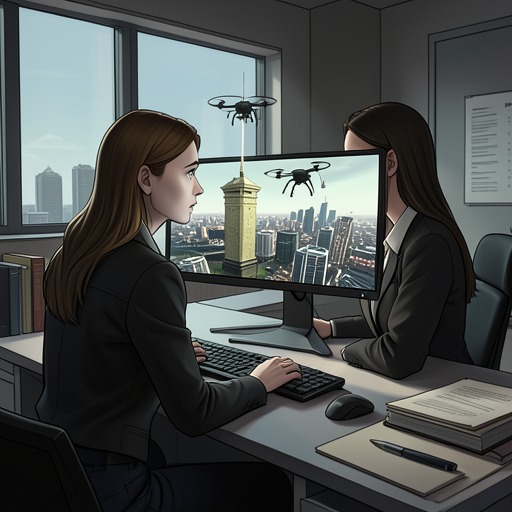
Neural cutout
The PeripheralThe Neural cutout is a head-mounted interface that prevents its wearer’s own body from responding while allowing full-body control of a remote peripheral. Built quickly by Macon and Edward for Flynne Fisher, it is at once a practical device, a misleadingly familiar piece of hardware, and the material threshold through which she first enters a body elsewhere. Its inaugural use makes the technology’s central contradiction physical: Flynne lies still in a trailer, yet wakes to unfamiliar hands, a different height, and a room that is not hers.
Design and Construction
The device arrives as an improvised prototype rather than a finished product. Macon tells Flynne that her friends have sent files for a piece of hardware they want her to arrange, while admitting he cannot explain its operation. By the time he drives her to try it, the device has been assembled with help from Fabbit, a printer operation owned by Hefty. Macon’s cousin, a part-time floor manager, makes the unusual printing possible after Burton makes him an offer. The local printer’s usable polymer resembles sugar frosting and is normally reserved for Christmas; in this application it bonds with the skin-conduction material.
That confectionary look gives the headpiece its joke-name, Snow White’s crown, but its appearance conceals an advanced interface. The first design would have required shaving a two-inch band around the back of Flynne’s head. Macon instead uses Japanese material that needs contact only across her forehead, with a dab of saline to help it work. The headpiece is nevertheless heavy at the front, a consequence of making a functional version in short order on the available printers. Macon guesses that the real device would weigh about as much as disposable sunglasses, but this prototype is what they can build quickly.
What It Does
Macon initially calls the device a game controller, a description that leaves out its defining function. He corrects himself: it is a telepresent interface that works without the user’s hands. When Flynne asks what happens if it succeeds, he explains that she will control another unit with her whole body and full range of motion, while her own body remains still. The equipment is not merely a display or a hand-operated controller: it lets her inhabit the remote unit’s movements without physically reproducing them in the trailer.
The other unit is an anthropomorphic drone, which Ash identifies as a telepresence avatar. Flynne does not need to consciously operate it, and its motion is being recalibrated as she arrives. The characters call such remote bodies peripherals. Later, Flynne explains to Burton that the Neural cutout keeps her body from responding when she acts through a peripheral, distinguishing the head-mounted control interface from the remote body it enables her to use.
First Connection
The first setup makes clear that the system depends on more than a crown. In Burton’s trailer, Edward connects equipment to Burton’s display; a cable runs to a white controller centered on the army blanket covering Burton’s bed. Macon emphasizes that the cables constitute about a third of the device, so the apparently simple headpiece is only one element in a larger, wired arrangement. He has Flynne lie on the bunk, wear the controller, and close her eyes. A yellow Hefty Mart bucket is kept nearby because nausea is possible; Macon describes the cause as an inner-ear effect, though he suspects that explanation is shorthand.
Macon applies saline paste across Flynne’s forehead and settles the headpiece over her hair. He checks whether it pinches, explains that they have installed basic vital-sign monitors, and squeezes her wrist to reassure her that he and Edward are there if anything seems wrong. Flynne chooses when to begin. Following Macon’s instructions, she closes her eyes and counts down from fifteen, expecting a wobble around ten. Instead, at the count, she experiences a pop and a color like Burton’s haptics scar, which she can taste inside her teeth. For several beats she believes the attempt has failed.
At zero, the scene turns over. The trailer’s ceiling gives way to a higher, polished one; the room seems backward and other, the crown’s weight disappears, and Flynne’s stomach feels upside down. She sees hands that are not hers and a stranger’s face reflected in the bottom of a steel canister. The body she has reached is taller than her own, and even her voice sounds different. Her first reaction is not an explanation but alarm: something is wrong, and the colors are wrong. Ash then identifies the experience as access through the anthropomorphic drone and tells her not to try to consciously control it while the system is recalibrated. Macon’s imperfect device, she confirms, works.
Use and Significance
The cutout’s name describes a boundary as well as a function: it cuts off the wearer’s ordinary bodily response while opening access to another body’s range of movement. That separation is not initially an abstraction for Flynne. She must reconcile the stillness of the body she has left with the sensory evidence of a different one, including its hands, face, height, voice, and altered sense of space. The sequence presents remote embodiment as a practical interface problem and a startling change in bodily perspective at the same time.
The device also crosses a gap in knowledge between the people who build it and the people who need it. Macon and Edward can print and wire the prototype, but they cannot first test it on a suitable unit: Flynne’s friends have asked them not to try the system themselves. Macon says there are no patents he can find for much of the technology and that any such patents would be valuable. His shop-floor improvisation therefore sits alongside an unexplained, high-value design whose operation becomes legible only when Flynne connects to the remote body.
Its first description as a game controller provides a small but consequential misdirection. Burton later sees Flynne wearing what looks to him like a sugarloaf cake on her head and asks what is happening; she explains that the Neural cutout is what prevents her body from reacting while she operates a peripheral. By the time she appears at Sushi Barn, the conspicuous white crowns are no longer hers alone: Burton and Conner are each under one. The improvised headpiece has become a visible sign that remote embodiment is being used by more than one person, even as its operation still depends on the hidden cables, the remote unit, and the user’s physical separation from it.