Newgate prison
The PeripheralNewgate prison is a rebuilt London jail that makes a history of confinement physically present: its notorious gate survives in Wilf Netherton’s childhood memory, while its cell-like interior becomes a place where Flynne Fisher is restrained and where stone and iron give way to concealed weapons. Its significance lies in this double movement. The prison presents authority as ancient, massive, and almost immovable, yet its very materials prove vulnerable to transformation.
A jail with a long history
At the City’s westernmost gate, Wilf’s mother explained, a jail had stood for more than a thousand years. The Newgate he sees is its “ultimate and final expression,” though even that finality has a complicated history: the prison was torn down in 1902, at the beginning of the strangely optimistic age before the Jackpot, and rebuilt by the assemblers a few years before Wilf’s birth. The klept considered its return wise and necessary. The account makes the building more than a surviving relic. It is a deliberate restoration of an institution associated with punishment, set against an earlier era that had imagined itself moving forward.
The rebuilt prison also joins distinct layers of memory and power. Its origins reach back over a millennium, its nineteenth-century predecessor vanished in 1902, and its later reconstruction was undertaken by assemblers under the klept’s authority. The structure’s return therefore complicates any simple story of historical progress: the old jail can be demolished, then recreated when those in power decide that it should exist again.
The gate and Wilf’s memory
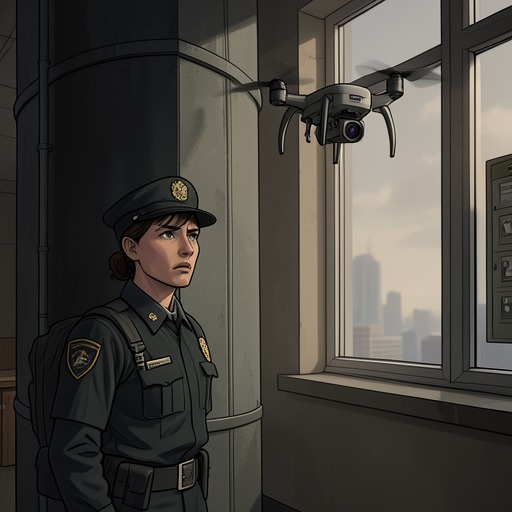
As the car approaches, Wilf recognizes the “glowering bulk” of Newgate. He had walked that far with his mother only once. The pitted granite flanks had repelled her, and the memory remains attached to the prison’s physical severity rather than to any account of its daily operation. The old wicket gate is especially vivid: iron-bound, made of nail-studded oak, and the object he had stared up at as a child.
His mother had told him that the gate frightened Dickens. Wilf had misunderstood her phrasing, imagining Dickens being frightened out of someone rather than frightened by the gate. The childhood error does not erase the fear: the gate frightened Wilf then, and it frightens him now. Newgate thus enters the scene already charged by inherited stories and remembered bodily apprehension. The prison is not simply a destination in the city; before anyone enters, it has been made present as something seen, described, and feared across generations.
Flynne inside the prison
For Flynne, Newgate’s historical weight becomes immediate confinement. She passes through a gate that recalls an image of hell, then enters a cold interior of white-painted iron-barred doors with rust showing through, flagstone floors, dim lamps, and small windows that seem to lead nowhere. A narrow stone staircase forces the group to climb one at a time. The architecture narrows movement and limits sight, turning the approach into a sequence of thresholds rather than an open passage.
At the top, the space opens into a court under the cloudy sky and then into a tall, narrow atrium resembling a four-storey arrangement of cells beneath a glass roof. Thin strips of light flicker beneath the railings. Flynne’s robot girl has grown extra eyes on one side of its face to keep better track of her, while Daedra West and the balcony man remain silent. The watchfulness of the artificial attendants contrasts with Daedra’s bored expression; the building’s institutional atmosphere is threatening, but the people overseeing Flynne do not offer an explanation of what will happen.
The robot girls seat Flynne and Daedra on separate whitewashed stone chairs, about six feet apart. The seats look almost childishly simple, as if built from oversized wooden blocks, but their arms hold thick, rusted iron cuffs. Flynne is fastened by the wrists to the stone, and the cold seat presses through her dress. In a place whose visible design evokes old punishment, the cuffs are not merely decoration: they make the prison’s coercion concrete, physical, and difficult to mistake.
Materials turned against their purpose
The restraint does not hold. Warmth reaches Flynne’s wrists, and the iron cuffs crumble as though pressed from dry, rust-brown talc. The granite beneath her right hand begins to disintegrate as well, rising between her fingers and drifting like smoke. From the chair arm emerges a candy-cane gun, its parrot-head handle pressing into her palm. The transformation is sharply opposed to the prison’s appearance: the iron and granite seem to promise permanence, but dissolve at the moment they are needed to confine her.
The concealed weapon connects Newgate’s scene to danger beyond its walls. The balcony man orders the man with the hat to finish what is happening, referring to the Homes drones striking Coldiron. Flynne returns to Janice’s couch, where she has taken the wakey Burton gave her, yet she is standing with the gun raised; its white trigger bump does not visibly move, and it makes no sound. The transition between the prison scene and the couch leaves the weapon’s use uncertain in that moment, but it preserves the connection between her restraint in Newgate and the urgent threat to her people in the stub.
Newgate’s role is therefore not confined to its history as a jail or its function as a place of detention. Its architecture stages the apparent authority of iron, stone, gates, and cells; the cuffs’ sudden collapse reveals that this authority can be breached. Later, the prison’s arsenal of hidden devices makes the same point from the opposite direction: the seemingly archaic setting can conceal highly consequential modern force.
A place where authority changes hands
During the later confrontation, the exoskeleton raises its arms. Its black robotic gloves close into fists; a hatch opens in the right wrist and releases another candy-cane gun, while a larger hatch in the left produces Lowbeer’s gilt, fluted ivory tipstaff. The hidden weapons are disclosed through the body of the exoskeleton, making it both an instrument of force and a container for authority’s signs.
The tall man blinks away to bone, leaving his clothes to fall and his tall hat to roll across the floor. After Sir Henry’s death, Lowbeer explains that her competitor has lost the kind of advantage Lev and she have been able to afford Flynne’s side. She had acted immediately when Sir Henry arrived, assuming he would prove guilty; the resulting shift of influence allows Homeland Security to withdraw and rescind its orders. Newgate thus holds a decisive reversal: within the prison’s oppressive setting, a killing changes the balance of power outside it, and the threat of a Homeland Security operation is lifted. The old jail’s closed world becomes a hinge between bodily danger and political consequence.