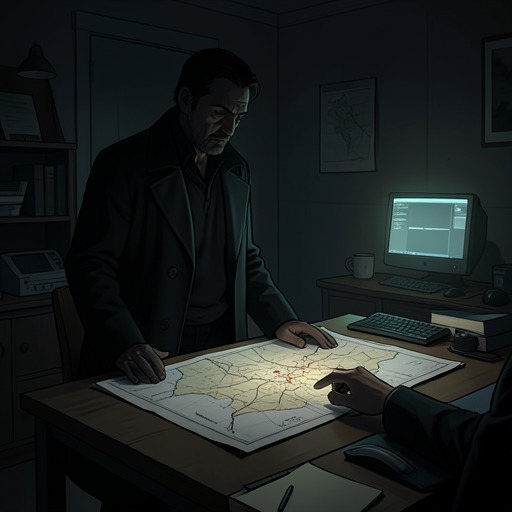
Peripherals
The PeripheralPeripherals are remotely operated, humanlike bodies that let a user act and perceive at a distance, making them more than game controllers or ordinary machines. In the novel they are interfaces between people, places, and competing systems of knowledge: an unfamiliar body can be a disorienting personal experience, a practical means of communication, or a manufactured identity with lethal political consequences.
Definition and operation
The technology first enters the conversation under misleadingly ordinary labels. Flynne objects when a device she had been told was a game controller is described instead as a telepresent interface requiring no hands. The difference matters: the controller is not merely a tool for manipulating an image on a screen, but access to a body operating elsewhere. A separate request for files about “A piece of hardware” similarly shows how the device can be treated as a transferable object before its purpose is understood; the person arranging it is promised generous payment without being told what it does.
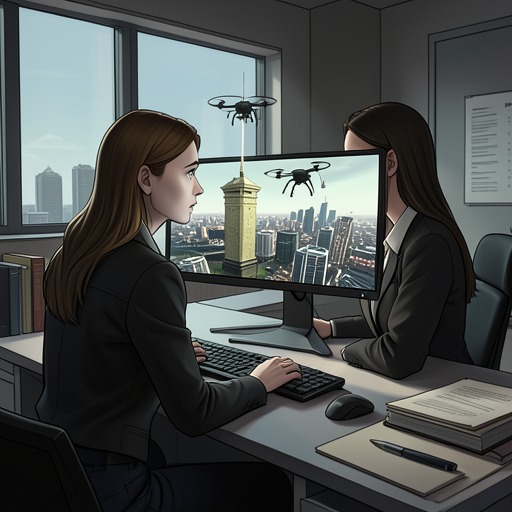
Macon’s device provides Flynne’s route into that embodied connection. Ash explains that Flynne is receiving input from an anthropomorphic drone, a telepresence avatar, and warns her not to try to control it consciously while it is being recalibrated. The interface is imperfect, but functional. The scene makes the distinction between receiving a body’s sensory input and deliberately directing its movements explicit: Flynne first encounters the remote body through bodily confusion, before she has a settled explanation for what is happening.
Peripherals also vary in form and capability. Ash distinguishes a resistance-training exoskeleton, which has a full range of movement but is not itself a peripheral, from a homunculus, a miniature peripheral that can control it. The latter is offered as a possible alternative for Conner while a more suitable body is sought. The difference between an exoskeleton and a peripheral is therefore not simply whether a machine moves: the relevant feature is the remote, embodied control relationship.
Embodiment and adaptation
Flynne’s first-person bodily experience of remote embodiment is abrupt and unsettling. She becomes aware of hands that are not hers, sees a face unlike her own in the reflective bottom of a steel canister, and hears herself speak in another voice. The apparent bed is instead a padded ledge, and the remote body is taller than her own. Ash’s explanation names the technology only after those physical discrepancies have made the ordinary boundary between user and body impossible to take for granted.
The body’s unfamiliarity continues even after the immediate shock. When Flynne’s peripheral encounters Burton, Ash introduces it as Flynne’s presence “in person, or more relatively so.” That qualification captures the device’s central ambiguity: Flynne is present enough to meet others and speak with them, yet the body they see is not her flesh-and-blood body. The scene treats presence as something that can be made practical without making it identical to physical co-location.
Conner’s possible use of a homunculus-controlled exoskeleton reveals a different problem of fit. Flynne’s peripheral looks down at the body and reacts to its breasts; Ash says another arrangement can be made, while noting that the exoskeleton is not a peripheral. The exchange establishes that a body’s movement range does not by itself make it an appropriate embodiment. Flynne’s peripheral checks the foot it used to kick Ossian, rotates it at the ankle, and reports that it is fine, offering a small but concrete instance of the remote body’s physical action and the user’s attention to its condition.
The contrast is sharp when Flynne sees Conner propped up on a bed with Burton’s pillow and one of Macon’s blue duffels behind him, wearing a Polartec body sock. So much of his body is missing; she remembers him running in the other peripheral. The scene places remote embodiment beside the lived consequences of bodily loss without treating the two as interchangeable. A peripheral can provide a body through which a person acts, but its availability does not erase the difference between that manufactured body and Conner’s injured one.
Identity, substitution, and strategic use
A peripheral can also carry an identity designed to stand in for someone else. Ash’s account of Hamed al-Habib explains that a bespoke peripheral was made to possess a complete genome, a full complement of organs, and fingerprints: the formal forensic traces needed to register a legal death. It was intended to die in Hamed’s place, allowing the island’s history to attach to an imaginary figure. His earlier peripheral had most likely been weighted and dropped into the water column to be consumed by assemblers. The bodily replica thus serves not only as a means of remote action but as a mechanism for producing convincing evidence about who has died.
This substitution operates on the level of political memory as well as forensic procedure. Hamed had been present at the beginning of the island’s settlement, though Ash distinguishes that presence from the public identity memorialized there. After the American attack, the survivors are seen memorializing the person Hamed had pretended to be, while his true identity remains concealed from his immediate cohort. The peripheral’s death can consequently become part of a community’s material history even when the person it supposedly represents has not died.
Peripherals also matter as strategic assets in the Fisher family’s crisis. Ash asks Burton whether Flynne’s peripheral was damaged when it struck Ossian, referring to it as being of immediate strategic importance. Its significance is therefore not exhausted by the personal convenience of remote presence: its continued availability matters to the larger operation in which the family is involved. Later, Burton judges a proposed action on a “war crimes dial” as about a twelve on a scale that stops at ten. The juxtaposition of remote bodies, political violence, and extreme judgment underscores how bodily technology enters a world where the means of acting at a distance can carry consequences beyond the user’s immediate encounter.
Appearance, concealment, and interpretation
A peripheral’s visible form can conceal the person behind it. In London, Wilf guides an apparently automated peripheral to a bench facing the wooded route that follows what had been Oxford Street toward Hyde Park. The bench vibrates to shed rain before she sits. Wilf initially waits for the figure to abandon its elaborate performance of being an AI-driven automaton; even then, he recognizes, the person behind it would not simply be Flynne, but somehow the woman whose face the body carries. Its bespoke appearance has a protected identity: Hermès maintains a privacy policy, and Lowbeer chooses not to bypass it because doing so might expose their intentions.
That encounter differs from Flynne’s own peripheral, but shares the same problem of reading a body as evidence of who is present. To observers, the outward figure may pass as an independent machine, a humanlike avatar, or the likeness of a particular person. None of those appearances alone settles who is acting through it. The technology creates a space between visible body and remote user, and characters must decide when to accept that surface, question it, or use it strategically.
Narrative significance
Peripherals work as boundary objects across the novel’s different worlds. A local user may encounter something that resembles a game controller; Ash can describe an anthropomorphic drone and its recalibration; an operator can understand it as a body to inhabit; and political actors can treat a bespoke model as evidence of a death. The technology makes cooperation between people with different technical and practical knowledge possible, but it also exposes the gaps between their descriptions. Calling it a controller, avatar, drone, or body brings different expectations about agency and responsibility into view.
The recurring tension is between embodiment and substitution. A peripheral gives a distant person a face, voice, and capacity for movement, yet cannot make remote presence identical to ordinary physical presence. It can also make a body serve as a decoy, a forensic record, or an apparently autonomous persona. The technology therefore changes not just where a person can act, but what a body can be taken to prove—and who may be held accountable for what it does.