Polt
The PeripheralPolt names a person from an alternate reality who can be engaged across worlds, but the novel refuses to make that connection a neutral technical convenience. A polt arrives with a life, a military past, and a place in the causal history of his own world; contact with him also risks changing that world’s long outcomes. Through the term, the novel makes a gift of personal security into an ethical and political question about access, agency, and intervention.
Meaning and Use
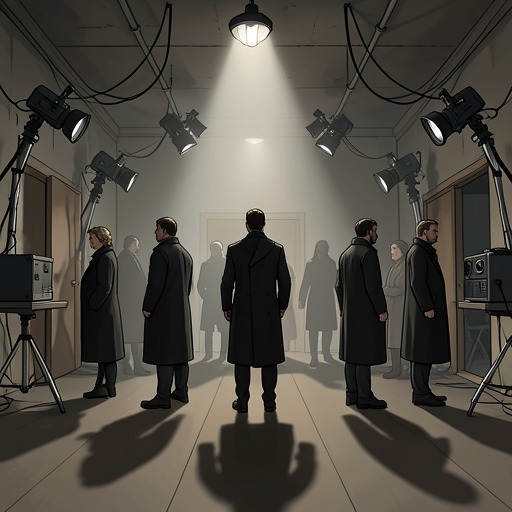
Lev explains the word through the image of “Ghosts that move things, I suppose.” The description suggests why a polt can seem uncanny to those encountering one from outside his reality: he is present and able to act, yet his origin lies in a world other than the one in which his services are being used. The image is not a claim that polts are spirits; it is a provisional explanation for a person whose movement between realities unsettles ordinary distinctions between presence and absence.
The practical meaning becomes clearer when Wilf explains the gift he arranged for Daedra: the services of an inhabitant of Lev’s stub. That inhabitant is to work as a security guard. He is ex-military and also a drone operator, so the arrangement draws on specific skills rather than treating the polt as a generic remote device. A person is transferred into a role of protection, but the transfer does not erase the fact that he belongs to a different world.
The Gift to Daedra
Wilf arranged the gift through Lev on his own behalf. He says he thought the unusualness of the arrangement might amuse Daedra, and the explanation links the choice to Lev’s interest in a particular military unit in his stub: the unit to which the man had belonged. Its equipment and practices represent transitional technology from slightly before the Jackpot, which gives the gift an additional appeal as a piece of military history made operational in the present.
The conversation identifies haptics as the relevant technology. The detail helps distinguish the polt’s service from ordinary security work: his military background and drone-operating experience come from a technologically specific context, and his presence carries something of that context with him. Wilf’s gift is therefore both practical and eccentric, shaped by Lev’s technical interest as well as by his own idea of what Daedra might find diverting.
Contact and Causal Risk
The arrangement acquires wider significance when Ash reports that somebody else is accessing Lev and Ash’s stub, apparently in connection with Wilf’s polt. The report connects an individual polt to a breach or additional use of the world from which he comes. The polt is not only the recipient of an unusual employment arrangement; his connection has become relevant to other people’s access to the stub.
Ash states the governing danger directly: each time they interact with the stub, they ultimately change all of it, including its long-term outcomes. This makes the stub more than a setting from which useful people or technologies can be drawn. It is a consequential world whose future is vulnerable to outside contact. The polt’s ordinary work as a guard thus sits inside a much larger problem: even an intervention that appears limited can participate in changing the course of an entire reality.
Burton Fisher and the Stakes
Ash’s account of the new access includes an image of Burton Fisher, whom Lev identifies as Wilf’s polt. The distinction between the possessive description and the human identity matters: the language of access and ownership can make a person sound like an asset, but the narrative specifies that Burton is the inhabitant whose life and world are implicated. The group’s visitors have hired someone to find him, apparently with the intention of killing him, making the polt connection a direct source of danger rather than a merely abstract ethical concern.
The report also places Burton in the history of Aelita’s reception: Lev recalls that Burton was on duty during it. This links the polt’s earlier security work to events now drawing scrutiny, while the possible attempt on his life raises the stakes of identifying and reaching him. The novel gives no basis here for treating a polt as a mere projection or instrument. Burton is an individual whose duties, past, and exposure to violence matter, and whose existence ties events in one world to those in another.
Significance
Polt condenses the novel’s tension between technological reach and responsibility. A person from another reality can be recruited for a concrete task, and his technical abilities can be valued across worlds; yet the same connection opens a channel through which other people may gain access and produce effects that cannot be confined to the immediate transaction. The terminology makes this tension visible: a polt may be discussed as a service or as someone’s polt, while the evidence insists on the person behind that shorthand.
The concept also complicates the idea of intervention as something small and manageable. A gift of guard services, selected partly for its novelty and connection to pre-Jackpot military technology, belongs to a system in which contact changes the stub’s long-term outcomes. The novel therefore holds two scales together: the intimate scale of one person’s employment and possible danger, and the historical scale of a whole alternate world being altered by outsiders. A polt is the living link between them.