Stub
The PeripheralThe Stub is a causally distinct continuum that branches into existence when a future connection reaches a corresponding past. It is not the communicators’ own history sent backward or altered; it is a new world whose inhabitants continue to live forward from the moment of contact. That distinction makes the Stub both an arena for consequential intervention and a rebuke to the fantasy that the past can simply be rewritten: its trajectory can be influenced, but its future cannot be known or guaranteed.
Definition and Causal Structure
The connection creates a fork in causality. As Lev Zubov explains, the new branch is causally unique, and its inhabitants are no longer headed toward the originating continuum’s history. The name “stub” therefore does not mean that the branch is destined to end or is unreal. Lev accepts that it continues to grow; the word is a label chosen for the new branch, not a description of its ultimate fate.
The two continua proceed at a fixed one-to-one ratio of duration, beginning with the first instant of contact. A given interval in the Stub corresponds to the same interval in the originating world. The connection is consequently not time travel in the sense of allowing its users to jump ahead and inspect what happens. Its operators cannot know the Stub’s future any more than they can know their own, and they cannot assume that it will reproduce the history they remember.
The divergence may begin imperceptibly. Wilf Netherton explains that his life and that of the corresponding woman in the Stub were identical until Lev’s first communication arrived. After that message, their circumstances began to separate; by the time she contacted him, she already knew parts of her life that were unfamiliar to him. The two people are counterparts, not successive versions of one person: neither simply becomes the other, because the branch has made their lives distinct.
Contact, Intervention, and Knowledge
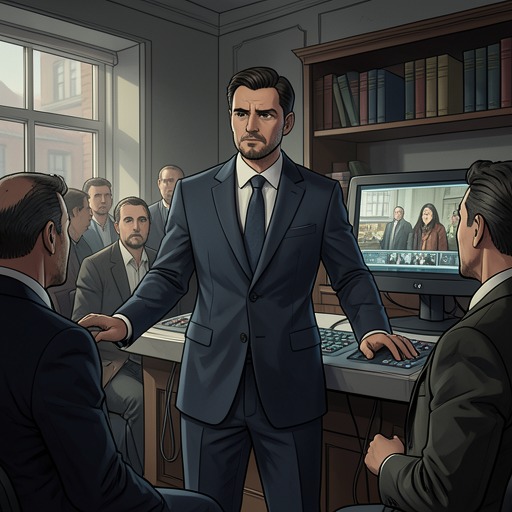
Future actors use the Stub for more than communication. Ash says that each interaction ultimately changes the long outcomes of the branch. The consequences extend beyond the immediate exchange: the act of making contact alters the conditions under which later events unfold. A still image of Burton Fisher accompanies her explanation, and Lev identifies him as the polt, or counterpart, associated with Netherton’s side of the connection.
The communicators’ knowledge is extensive but partial. Ainsley Lowbeer says she has an overview of the Stub’s history and information unavailable to people in either continuum, including concealed facts about political and nonstate actors. She passes selected information to Ash and Ossian Murphy on a need-to-know basis, strengthening their position in the branch without making its future fully legible. In the Stub itself, Lowbeer has an apparently unpaid contact able to enter places and learn information, while Lev admits that he does not know who else has gained access. The branch is not a sealed experiment controlled by one party.
The terminology itself exposes the imbalance between those who connect and those whose world is connected to. Lowbeer challenges the word “stub” because it makes a growing branch sound short-lived and disposable. Ash calls the practice a form of imperialism: people in the future are “third-worlding” alternate continua, and the diminutive label makes that easier. The language is therefore part of the technology’s politics. It can turn a populated world into an object of management before its inhabitants have any say in how outsiders describe or use it.
Political Stakes and Uncertain Outcomes
The Stub becomes the site of a contest between Coldiron and Matryoshka, two forces seeking control of its world through rapid financial operations. Lowbeer describes Coldiron as relying on Lev’s brilliant but makeshift apparatus, while Matryoshka appears to have access to a more powerful state financial system and exists, in her account, to kill Flynne Fisher. The struggle is not merely a competition for profit: Lowbeer believes that the balance of power in the Stub could affect whether a later political catastrophe can be prevented.
That possibility is tied to the assassination of Felicia Gonzales. In Lowbeer’s view, Gonzales’s assassination was a pivotal turn toward the deeper Jackpot. Because the Stub has not yet reached that event, the actors may be able to prevent it. But intervention is not the same as restoring a known history. The two continuums have already diverged, and the divergence can be steered only broadly; no one can promise what the resulting branch will become. Lowbeer’s stated hope is to ameliorate the Jackpot, not to claim that its consequences can be erased.
The limits become especially clear in the question of whether Flynne exists in the originating continuum. Lowbeer can find a surviving birth record but no death record. Records from the deeper Jackpot are incomplete or nonexistent, particularly in the United States, where a brief military government erased large quantities of data. If Flynne were alive in the present, Lowbeer reasons, she would likely be wealthy or well connected and thus traceable. The surviving evidence cannot settle the question, illustrating how historical knowledge in this world is constrained not only by branching causality but also by damaged records.
The Stub’s Lasting Consequences
The branch’s influence persists beyond its initial creation. In the Stub, Coldiron grows into a major enterprise, but its expansion is deliberately paced. Ainsley warns that importing too much technology too quickly could destabilize the world, so controlling the rate of change becomes part of the project. Industrial espionage is a major concern because Coldiron’s advantage lies in knowing how to do things that others in the Stub do not. Macon and Edward’s specialized printing work is kept in a barn designed to resemble an old structure, helping protect information Coldiron does not want released prematurely.
This later development gives the Stub a double meaning. It begins as a branch opened by outsiders, exposed to interventions that alter its long outcomes; it also becomes a world with its own institutions, risks, and uncertain future. Even those who seek to direct its development cannot see where it is going. The decisive fact is not that the Stub copies the future’s past, but that contact creates a separate history whose people and events continue beyond the knowledge—and beyond the control—of the people who opened the connection.