The Jackpot
The PeripheralThe Jackpot is a decades-long, multicausal collapse that kills most of humanity and remakes the world of Wilf Netherton and Ainsley Lowbeer. It is not one cataclysm followed by a clean break, but an accumulating climate of crises: environmental damage, shortages, crop failures, disease, and social breakdown overlap without a single beginning or decisive end. Its consequences include a radically reduced population, altered political and economic power, and the technological landscape from which the novel’s future characters look back toward an earlier, still-diverging world.
A catastrophe without a single event
Wilf explains the Jackpot to Flynne Fisher as something unlike the familiar apocalypse story: there is no lone disaster after which survivors simply run around with guns or face a new monster. The catastrophe is multicausal and drawn out, more like a worsening climate than a discrete event. Its very structure frustrates the expectation that history can be divided neatly into before and after. The characters can name the Jackpot, but that name gathers together a long succession of causes and consequences rather than identifying one moment of origin.
The causes are anthropogenic, though not necessarily intended. Human activity drives climate change, and the accumulating carbon burden contributes to worsening weather and the crises that follow. Earlier generations fail to understand the consequences in time, and even once the danger becomes known, they do not manage to reverse it. By the time the damage is undeniable, the opportunity to prevent it has passed. In this account, responsibility is broadly human and historical, but the resulting harm is not a deliberate plan: people create conditions they do not know how to control.
The cascade and its human toll
The breakdown comes unevenly, through familiar kinds of crisis rather than one universal blow. Drought and water shortages, crop failures, the loss of honeybees and other keystone species, the disappearance of alpha predators, and the declining effectiveness of antibiotics accumulate alongside diseases that never become one defining pandemic but are individually large enough to mark history. The disaster is therefore both environmental and social: it changes the living systems people depend on while exposing the consequences of how many people there are and how they have transformed their surroundings.
The scale is devastating. Wilf tells Flynne that the Jackpot kills 80 percent of everyone alive over roughly forty years. The figure makes the drawn-out chronology concrete: immense mortality occurs not in one instant but across generations, amid repeated emergencies. In Flynne’s own time, the danger is not merely a future event she can watch from a safe distance. She is told that her world is already entering a similarly systemic crisis, with most people expected to die over decades if its course is not altered.
Technology, survival, and unequal outcomes
Scientific progress arrives during the worsening crisis, but not as a single rescue. Cleaner and cheaper energy, more effective ways to remove carbon from the atmosphere, new medicines, nanotechnology, and food-printing methods emerge incrementally. These advances illuminate a society that is otherwise deteriorating; they do not halt the suffering or restore the previous world. The contrast makes technological progress real but morally and practically incomplete: new capabilities appear amid continuing violence and losses that cannot be repaired by innovation alone.
The aftermath is sharply unequal. The richest can become richer as the population falls and ownership concentrates in fewer hands; continuous crisis also creates opportunities for those with resources. In Wilf’s world, towers built after the die-off serve wealthy residents, but they also absorb carbon still being produced. Survivors interpret that reduction in emissions as having dodged a bullet. The image captures a compromised recovery: the system becomes more sustainable in one measurable respect only after catastrophic loss, and its protective infrastructure serves both a shared environmental function and an elite population.
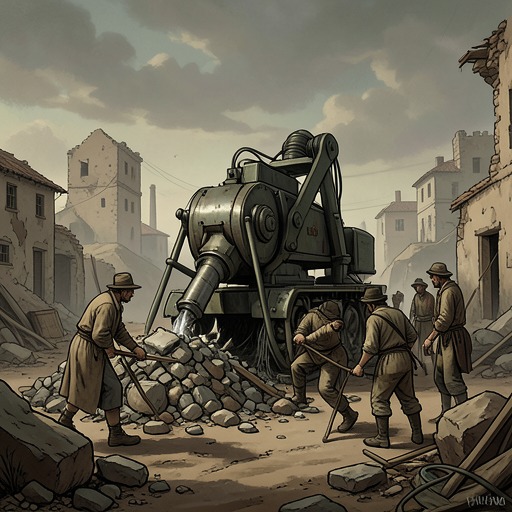
Nanobot assemblers arrive later, after an interval in which the crises have run their course. They help excavate and clean London’s buried rivers, maintain the city, and construct its towers and other buildings. Their capabilities explain much of the automated environment Flynne encounters in the future. Yet the assemblers belong to the aftermath, not to an uncomplicated solution: they help manage and rebuild a world whose population and social order have already been transformed by the Jackpot.
Historical memory and the branching continuum
For Flynne, learning about the Jackpot links the future’s ruins and technologies to the familiar world she inhabits. Wilf describes the long disaster while she looks across the moonlit lawn at home, where Leon has cut the grass with a push mower held together by baling wire. That everyday object gives the explanation a material contrast: her present still contains ordinary, improvised life, while the future’s history shows how fragile its conditions are. The account turns the remote future into a possible consequence of processes already underway, rather than an unrelated world.
The novel’s time structure makes that history politically consequential. When Lev Zubov first connects with Flynne’s continuum, the connection creates a fork: the events that follow belong to a branch, and do not alter the actual past from which the future characters came. The original Flynne would, if still alive, be much older by Wilf’s time; records from the deeper Jackpot are incomplete or nonexistent, especially in the United States, so her ultimate fate cannot be established. The connection therefore does not offer a way to rewrite the history that produced Wilf’s world. It opens a separate history whose future remains uncertain.
That uncertainty matters because the assassination of President Felicia Gonzales is understood in Lowbeer’s world as a tipping point into a deeper Jackpot. Lowbeer and Wilf hope that preventing it might help avert their political system in the branching continuum, but they can only steer events broadly and cannot guarantee the result. The Jackpot is thus both a history already suffered in one world and a threatened horizon in another. Its importance lies not in a promise that intervention will save the second continuum, but in the possibility of amelioration—and in the limit placed on anyone’s power to control what follows.
Legacy and moral stakes
Ainsley Lowbeer describes the world she inhabits as the result of choices made while civilization was dying. She does not treat that survival as clean vindication: the actions taken were, tactically and strategically, the best available under the circumstances, yet the present remains the consequence of a compromised response to collapse. The Jackpot’s history consequently resists a simple division between innocent survivors and exceptional villains. Lowbeer warns Flynne against imagining that people who wield power are fundamentally other; ordinary human baseness, given room to grow, can produce much larger harms.
That warning continues into the post-Jackpot economy. Coldiron’s effort to introduce advanced technology cautiously reflects knowledge that rapid technological change could destabilize the society it might also benefit. After Matryoshka’s financial apparatus collapses, Coldiron divests to move the economy toward something more normal, though it retains enormous resources. Flynne worries that the organization may become a new version of the klept, and Lowbeer insists that people must remain alert to their own capacity for wrongdoing. The Jackpot is therefore not merely a record of environmental failure: it shapes the institutions, technologies, and ethical caution of the surviving world, while leaving open whether those survivors can avoid reproducing the concentrations of power that flourished during the crisis.