The Newgate confrontation
The PeripheralThe Newgate confrontation is a turning point in which a threatened execution becomes a counterattack, and the violence in the room alters the crisis beyond it: Sir Henry’s death shifts influence, enabling Homeland Security to withdraw its orders against Coldiron. Flynne and Burton do not merely escape their immediate danger; their actions help change the political balance on which their survival depends.
Captivity and the threat to Flynne
Flynne is secured to a stone chair with thick iron cuffs, and the cold seat beneath her dress makes the setting’s physical restraint unmistakable. The man later called the balcony man tells her that someone wants to be present when she dies—not the remote body through which she acts, but Flynne in her own body. He says that her headquarters is surrounded by government security forces and is about to be destroyed in a drone attack. The threat makes the distinction between Flynne’s remote presence and her vulnerable body central to the confrontation: the danger is not confined to the room where she is being held.
The balcony man has apparently recovered from Conner’s attempt to kill him through Pavel, the peripheral also called the dancing master. That failed attack explains why the man is physically present and able to taunt Flynne, but it has not ended the danger. He orders an associate to tell their people to finish the attack on Coldiron. The execution threat and the impending assault are therefore parts of the same immediate crisis.
Flynne’s counterattack
As Hamed al-Habib speaks with Lowbeer’s bone-static, warmth comes to Flynne’s wrists and the iron cuffs crumble. The granite of the chair arm also breaks down beneath her hand, revealing a candy-cane gun. The reversal is practical as well as uncanny: what had held Flynne in place now yields the weapon with which she can answer the threat.
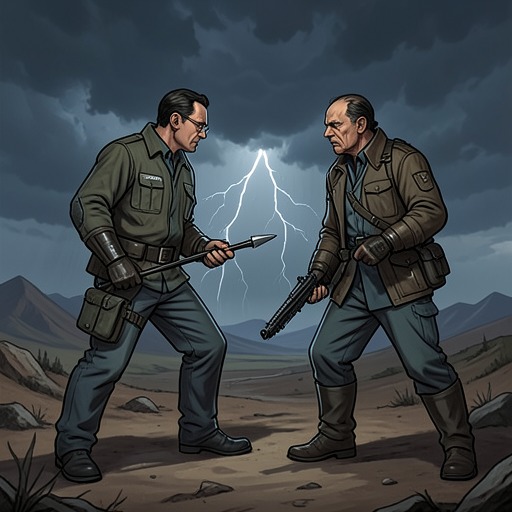
Flynne returns to Janice’s couch, where she is under the effects of the wakey Burton gave her, but she is standing and raising the gun. Its trigger does not seem to move, and the shot makes no sound. The balcony man dies, while the surviving evidence in the room indicates that the weapon has acted without an ordinary visible discharge. The moment reverses the balance of power, but does not resolve the larger danger: the robot girls move toward Flynne, and she still needs the attack on Coldiron stopped.
Burton’s arrival and Sir Henry’s death
A red cube bursts through the damaged wall and disables the robot girls. In the interval it creates, an exoskeleton enters carrying a homunculus beneath a bell jar. Its upbeat voice apologizes to Henry for damaging his car and killing his driver and security detail. The incongruity of the apology against the violence makes the arrival sound almost routine, even as it demonstrates that the balance of force has changed again.
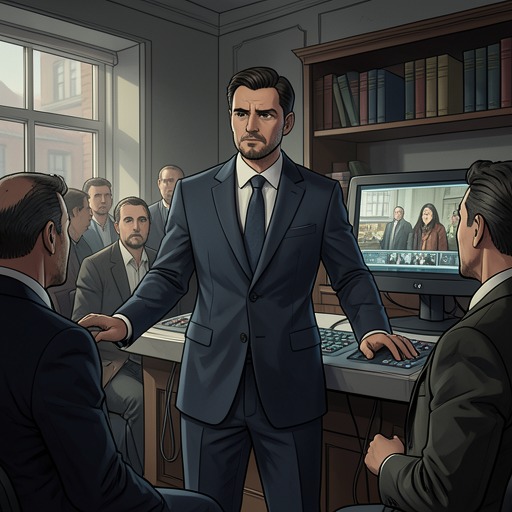
Lowbeer identifies the exoskeleton’s operator as Burton and nods to him. The exoskeleton raises its arms; a hatch in one wrist reveals a second candy-cane gun, while a larger hatch in the other produces Lowbeer’s gilt, fluted-ivory tipstaff. Burton uses the tipstaff against the tall man, who is revealed as Sir Henry: Sir Henry dies, leaving his clothes and hat behind. Flynne, still armed, demands that someone act in the stub to stop Homes from killing them with drones. Her demand keeps the confrontation’s focus on the threatened people beyond Newgate, rather than on escape alone.
Political consequence and significance
Lowbeer explains that Sir Henry’s death has deprived Flynne’s competitor of an advantage that Lev and Lowbeer had afforded Flynne’s side. She had acted as soon as Sir Henry arrived, assuming he would prove guilty; his death then shifted influence, and Homeland Security withdrew, with its orders rescinded. The confrontation’s consequence thus reaches from an improvised fight in a room to a decision affecting the threatened Coldiron operation.
When Flynne asks what had to be bought to make that change, Lowbeer says she believes a sufficient share of Hefty Mart’s parent corporation was involved, although she does not yet have the details. The exchange makes clear that force and corporate leverage operate together in this resolution. The immediate political threat is checked, but the means of securing that result remain only partly known; Lowbeer’s account gives Flynne an outcome before it gives her a complete explanation.