The assassination of Felicia Gonzales
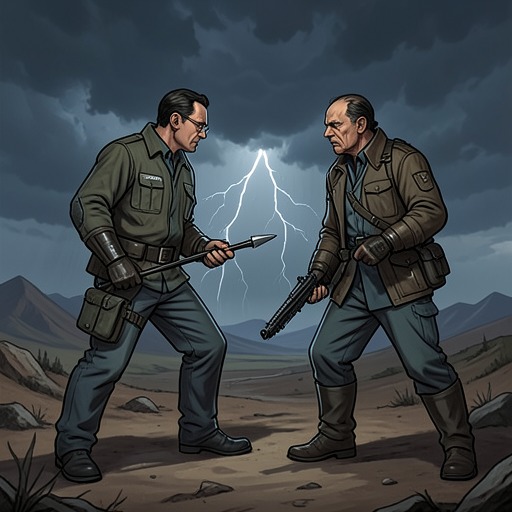
The PeripheralThe assassination of Felicia Gonzales is a future political killing that links an apparently specific act of violence to the much slower catastrophe known as the Jackpot. In Wilf Netherton’s future history, Vice President Wally Ambrose kills Gonzales after she has been elected to a second term; Ainsley Lowbeer identifies the assassination as a pivotal turn toward deeper collapse. In Flynne Fisher’s still-diverging timeline, it has not happened yet, making its prevention a consequential, though uncertain, objective.
Historical Role and Political Stakes
Gonzales’s assassination is disclosed to Flynne through Wilf’s account of Lowbeer’s understanding of the history connecting their worlds. Gonzales does not finish her second presidential term: she is elected again, and her vice president, Wally Ambrose, kills her. The revelation changes the meaning of the future Wilf has been describing. The Jackpot is not simply an environmental and social breakdown already gathering force; in Lowbeer’s analysis, this particular political murder marks a tipping point into its deeper phase.
The identity of the killer also makes the event more than a generalized warning about political instability. Ambrose is not an outside attacker but the vice president, a figure already situated at the center of the government whose president is killed. The evidence does not specify the method, immediate circumstances, or public response to the assassination, so its significance rests on the disclosed perpetrator and the historical consequences Lowbeer assigns to it rather than on a narrated scene of the killing.
The Assassination and the Jackpot
Wilf’s explanation places the assassination within a catastrophe that is multicausal and extended over time, not a single apocalypse with a clear beginning. He describes the Jackpot as more like a climate than an event: human-caused pressures accumulate, interact, and produce cascading losses. Climate change drives further crises, while drought, water shortages, crop failures, the loss of honeybees and other keystone species, the disappearance of alpha predators, declining antibiotic effectiveness, and serious diseases combine without forming one defining disaster.
The eventual scale of the collapse is immense: Wilf says that roughly 80 percent of the living population dies over about forty years. Yet the disaster is not presented as uninterrupted decline. Scientific advances—including cleaner energy, improved carbon removal, new drugs, nanotechnology, and food-printing methods—arrive amid worsening conditions. The resulting contrast is central to his account: technological progress continues, but it does not prevent ongoing violence and suffering. Lowbeer’s designation of Gonzales’s assassination as a tipping point therefore gives a discrete political event a place within a far larger history of cumulative, systemic crisis.
That crisis also has unequal consequences. Wilf explains that the richest can become richer as the population falls and remaining assets concentrate, while constant emergency creates new opportunities for those able to exploit it. In the later world, towers serve both as housing for the wealthy and as structures that absorb carbon. The assassination is thus connected to a future whose political violence and environmental ruin do not distribute harm or advantage evenly.
Prevention in the Diverging Timeline
When Wilf tells Flynne about the assassination, it is still in the future of her timeline. He explains that the two continuities have diverged and will continue to do so; the divergence can be steered only broadly, with no guarantee of the eventual result. Lowbeer hopes to ameliorate the Jackpot, not to claim that it can simply be erased. She and Wilf believe that preventing Gonzales’s assassination is a necessary step toward avoiding the system that has taken shape in Lowbeer’s world.
The proposed intervention remains constrained by incomplete knowledge. Wilf says he cannot know everything Lowbeer knows, and she cannot simply brief him on all of it. He acknowledges her greater experience and the possibility that a measure he would otherwise reject could be judged necessary in light of information unavailable to him. At the same time, he warns that actions by Coldiron and its competitor could affect the assassination’s outcome by crashing the global economy, itself a danger. The effort to alter history therefore unfolds under uncertainty: intervention may change a pivotal outcome, but it may also produce serious consequences of its own.
Conspiratorial Connections and Narrative Significance
A later account of Aelita West’s murder supplies a further, carefully qualified connection to the assassination’s political history. Lowbeer says that Aelita’s father was a co-conspirator in the Gonzales assassination and expects Griff to deal with him in that capacity. The evidence does not establish that Aelita’s murder was caused by the assassination plot, nor does it resolve why she was killed. It instead places the same political conspiracy in the background of the investigation into her death, showing how the consequences of the event reach beyond the presidential killing itself.
The narrative gives the assassination weight before staging it: it is disclosed as a fact of another timeline, then becomes a possible turning point in Flynne’s. Its importance lies in the tension between a slow, diffuse disaster and a sharply identifiable act of political violence. The Jackpot has no single origin, yet Lowbeer’s account isolates Gonzales’s murder as a moment at which history might still be steered. That distinction keeps prevention from becoming a promise of rescue: the assassination can be opposed, but the broader catastrophe is already underway, and its eventual course remains uncertain.