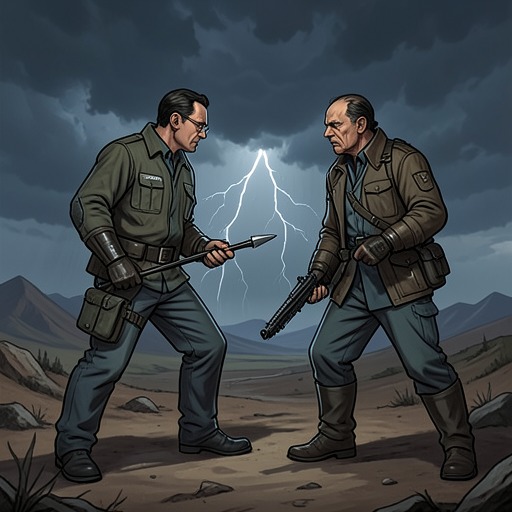
Wally Ambrose
The PeripheralWally Ambrose is the vice president whom Wilf identifies as the future assassin of President Felicia Gonzales, making him central to a political danger that reaches across timelines. The later account of his death from an embolism, and of Felicia’s evident affection for him, gives that forecast a personal dimension without explaining how their relationship ends in assassination.
Identity and Political Role
Ambrose is the vice president in Wilf’s account of a possible future assassination. When Flynne asks who kills the president, Wilf answers that the vice president does, then names Ambrose; Flynne responds with disbelief, stressing that the person he means is Wally Ambrose. The exchange establishes the claim as a specific warning, not a vague suspicion about political violence.
The Assassination Threat
Wilf connects the threat to competing pressures surrounding Coldiron and its rival. He says their actions could affect the outcome, but warns that crashing the global economy would itself be dangerous. His uncertainty is explicit: he cannot know everything Lowbeer knows, and she has greater experience. Although Wilf says he would use party time if Lowbeer believed it necessary to prevent the assassination, the evidence does not establish that such a measure is used or that it would determine the outcome.
The political obstacles are not merely a matter of delivering a warning. Lowbeer says that trust with the president’s office has not been established, that the office is riddled with people aligned with those who will soon plot against her, and that politics further complicates intervention. Flynne proposes telling the president that she can be saved if she orders the operation to turn around; Lowbeer replies that the situation is not that simple. Ambrose’s projected role thus sits within a wider crisis of access, trust, and political control.
Felicia Gonzales and the Later Account
A later scene places Ambrose in Felicia’s past: Flynne recalls meeting Felicia shortly after Ambrose had an embolism. Their conversation was awkward because Felicia spoke of Wally with what Flynne perceived as real and painful affection. The account identifies the embolism as the cause of Ambrose’s death, but does not specify when it occurred or reconcile his death with the earlier forecast that he would assassinate Felicia.
Flynne’s knowledge of Ambrose’s death is shaped by information from Griff, who had shown her footage of her own state funeral and explained what led up to it. The recollection therefore sets Felicia’s grief alongside a future political catastrophe already known to Flynne, while leaving the precise sequence between Ambrose’s death and the assassination plot unresolved.
Narrative Significance
Ambrose is characterized through two sharply different kinds of evidence: Wilf’s blunt identification of him as a future assassin, and Felicia’s later, personal remembrance of Wally after his death. The contrast makes the political prediction more unsettling without converting it into a fully explained biography. His role also illustrates the difficulty of acting on foreknowledge: even a specific warning cannot be readily carried into a political system whose officials and loyalties are divided.