Cellars of the Opera
The Phantom of the OperaThe Cellars of the Opera are the immense, five-tiered underground labyrinth that lies beneath the Paris Opera House, a hidden world that becomes the exclusive domain of the Opera Ghost, Erik. Constructed with extraordinary engineering to manage the groundwater that threatened the building's foundations, this subterranean realm is not merely a basement but a complete, secret geography. It contains a network of passages, a lake, a house, a torture chamber, and a powder magazine, and it is the stage for the novel's most pivotal and terrifying events, including Christine Daae's captivity and the final confrontation between Erik, Raoul, and the Persian.
Architecture and Construction
The cellars were a necessary and monumental feat of engineering. The site was chosen in 1861, and it was known that water would be encountered. To create a dry, solid foundation capable of supporting the immense weight of the building and its stage machinery, a double case was built in every direction. This involved an outer wall built as a coffer-dam, a brick wall, a coat of cement, and a wall proper over a yard thick. The entire excavation was kept dry by eight steam-powered pumps operating day and night for over seven months. The floor was covered with layers of concrete, cement, and bitumen, and the whole structure was then filled with water so that sediment would seal the tiniest interstices. This construction created a space between the inner and outer walls, a hollow zone that Erik would later exploit to build his secret house. The cellars themselves are five in number, descending deep into the earth, and they contain the waterworks, furnaces, and the stables for the Opera's horses. The building's history also left its mark: during the Paris Commune, the cellars were used as a state prison, and the Communists dug a passage, known as the Communists' Road, which Erik later incorporated into his domain.
Erik's Subterranean Kingdom
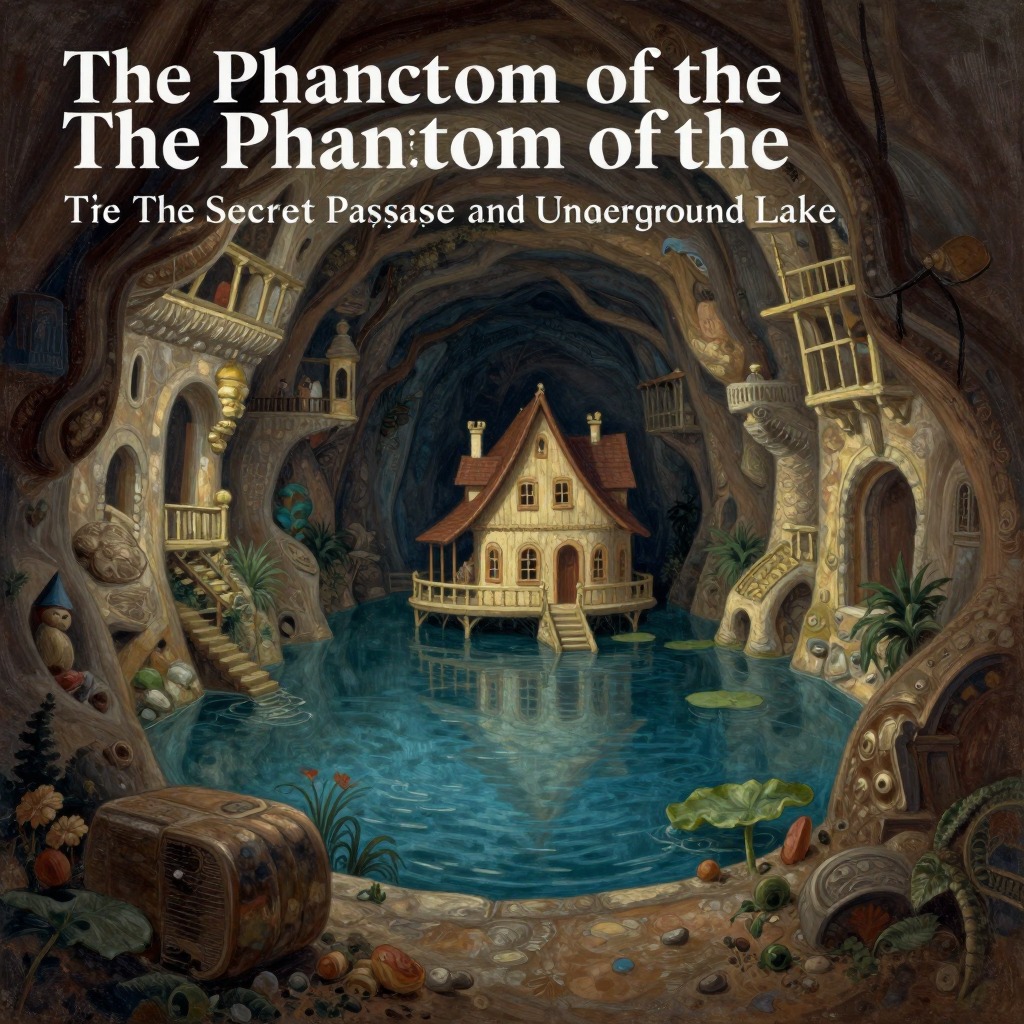
Erik, who had been a contractor for part of the Opera's foundations, made the cellars his personal kingdom. He built a house for himself within the double case of the foundation walls, a dwelling that included a drawing-room, a bedroom with a coffin, a Louis-Philippe room, and the infamous torture chamber. This house was accessible only by crossing an underground lake in a small boat, a journey guarded by Erik's siren trick—a reed that allowed him to breathe and sing from beneath the water's surface. The cellars are also the location of the powder magazine, a cellar filled with gunpowder barrels that Erik planned to detonate if Christine refused to marry him, threatening to destroy the entire Opera and its audience. The Persian, who had known Erik in Persia, was familiar with many of his tricks and knew that the cellars were the key to finding Christine. He led Raoul through this labyrinth, navigating past the gas-man's box, the door-shutters, and the rat-catcher, to reach the secret entrance to Erik's house in the third cellar, between a set piece and a discarded scene from Le Roi de Lahore.
Key Events and Narrative Significance
The cellars are the setting for the novel's most dramatic sequences. It is here that Christine Daae is first taken by Erik after her triumph, riding the white horse Cesar through the winding galleries to the edge of the underground lake. It is here that Raoul and the Persian descend to rescue her, only to be trapped in the torture chamber, a room of mirrors and illusions designed to drive its victims mad. The cellars are also where the final choice is made: Christine, to save Raoul and the Persian, agrees to marry Erik, turning the scorpion to flood the powder magazine rather than the grasshopper, which would have caused an explosion. The body of Count Philippe de Chagny is found on the bank of the lake in the cellars, and it is here, years later, that Erik's skeleton is discovered, still wearing the plain gold ring Christine had placed on his finger. The cellars are thus the physical and symbolic heart of the novel's gothic horror, a space that contains both the monster's lair and the ultimate proof of his tragic, human end.