Death of Count Philippe
The Phantom of the OperaThe death of Philippe Georges Marie Comte de Chagny, the elder brother of Raoul de Chagny, is the novel's most consequential offstage tragedy, a drowning in the underground lake of the Paris Opera House that the Persian, the only man who understands Erik, reconstructs as the monster's final crime. The count's body is found on the bank of the lake on the Rue-Scribe side, and his death, following Christine Daae's onstage abduction and Raoul's disappearance, throws the entire Chagny case into a mystery that the examining magistrate, M. Faure, can only explain as madness and accident. Yet the Persian, who knows Erik's methods and his history, reads the corpse as the work of the siren, Erik's guard, and the event becomes the pivot on which the novel turns from the pursuit of a living singer to the reckoning with a dying monster.
The Discovery of the Body and the Official Verdict
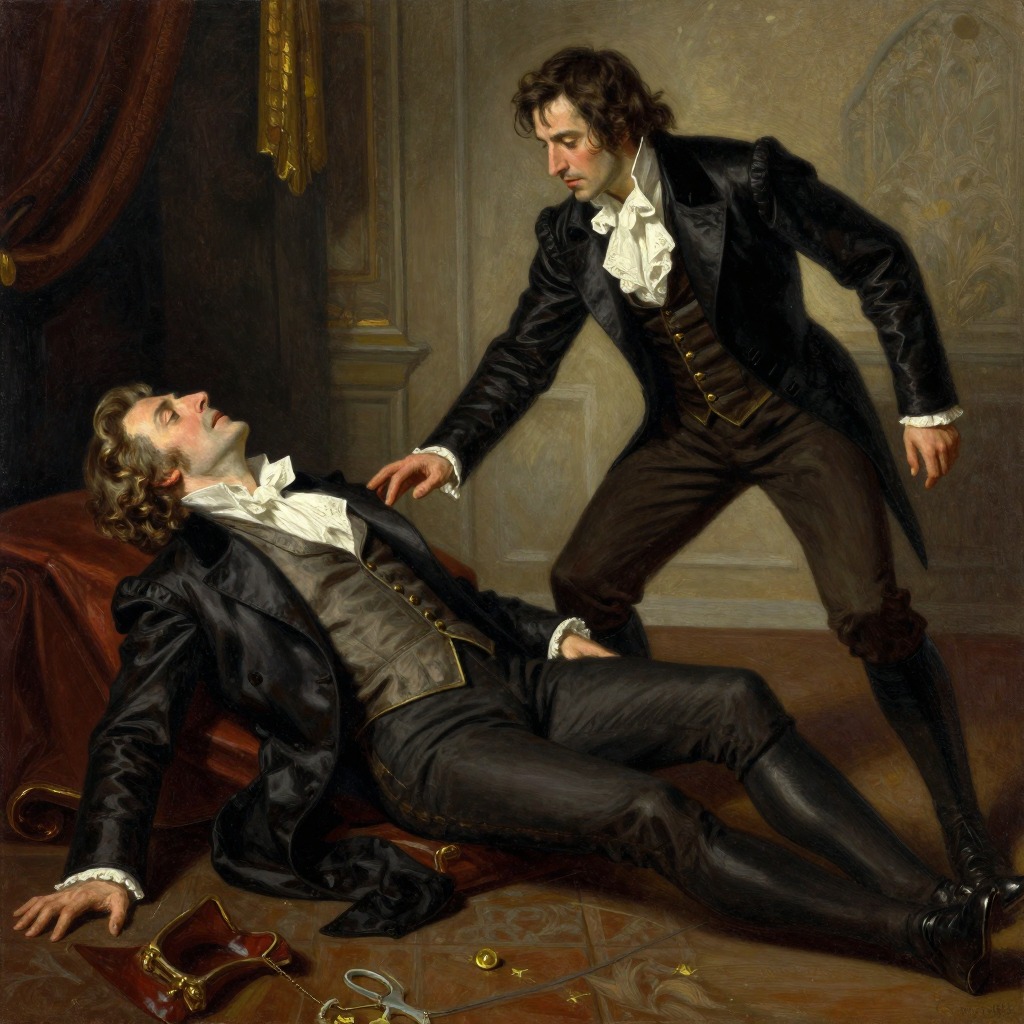
The count's body is found on the bank of the Opera lake, on the Rue-Scribe side, a location that ties his death directly to the hidden world beneath the theater. The discovery comes after Raoul has vanished into the cellars with the Persian, leaving his hat in Christine Daae's dressing-room beside an empty pistol-case, and after the count himself, believing his brother mad and Christine carried off, has plunged into the same underground maze. The official inquiry, led by M. Faure, concludes in favor of the viscount's madness and the accidental death of the elder brother, for lack of evidence to the contrary. The magistrate, who has never seen anything worthy of attention in the ghost's manifestations, treats the Persian's testimony as the ravings of a visionary, and the case is pigeonholed by his unintelligent care. The count's death thus becomes the event that the public cannot explain, the tragedy that throws the Faubourg Saint-Germain into mourning, and the reason the ghost legend is forgotten in the face of a more terrible story.
The Persian's Reconstruction: The Siren and the Crime
The Persian, who has heard Erik's requiem mass from behind the wall of the torture-chamber, has no doubt concerning the crime and the criminal. He reconstructs the tragedy with the precision of a man who has known Erik for decades: thinking that his brother had run away with Christine Daae, Philippe dashed in pursuit along the Brussels Road, where he knew everything was prepared for the elopement. Failing to find the pair, he hurried back to the Opera, remembered Raoul's strange confidence about his fantastic rival, and learned that the viscount had made every effort to enter the cellars and had disappeared. The count, who no longer entertained any doubt of his brother's madness, in his turn darted into that infernal underground maze. This was enough, in the Persian's eyes, to explain the discovery of the corpse on the shore of the lake, where the siren, Erik's siren, kept watch. The siren, whose reed trick the Persian had nearly died from, is the guardian of the approach to the house on the lake, and the count, stumbling into her domain, met the fate that Erik had designed for any intruder.
Erik's Account: An Accident or a Murder?
When Erik, near death, visits the Persian in his flat in the Rue de Rivoli, he offers a different version of the count's end. Staggering under the direct attack, he gasps out that Count Philippe was dead by the time he left his house, dead when the siren sang, and that it was an accident, a sad, very sad accident: he fell very awkwardly, but simply and naturally, into the lake. The Persian shouts "You lie!" but Erik does not defend himself; he has come not to talk about the count but to announce his own impending death. The ambiguity is deliberate: the Persian believes Erik murdered Philippe, while Erik insists on the accident, and the novel never resolves the contradiction. What matters is that Erik's account, delivered in short, gasping phrases, is part of his final confession, the same confession in which he reveals that he kissed Christine Daae alive and that he is dying of love. The count's death, whether murder or accident, is the price of Erik's jealousy, the consequence of a brother's devotion that led him into the one place he should never have gone.
Consequences: The End of the Chagny Line and the Resolution of the Love Story
The count's death has immediate and lasting consequences. It removes the last obstacle to Raoul and Christine's union, for Philippe had sworn that, for the first time on record, the Chagnys should not keep their promise of marriage. It also drives the two lovers into hiding: Raoul and Christine, both disappeared, withdraw far from the world to enjoy a happiness they would not care to make public after the inexplicable death of Count Philippe. They take the train one day from the northern railway station of the world, and the narrator speculates that he may one day seek their traces in Norway, the silent Scandinavia. The count's death also seals Erik's fate: having relinquished his marriage with Christine, he relinquishes everything above the surface of the earth, and his own death follows within weeks. The Persian, who has saved Erik's life in Persia and who has forgiven him the harm he has done, is the only one who knows the whole truth, and he holds the main proofs, which come to him with the pious relics promised by the ghost. The count's body, found on the bank of the lake, is thus the final proof of Erik's power and the beginning of his end.
Narrative Role and Thematic Significance
The death of Count Philippe is the novel's most powerful demonstration of the cost of Erik's obsession. It is an offstage event, reconstructed rather than witnessed, and this indirection makes it all the more terrible: the reader, like the Persian, must piece together what happened from the siren's song and the count's desperate search. The count's death also serves as the novel's moral turning point. Until this moment, Erik's crimes have been directed at those who threaten his possession of Christine—Joseph Buquet, who saw too much; Carlotta, who sang in his way; the managers, who defied him. But Philippe is innocent of any direct offense; he is simply the brother of the man Christine loves, and his death is the purest expression of Erik's jealousy. The Persian's refusal to accept Erik's account, and Erik's own insistence on the accident, leaves the reader with an unresolved ambiguity that mirrors the novel's larger theme: the impossibility of knowing the truth about a monster who is both genius and criminal. The count's death, like the ghost himself, is a mystery that the official world cannot solve, and only those who have descended into the cellars can even begin to understand it.