Erik
The Phantom of the OperaErik, known to the world as the Opera Ghost, is the central, tragic figure of Gaston Leroux's novel. He is not a supernatural specter but a man of flesh and blood, a genius of music, architecture, and illusion whose horrifying physical deformity has exiled him from humanity and driven him to build a hidden kingdom within the cellars of the Paris Opera House. His existence is a paradox: a creator of sublime beauty who commits terrible crimes, a man who yearns for love but inspires only terror, and a monster whose final act is one of profound renunciation and heartbreak. His story is the engine of the entire narrative, shaping the fates of Christine Daae, Raoul de Chagny, and the managers of the Opera, and his ultimate tragedy is that he, who could command the world with his art, could not be loved for himself.
Identity and Origins
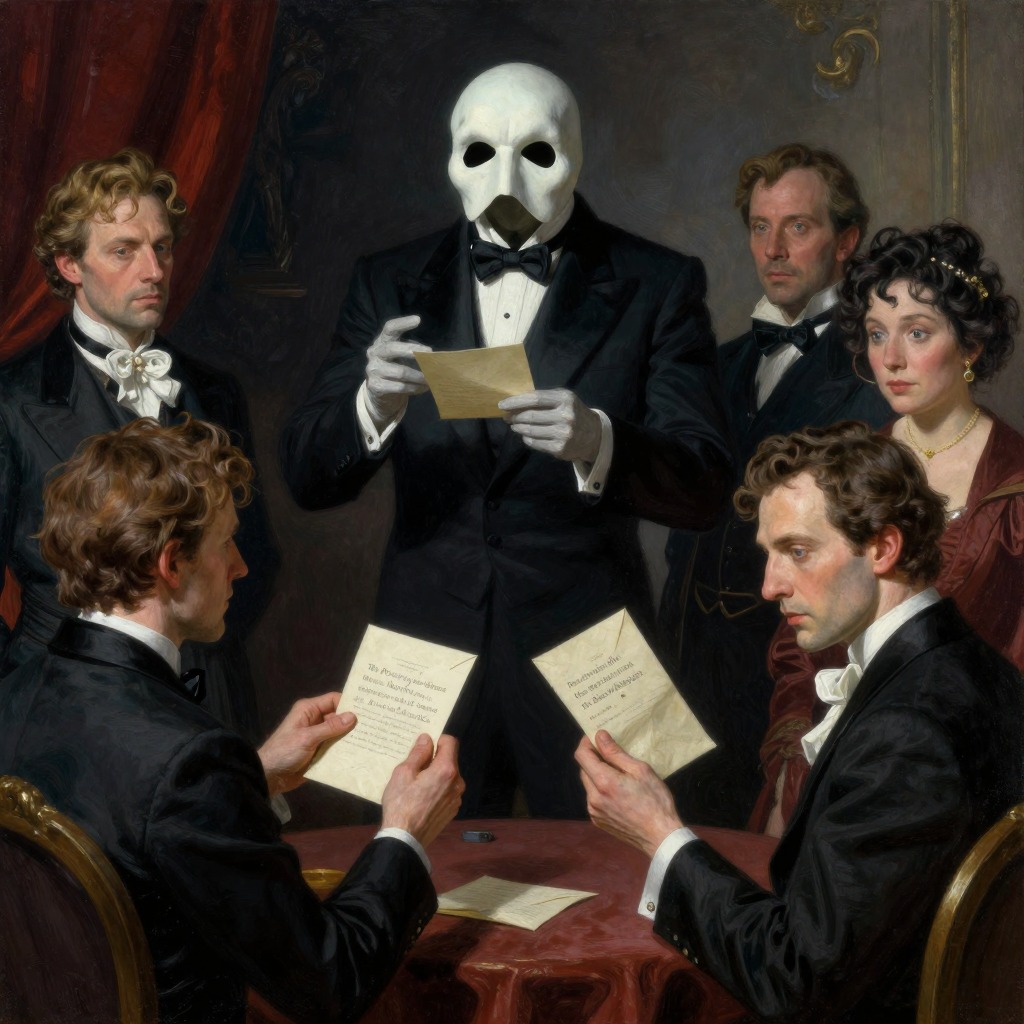
Erik's identity is a carefully constructed mystery, revealed in layers throughout the novel. To the public and the Opera's staff, he is the "Opera ghost," a spectral figure in dress-clothes with a death's head, blamed for accidents and practical jokes. To the managers, he is "O. G.," a blackmailer who demands a monthly allowance and the exclusive use of Box Five. To Christine Daae, he is first the "Angel of Music," a celestial voice promising to fulfill her father's dying wish, and later a terrifying, pitiable monster. He himself reveals his true name, Erik, when he is unmasked before Christine, confessing, "I am not an Angel, nor a genius, nor a ghost...I am Erik!"
The Persian, who knows Erik from their shared past, provides the most complete account of his origins. Erik was born in a small town near Rouen, the son of a master-mason. His ugliness was so horrifying that he ran away from home at an early age, becoming a fairground exhibit known as the "living corpse." He traveled across Europe, honing his skills as an artist and magician among the Gipsies, and was seen at the fair of Nijni-Novgorod, where his singing, ventriloquism, and legerdemain were legendary. His reputation eventually reached the palace at Mazenderan, where the daroga (the Persian) was sent to find him. In Persia, Erik's will was law for a time; he participated in political assassinations and used his inventive genius to build a palace for the Shah-in-Shah so ingenious that the monarch could move unseen. This very skill sealed his fate: the Shah ordered his eyes put out and his death, a sentence the daroga defied by helping him escape. Erik then served the Sultan in Constantinople, constructing the famous trap-doors and secret chambers at Yildiz-Kiosk, before finally longing to be "some one like everybody else." He became a contractor and, by a stroke of fate, was hired to work on the foundations of the Paris Opera House, where he found his permanent, hidden home.
Life and Plot Trajectory
Erik's life in Paris is one of secret dominion. He builds a house for himself on the shore of an underground lake, five stories below the Opera, furnished with his mother's belongings and filled with his own inventions, including an organ and a torture-chamber. He establishes his authority over the Opera through a campaign of terror and extortion, forcing the managers, first Debienne and Poligny and then Richard and Moncharmin, to accept his memorandum-book with its clauses for a monthly allowance of twenty thousand francs and the reservation of Box Five. He is responsible for the death of Joseph Buquet, the chief scene-shifter, who had seen him and described his appearance; Buquet is found hanged in the third cellar, and the Punjab lasso used for the deed is later discovered in the torture-chamber. He also causes the fall of the chandelier, which crashes into the audience, killing the concierge who had replaced Mme. Giry as his box-keeper.
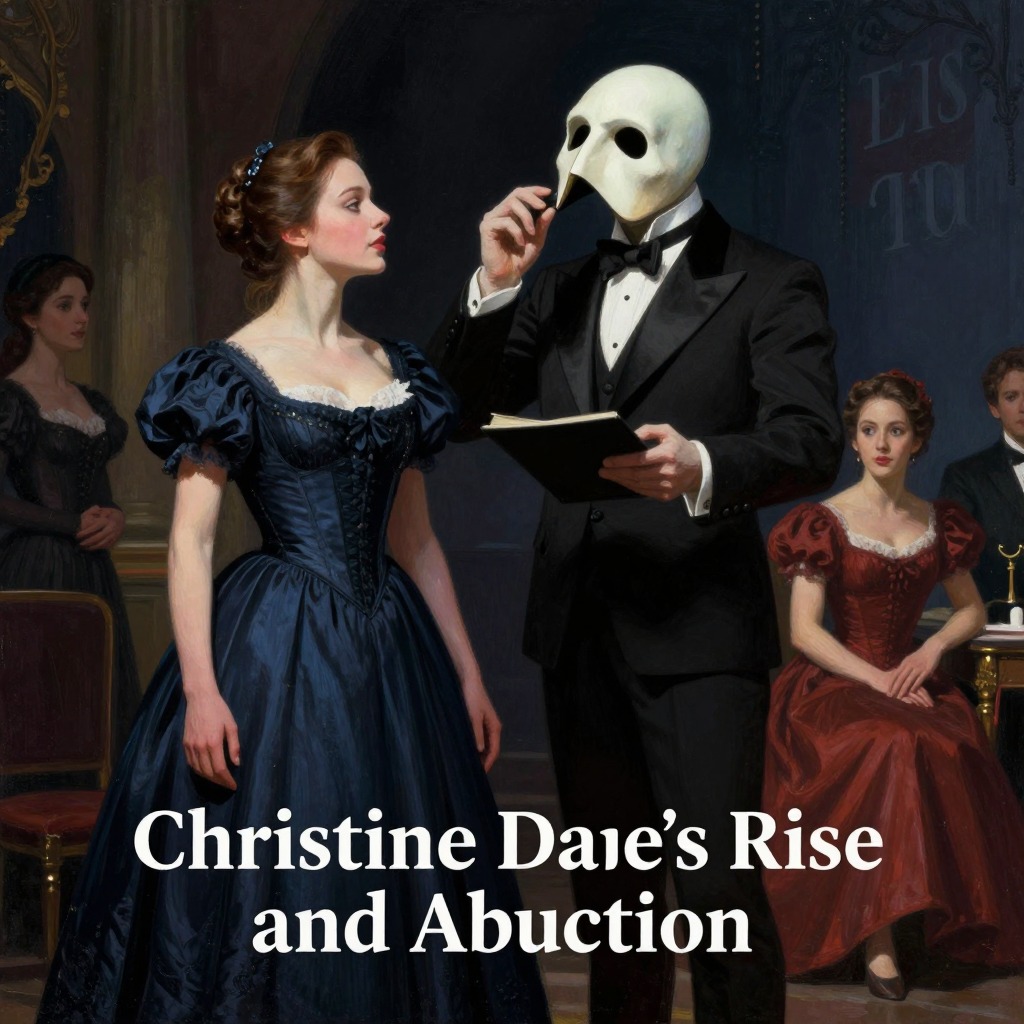
His life changes irrevocably when he hears Christine Daae sing. Believing her to be the fulfillment of his musical dreams, he poses as the Angel of Music, giving her daily lessons in her dressing-room through a hidden voice. When she begins to love Raoul de Chagny, Erik's jealousy erupts. He kidnaps her, taking her to his house on the lake, where she finally sees his face and is horrified. He keeps her prisoner for a fortnight, during which she lies to him, feigning affection to secure her freedom. He releases her on the condition that she wears his gold ring, but her love for Raoul and her attempt to flee with him provoke his ultimate act of desperation: he abducts her from the stage during a performance of Faust, in full view of the audience.
Relationships and Conflict
Erik's relationships are defined by his isolation and his desperate, unrequited love. His relationship with Christine Daae is the central conflict of the novel. He loves her with an "immense and tragic love," but his methods are those of a captor, not a suitor. He imprisons her, threatens to kill her and himself, and gives her an ultimatum: to marry him or face the destruction of the Opera and everyone in it. Yet, even in his cruelty, there is a profound vulnerability. When Christine, in a moment of pity, weeps with him and allows him to kiss her forehead, he is overwhelmed, saying, "I have tasted all the happiness the world can offer!" This single act of human connection leads to his renunciation. He releases Raoul, gives Christine his blessing, and tells her to marry the man she loves, asking only that she return to bury him when he dies.
His relationship with the Persian is one of the few he has that is not based on terror. The Persian saved Erik's life in Mazenderan, and Erik, in his own way, respects this debt. He warns the Persian to stay away from his house, but when the Persian and Raoul invade it, Erik does not kill them outright, instead subjecting them to the tortures of his chamber. Ultimately, it is Christine's plea, made to save them, that leads to their release. Erik's relationship with the Opera managers is purely adversarial; he is a blackmailer and a tormentor, using his knowledge of their secrets and his mastery of illusion to extract money and obedience. His relationship with Mme. Giry is one of a patron, rewarding her loyalty with tips and the promise of her daughter Meg's future as an empress.
Change and Ending
Erik's character undergoes a profound transformation in the final chapters. From a vengeful, possessive monster, he becomes a figure of tragic pathos. After Christine turns the scorpion, flooding the gunpowder and saving the Opera, she honors her promise to be his living wife. This act of compassion, and her tears mingled with his, breaks through his isolation. He tells the Persian, "I tore off my mask so as not to lose one of her tears...and she did not run away!...And she did not die!...She remained alive, weeping over me, with me." This experience of being seen and pitied, of having his tears met with hers, is the first time he has ever felt human connection. He releases Raoul and Christine, gives Christine his gold ring as a wedding present, and tells her to bury him with it when he dies. He then goes to the Persian, announces that he is dying of love, and asks him to advertise his death in the Epoque. Three weeks later, the advertisement appears: "Erik is dead." The narrator later discovers his skeleton near the well in the cellars, still wearing the gold ring, and prays over his remains, acknowledging that he was a man who "had a heart that could have held the empire of the world" but was forced to "content himself with a cellar."
Narrative Role and Evaluation
Erik is the novel's central enigma and its most complex character. He is the embodiment of the Gothic sublime, inspiring both terror and awe. His genius is undeniable: he is a master musician, a brilliant architect, a skilled ventriloquist and magician. Yet his ugliness, which he describes as being "built up of death from head to foot," has made him an outcast, and he uses his gifts to prey upon humanity rather than to enrich it. The narrator's final judgment is one of pity: "Poor, unhappy Erik! Shall we pity him? Shall we curse him? He asked only to be `some one,' like everybody else. But he was too ugly!" Erik's tragedy is that his extraordinary abilities are inseparable from his monstrous appearance, and his quest for love is doomed from the start. He is a figure of immense pathos, a villain who is also a victim, and his story elevates the novel from a simple mystery to a profound meditation on beauty, love, and the human need for connection. His death, and the discovery of his skeleton, provides a poignant and definitive end to the legend of the Opera Ghost.