M. Debienne
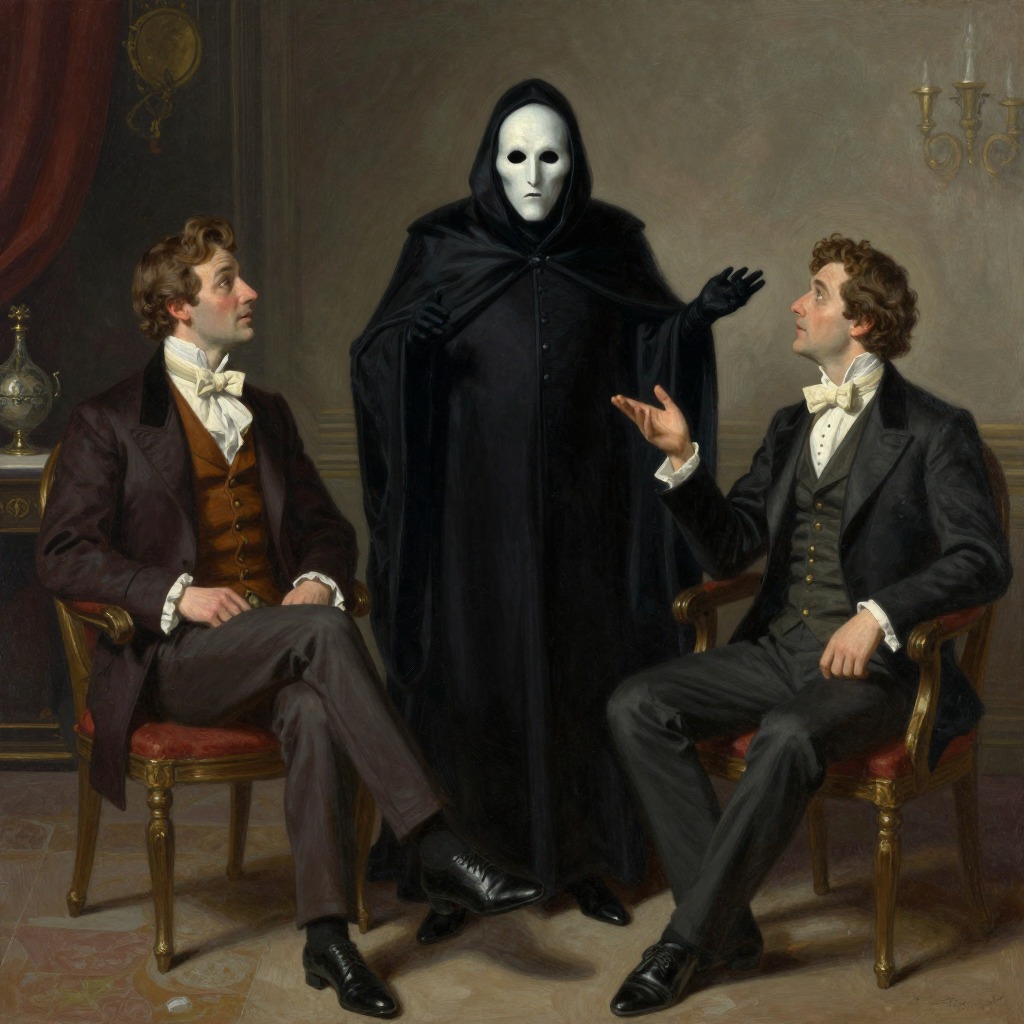
The Phantom of the OperaM. Debienne, together with his colleague M. Poligny, was one of the joint managers of the Paris Opera House who presided over the establishment during the period when the Opera Ghost first made his presence felt. The two men are introduced at the moment of their retirement, when they are giving a last gala performance to mark their departure from the management. It is on this evening that the ghost legend, long simmering among the ballet-girls, comes to a head with the discovery of the hanged body of Joseph Buquet, the chief scene-shifter, and it is M. Debienne who, with his partner, must hand over the reins to their successors, M. Firmin Richard and M. Armand Moncharmin.
The Farewell Gala and the Warning to Successors
M. Debienne and M. Poligny are present at the farewell ceremony in the foyer of the ballet, where Sorelli waits with a glass of champagne and a prepared speech. The retiring managers appear cheerful, as is the Parisian way, wearing a mask of gaiety over their sorrows. Their composure is shattered when little Jammes cries out "The Opera ghost!" at the sight of a pallid, lugubrious face among the crowd of dandies. Later, at the supper table in the great lobby outside the managers' office, the ghost himself appears to take a seat, neither eating nor drinking, and it is he who announces the death of Joseph Buquet, which the two ex-managers had not yet heard. M. Debienne and M. Poligny rise, stare strangely at the speaker, and turn whiter than the table-cloth, more excited than the announcement of a scene-shifter's suicide would warrant.
The Memorandum-Book and the Ghost's Demands
M. Debienne and M. Poligny then take the new managers into the office and reveal the secret of the ghost. They explain that they would never have spoken of him had they not received formal orders from the ghost himself to ask the new managers to be pleasant to him and to grant any request he might make. They confess that whenever they disregarded the ghost's wishes, some fantastic or disastrous event brought them to a sense of their dependence. M. Poligny produces a copy of the memorandum-book, which contains a paragraph in red ink, in a queer, labored handwriting, adding a fifth clause requiring the manager to pay the Opera ghost an allowance of twenty thousand francs a month, and a line reserving Box Five on the grand tier for the ghost's disposal at every performance. M. Debienne and M. Poligny explain that they are retiring because business is impossible with so unreasonable a ghost, citing the loss over Box Five and the burden of the allowance. When Richard suggests having the ghost arrested, they cry in chorus that they have never seen him, and when Richard proposes selling the box, they reply, "Sell the Opera ghost's box! Well, gentlemen, try it."
The Handover and the Ghost's Continuing Influence
M. Debienne and M. Poligny hand over the two tiny master-keys which open all the doors of the Opera house, and advise the new managers to have new locks made with the greatest secrecy. They also send a letter to Richard and Moncharmin after the new managers have sent them Box Five, explaining that they have no right to occupy it, as it is the exclusive property of the ghost, citing Clause 98, final paragraph. The ghost's letter to the new managers later confirms that M. Debienne and M. Poligny have sent him the 6,575 francs 30 centimes representing the first ten days of his allowance for the current year, their privileges having finished on the evening of the tenth. M. Debienne thus serves as the conduit through which the ghost's authority is transmitted from one management to the next, and his departure marks the beginning of the new managers' struggle with the ghost, a struggle that will culminate in the fall of the chandelier and the disappearance of Christine Daae.