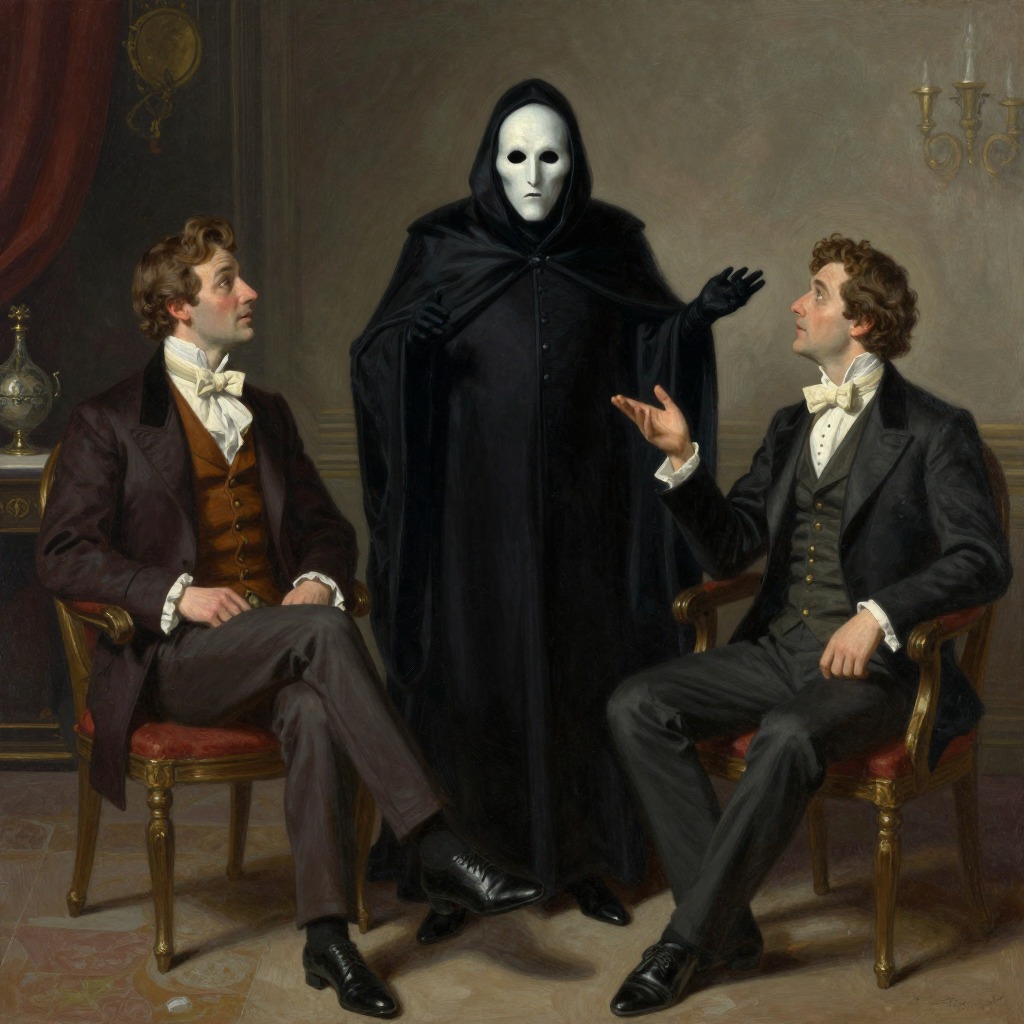
M. Poligny
The Phantom of the OperaM. Poligny, joint manager of the Paris Opera House alongside M. Debienne, presides over the farewell gala performance that opens the novel, an evening that marks both his retirement and the first public revelation of Christine Daae's extraordinary talent. His departure, however, is shadowed by the legacy of the Opera Ghost, a spectral figure whose demands have shaped the final years of his management and whose influence he passes, with evident relief, to his successors, Firmin Richard and Armand Moncharmin.
Identity and Background
M. Poligny is introduced as one of the two retiring managers of the National Academy of Music, giving a last gala performance to celebrate their departure. He is a man of pleasure, as the Persian later describes him, whose life has been restless and who is deeply superstitious. His management has been marked by a curious deference to the Opera Ghost, a figure he has never seen but whose wishes he has learned to obey. The Persian, reflecting on Poligny's tenure, notes that he was superstitious and that Erik, the ghost, knew it, exploiting this weakness to manipulate him. Poligny, along with Debienne, had been victimized by a shrewd blackmailer who forced a singular memorandum-book upon them, and they left the management without investigating the ghost's true identity, bequeathing the mystery to their successors with a sigh of relief.
The Farewell Gala and the Ghost's Ominous Presence
At the farewell gala, Poligny and Debienne appear cheerful, as is the Parisian way, masking their true feelings. The evening is marked by Christine Daae's triumph, but also by the ghost's unsettling presence. During the supper following the performance, a ghastly figure, whom no one knows, sits at the table and announces the death of Joseph Buquet, the chief scene-shifter. Poligny and Debienne, upon hearing this, rise and stare at the speaker, turning whiter than the tablecloth. They then take Richard and Moncharmin into the managers' office, where they reveal the ghost's demands, including the reservation of Box Five and a monthly allowance of twenty thousand francs. Poligny, pointing to the memorandum-book, explains that they have never seen the ghost, only heard him, and that they prefer to go away rather than work to keep ghosts. His relief at leaving the domain where the tyrannical shade held sway is palpable, and he and Debienne advise their successors to have new locks made with the greatest secrecy.
The Incident in Box Five
Poligny's most significant encounter with the ghost occurs during a performance of La Juive, when he decides to watch the performance from the ghost's box. Mme. Giry, the box-keeper, recounts the incident to the new managers: when Leopold cries "Let us fly!" and Eleazer stops them, Poligny gets up and walks out quite stiffly, like a statue, without breaking his leg. This incident, witnessed by Mme. Giry from the back of the next box, demonstrates the ghost's power over Poligny, who is compelled to leave the box as if by an unseen force. From that evening, no one tries to take the ghost's private box from him, and the manager gives orders that he is to have it at each performance. This event establishes the ghost's authority and the fear he inspires, even in the managers who have never seen him.
The Legacy of the Ghost's Rule
Poligny's management ends with the ghost's demands firmly in place, and his departure marks a transition in the opera house's history. He and Debienne, tired of management and the ghost's interference, leave without trying to investigate the ghost's identity, bequeathing the mystery to Richard and Moncharmin. The Persian later explains that Poligny never knew how far Erik humbugged him, and that his superstition made him an easy target for the ghost's manipulations. Poligny's legacy is one of deference and fear, a testament to the ghost's ability to control even those who have never seen him. His departure sets the stage for the new managers' struggles with the ghost, which culminate in the fall of the chandelier and the eventual revelation of Erik's true nature.