Magic Envelope
The Phantom of the OperaThe Magic Envelope is the instrument through which the Opera Ghost, Erik, systematically extracts his monthly allowance of twenty thousand francs from the managers of the Paris Opera House. First mentioned in the prologue as the focus of the "curious financial operation" that victimized the skeptical Moncharmin, the envelope becomes a recurring symbol of the ghost's power over the mortal administrators who try to outwit him. Its apparent ability to transport money without human intervention—replacing real notes with fakes and vanishing funds from a sealed pocket—challenges the managers' rational worldview and precipitates a crisis of trust between them, ultimately revealing Erik's genius for trapdoors and misdirection.
The Envelope's Role in the Ghost's Extortion Scheme
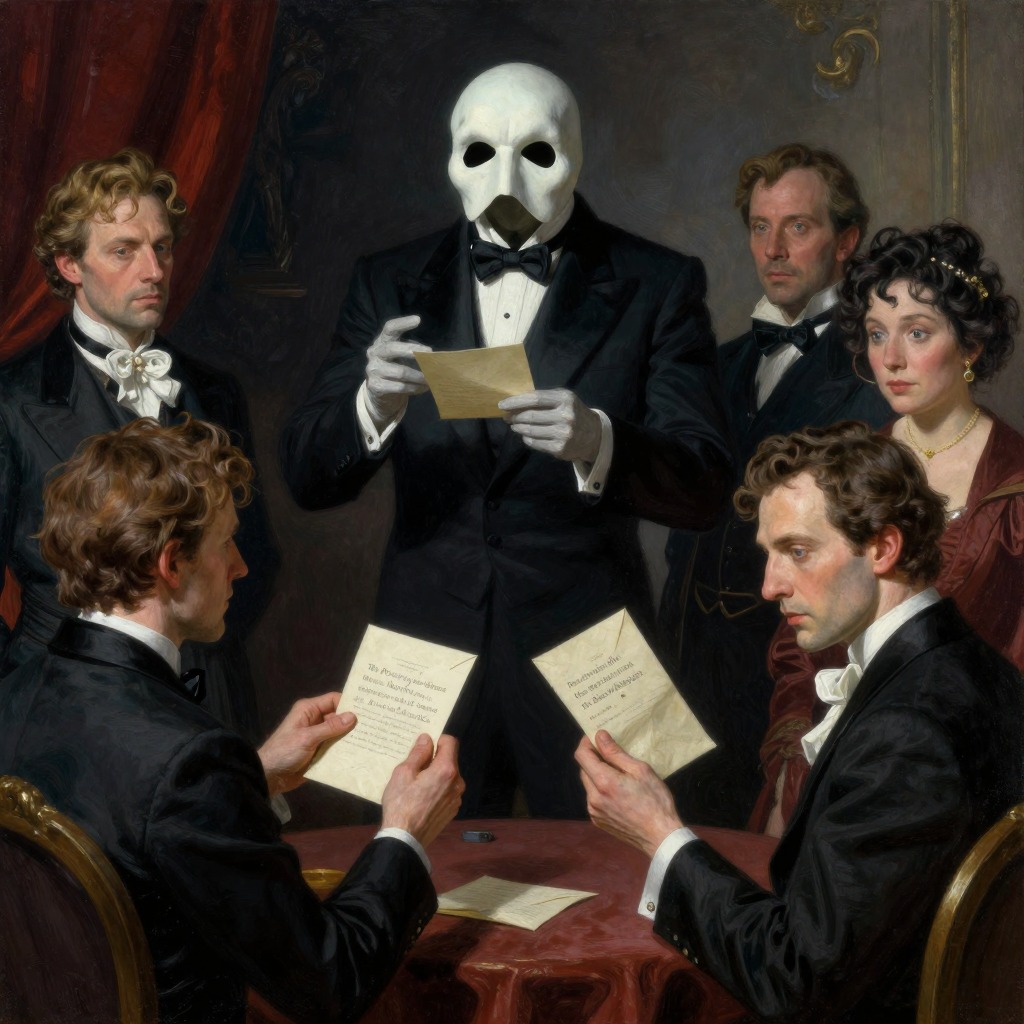
The envelope first appears in the narrative when the ghost, having established his demands in the memorandum-book, instructs the managers to place twenty thousand francs in an envelope addressed to "Monsieur O. G. (private)" and hand it to Mme. Giry, who would "do what is necessary." The managers, eager to catch the blackmailer, comply, sealing the envelope with their own seal and watching it placed in Box Five. Yet when they retrieve it, they find the real notes replaced by twenty notes from the "Bank of St. Farce," a joke currency. This first theft establishes the envelope as a vessel of supernatural seeming, for the seals remain unbroken and the substitution appears impossible. The managers' rage and fright are unmistakable; Moncharmin wants to call the police, but Richard objects, fearing ridicule, and vows to win the "second game."
The second month, the ghost repeats the demand, and the managers, now wary, devise a plan: Richard will carry the envelope in his coat-tail pocket, and Moncharmin will watch it constantly. Yet despite their vigilance, the money vanishes again, this time from a pocket secured with a safety-pin. The envelope itself, however, is not the thief; it is merely the container that Erik manipulates through his hidden knowledge of the Opera's architecture. The managers' obsession with the envelope leads them to suspect each other, and the incident culminates in the famous scene where Moncharmin, desperate to prove his innocence, pins the envelope to Richard's pocket with a safety-pin, only to find the notes gone while the pin remains.
The Substitution Trick and Mme. Giry's Confession
The mystery of the envelope is partially unraveled when Mme. Giry, the box-keeper, is interrogated by the managers. She reveals that the ghost had given her a duplicate envelope, identical in appearance and sealed with the managers' own seal, which she substituted for the real one. The real envelope, she confesses, she slipped into Richard's coat-tail pocket during a moment of distraction, while the fake envelope, containing the Bank of St. Farce notes, was left in Box Five. This confession exposes the envelope as a tool of misdirection, but it also deepens the mystery: how did the ghost obtain the managers' seal and prepare the duplicate? The managers, though they now understand the mechanics of the substitution, are no closer to catching the ghost, and the envelope remains a symbol of their helplessness.
The Envelope's Thematic Significance
The Magic Envelope embodies the ghost's ability to operate beyond the bounds of ordinary human understanding. It is a physical object that seems to defy logic, yet its true power lies in Erik's mastery of the Opera's hidden passages and his psychological manipulation of the managers. The envelope also serves as a test of the managers' rationality: Richard and Moncharmin, who pride themselves on their skepticism, are reduced to superstition and mutual suspicion by its apparent magic. The envelope's eventual return, with "O. G.'s compliments," after the ghost has renounced his claim on Christine Daae, underscores Erik's capricious nature—he restores the money not out of guilt but because he no longer needs it. In the end, the envelope is a reminder that the ghost's power is not supernatural but human, albeit a humanity twisted by genius and isolation.