Rosy Hours of Mazenderan
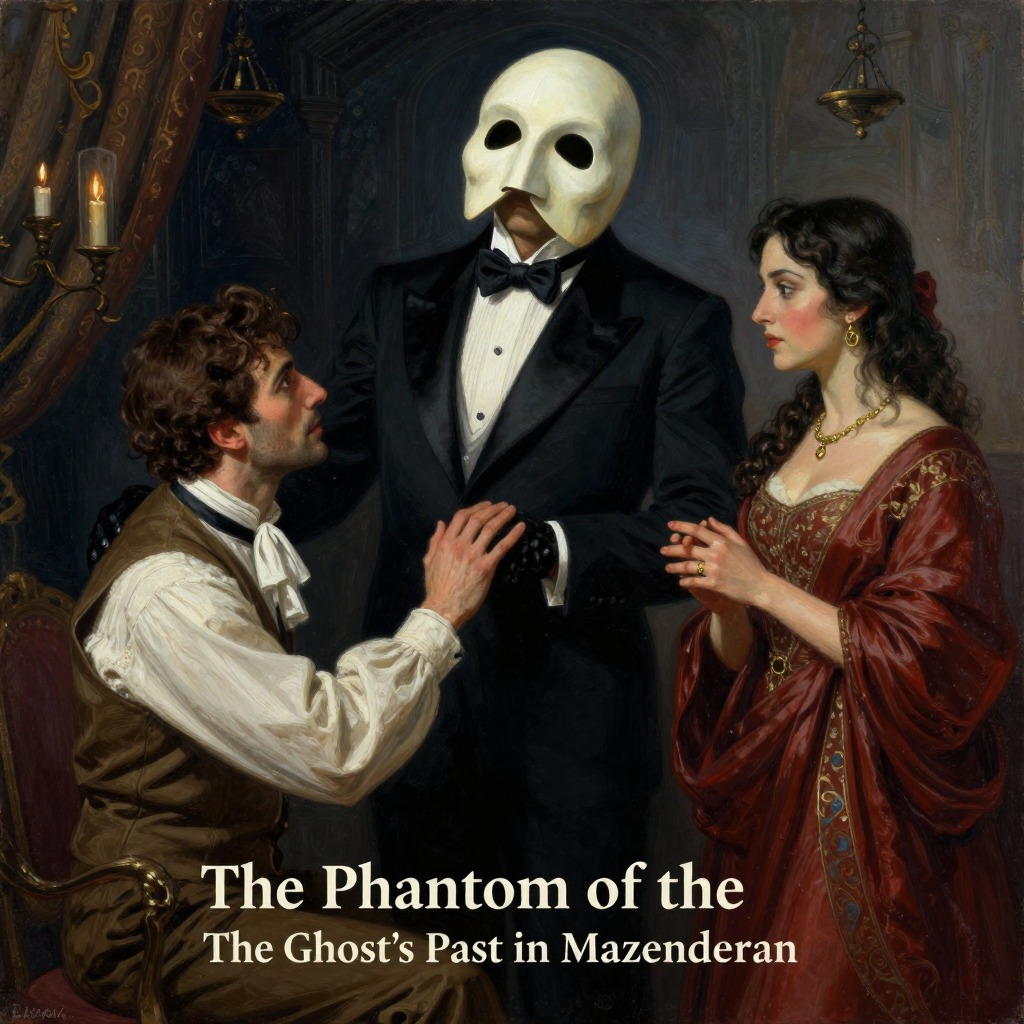
The Phantom of the OperaThe Rosy Hours of Mazenderan represent the most notorious and formative period of Erik's life before he came to Paris, a time when his talents for architecture, illusion, and murder were cultivated and indulged at the highest levels of the Persian court. The Persian, who served as the daroga (chief of police) of Mazenderan, knew Erik during this era and later recognized the same diabolical ingenuity in the Opera house. The phrase itself evokes a world of absolute power, exotic cruelty, and the perverse entertainment of a bored aristocracy, a world that Erik both served and shaped.
Origins and Nature of the Rosy Hours
The Rosy Hours of Mazenderan were the period when Erik, having fled his life as a fairground exhibit known as the "living corpse," was brought to Persia by the daroga on the orders of the Shah-in-Shah. The Shah, having heard of Erik's marvels from a traveling fur trader, commanded that Erik be found and brought to court. Once there, Erik's will became law for several months. He was guilty of not a few horrors, for he seemed not to know the difference between good and evil. He took part calmly in a number of political assassinations and turned his diabolical inventive powers against the Emir of Afghanistan, who was at war with the Persian empire. The Shah took a liking to him. The "rosy hours" themselves were the entertainments Erik devised for the little sultana, the Shah's favorite, who was bored to death. He made her laugh and gave her thrills, most notoriously through the sport of the Punjab lasso.
The Punjab Lasso and the Sport of Strangulation
Erik had lived in India and acquired an incredible skill in the art of strangulation. During the Rosy Hours, he would be locked into a courtyard with a warrior—usually a man condemned to death—armed with a long pike and broadsword. Erik had only his lasso, and it was always just when the warrior thought he was going to fell Erik with a tremendous blow that the lasso would whistle through the air. With a turn of the wrist, Erik would tighten the noose around his adversary's neck and drag him before the little sultana and her women, who watched from a window and applauded. The little sultana herself learned to wield the Punjab lasso and killed several of her own women and even friends who visited her. This sport established Erik's reputation as the king of stranglers and the prince of conjurors, a reputation that would later haunt the cellars of the Paris Opera.
The Torture-Chamber and the Palace of Illusions
Erik's most significant architectural creation during the Rosy Hours was a palace built for the Shah, designed much as a conjuror contrives a trick-casket. The building was so ingenious that the Shah-in-Shah could move about in it unseen and disappear without the trick's being discovered. Within this palace, Erik built the first torture-chamber, a hexagonal room lined with mirrors that could be rotated to produce three successive scenes: a forest, a desert, and a mirage of an oasis. The room was heated by an electric system and could be flooded. The decorative object placed in one corner was an iron tree, made to resist all attacks by the "patient" locked inside. The little sultana amused herself by inflicting suffering upon unoffending citizens in this room, and wretches condemned to death were also sent there. At the foot of the iron tree, a Punjab lasso or bowstring was left for them to end their own sufferings when they had "had enough." This room was the direct prototype for the torture-chamber Erik later built in the double case of the Opera's foundation walls.
The Fall from Favor and Erik's Escape
Erik's downfall came because he knew too many secrets. The Shah, fearing that Erik could build a similar palace for another sovereign, decided to have him blinded and then killed, along with all the laborers who had worked under his orders. The execution of this decree fell to the daroga of Mazenderan, the Persian. Erik had shown the daroga kindness and procured him many laughs, so the daroga saved Erik by providing him with the means of escape. A corpse, half-eaten by birds of prey, was found on the shore of the Caspian Sea and was taken for Erik's body because the daroga's friends had dressed the remains in Erik's clothing. The daroga was punished with the loss of imperial favor, the confiscation of his property, and perpetual banishment, though he retained a small pension. Erik fled to Asia Minor and then to Constantinople, where he entered the Sultan's employment and constructed the famous trap-doors and secret chambers at Yildiz-Kiosk. The Rosy Hours thus ended, but they left an indelible mark on Erik's psyche and on the Persian's understanding of the monster he would later confront in Paris.
Narrative Significance
The Rosy Hours of Mazenderan serve as the dark prehistory that explains both Erik's genius and his complete lack of moral restraint. The Persian's firsthand knowledge of this period gives him the unique ability to recognize Erik's methods in the Opera—the Punjab lasso, the torture-chamber, the ventriloquism, the trap-doors—and to attempt to counter them. The phrase also underscores the tragic irony of Erik's later life: the man who once commanded the power of life and death in a Persian palace ends his days as a lonely, lovelorn ghost in a Parisian cellar, begging for a kiss on the forehead. The Rosy Hours represent the height of Erik's power and the depth of his inhumanity, a benchmark against which his later, more desperate attempts at love and normalcy are measured.