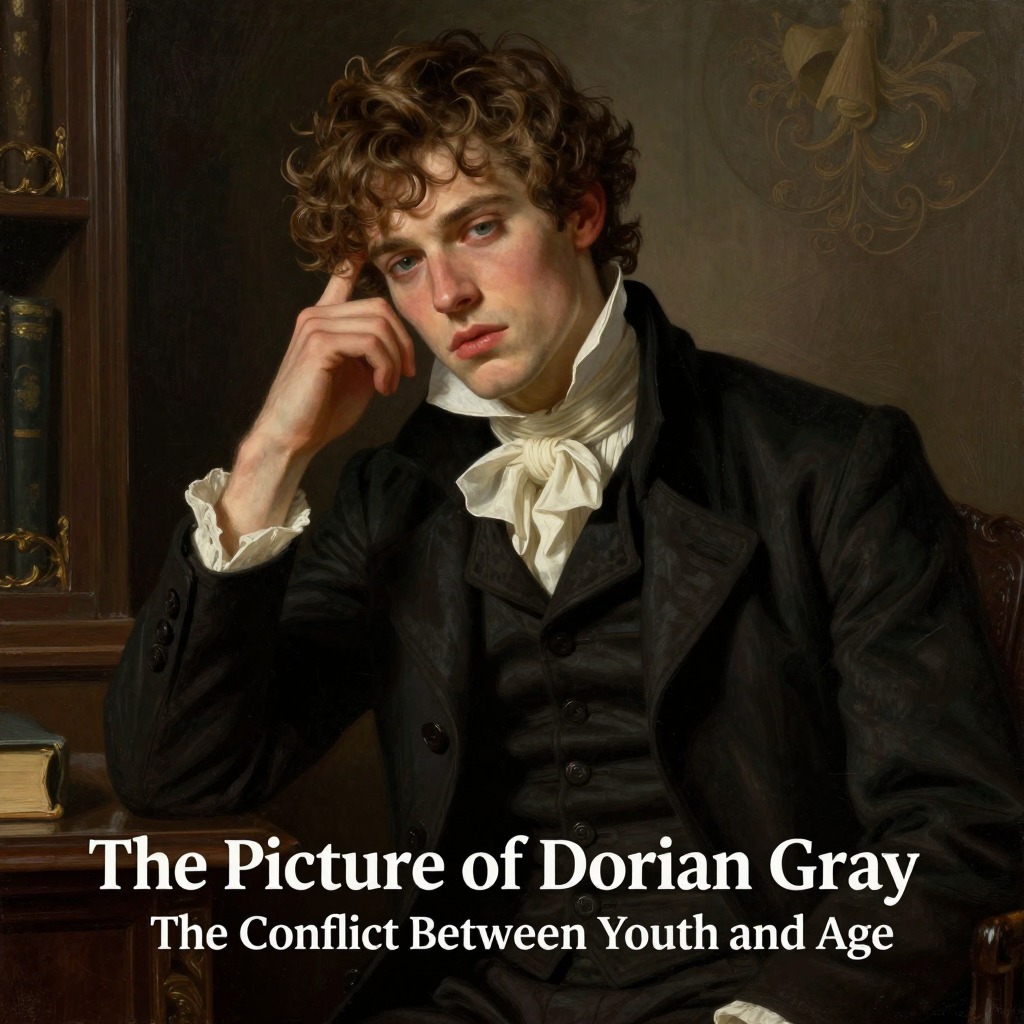
Eternal youth, infinite passion, pleasures subtle and secret, wild joys and wilder sins.
The Picture of Dorian GrayThe phrase "Eternal youth, infinite passion, pleasures subtle and secret, wild joys and wilder sins" is the distilled credo of Dorian Gray's transformed existence, the moment he consciously embraces the supernatural bargain that the portrait has made possible. It appears in the narrative immediately after he learns of Sibyl Vane's suicide and, instead of succumbing to remorse, decides to accept the consequences of his wish. The words are not spoken aloud but represent his internal resolution: life, and his own infinite curiosity about life, have decided for him. He will have all these things, and the portrait will bear the burden of his shame. This is the pivot on which the entire second half of the novel turns, the point at which Dorian definitively rejects the possibility of redemption and commits himself to a career of sensation and sin.
Origin and Context
The phrase emerges in Chapter VI, after Dorian has received the news of Sibyl Vane's death and has spent hours in a state of horrified paralysis before the portrait. He had written a passionate letter of forgiveness to the girl, but the letter was never sent; she was already dead. Lord Henry's cynical consolation—that Sibyl's death was a beautiful artistic event, a wonderful ending to a wonderful play—has taken hold. Dorian feels that the time has really come for making his choice, or rather that life has already made it for him. The words "Eternal youth, infinite passion, pleasures subtle and secret, wild joys and wilder sins" form the content of that choice. They are the terms of the contract he now accepts without further prayer or hesitation. The portrait, he decides, is to be the sole repository of his degradation; he himself will remain untouched, forever young, forever free to pursue every impulse.
The Wish That Made It Possible
The phrase is the logical fulfillment of a wish uttered in Basil Hallward's studio on the day the portrait was finished. When Dorian first saw the completed painting, he was struck by a revelation of his own beauty and an immediate terror of its transience. He cried out, "How sad it is! I shall grow old, and horrid, and dreadful. But this picture will remain always young. . . . If it was only the other way! If it was I who were to be always young, and the picture that were to grow old! For this—for this—I would give everything!" That desperate prayer, made in a moment of passionate self-awareness, had been answered. The portrait had already begun to change, showing a touch of cruelty around the mouth after his brutal rejection of Sibyl Vane. Now, with the phrase "Eternal youth, infinite passion, pleasures subtle and secret, wild joys and wilder sins," Dorian ratifies that supernatural answer and commits himself to living out its implications.
The Life It Enables
For years after this decision, Dorian Gray lives exactly the life the phrase promises. He remains physically unchanged, his boyish beauty intact while the portrait grows hideous with the marks of every vice. He pursues a new hedonism, studying perfumes, music, jewels, embroideries, and ecclesiastical vestments with the same intense curiosity he once brought to love. He frequents opium dens and low taverns in disguise, consorts with thieves and sailors, and corrupts the young men who become his companions. The phrase "wild joys and wilder sins" becomes a literal program: he experiences the wild joy of watching the portrait's corruption and the wilder sin of continuing to add to it. His life becomes a work of art in itself, as Lord Henry observes, with every day a sonnet and every sensation a carefully cultivated experience.
The Inevitable Reckoning
The phrase also contains the seeds of its own destruction. The "wild joys and wilder sins" accumulate until they culminate in the murder of Basil Hallward, the man who painted the portrait and who had loved Dorian with a devotion that bordered on idolatry. When Basil confronts Dorian with the rumors of his corruption and demands to see his soul, Dorian leads him to the locked room and shows him the portrait. In a fit of hatred and panic, he stabs Basil to death. The murder is the logical endpoint of the life the phrase describes: a life in which every passion is indulged, every restraint broken, and every consequence denied. After the murder, Dorian blackmails his former friend Alan Campbell into destroying the body, and Campbell later commits suicide. The phrase's promise of "eternal youth" has been kept, but at the cost of everything else.
The Final Contradiction
In the novel's final chapter, Dorian attempts to break free from the bargain. He tells Lord Henry that he has begun his good actions, that he spared a village girl named Hetty Merton from ruin. But when he goes to the locked room to see if the portrait has responded to his act of renunciation, he finds it more loathsome than before, with a look of cunning and hypocrisy in the eyes. The phrase "Eternal youth, infinite passion, pleasures subtle and secret, wild joys and wilder sins" has become a trap: the portrait cannot be cleansed by a single good deed because the life it records is already irredeemable. In a final, desperate act, Dorian seizes the knife that killed Basil Hallward and stabs the canvas. The result is the destruction of the portrait and the instantaneous transformation of Dorian into the withered, wrinkled, loathsome figure the painting had become. The servants find a splendid portrait of their master in all his youthful beauty hanging on the wall, and on the floor a dead man with a knife in his heart, recognizable only by the rings on his fingers. The phrase's promise of eternal youth is fulfilled only in the portrait; the man himself receives the death he had tried to escape.