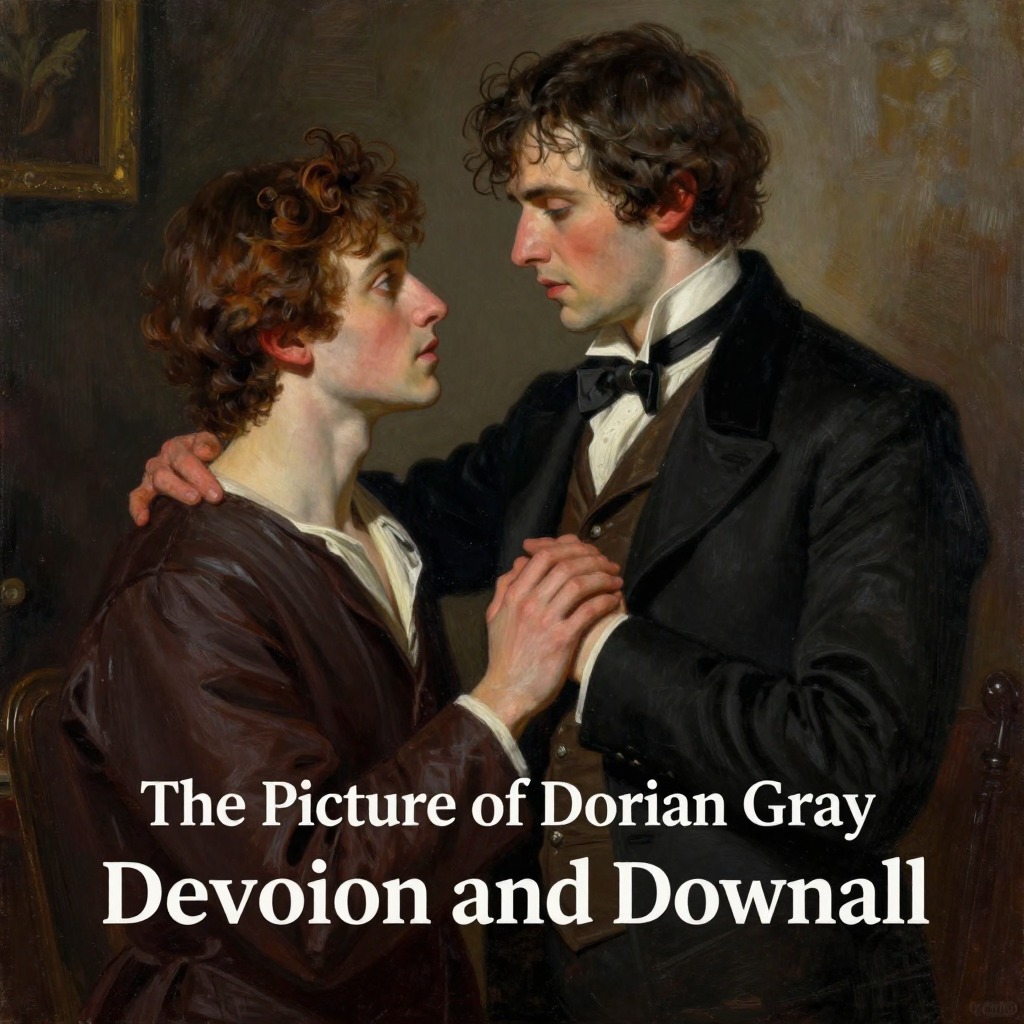
Lady Brandon
The Picture of Dorian GrayLady Brandon is a society hostess whose loud, intrusive manner and comically inaccurate introductions serve as a catalyst for the first meeting between Basil Hallward and Dorian Gray, setting the novel's central relationships in motion. Though she appears only briefly, her role as a purveyor of social connections and her grotesque, auctioneer-like treatment of guests mark her as a satirical figure, embodying the shallow, performative nature of Victorian high society that Wilde relentlessly critiques.
Identity and Introduction
Lady Brandon is introduced through Basil Hallward's recollection of a crush at her house two months before the novel's opening. Hallward describes her as having a "shrill horrid voice" and a habit of "lionizing" people she barely knows. When he first met her, she spoke of him as her "dearest friend" despite having met him only once before. Lord Henry Wotton, upon hearing this, compares her to "a peacock in everything but beauty," a remark that captures her ostentatious, self-aggrandizing nature. Her function in society is to act as a social broker, introducing guests to one another with rapid, often absurd precis that reveal more about her own superficiality than about the people she presents.
Role in the Plot: The Introduction of Dorian Gray
Lady Brandon's most significant action occurs at her own party, where she inadvertently brings together Basil Hallward and Dorian Gray. Hallward, feeling a premonition of danger, tries to escape the room, but Lady Brandon intercepts him, screaming, "You are not going to run away so soon, Mr. Hallward?" She then drags him through the crowd, introducing him to "Royalties, and people with Stars and Garters, and elderly ladies with gigantic tiaras and hooked noses." In the midst of this forced social parade, Hallward finds himself face to face with Dorian Gray, whose personality he had already felt would "absorb my whole nature, my whole soul, my very art itself." Lady Brandon's officiousness thus creates the very encounter Hallward had been trying to avoid, setting the stage for the novel's central relationships.
Comic and Satirical Function
Lady Brandon's method of introducing guests is a source of comedy and social satire. Lord Henry recalls an occasion when she brought him up to a "truculent and red-faced old gentleman" and hissed a garbled biography into his ear: "Sir Humpty Dumpty—you know—Afghan frontier—Russian intrigues: very successful man—wife killed by an elephant—quite inconsolable—wants to marry a beautiful American widow—everybody does nowadays—hates Mr. Gladstone—but very much interested in beetles: ask him what he thinks of Schouvaloff." This torrent of disconnected facts reduces a human being to a collection of absurd, marketable attributes, treating guests "exactly as an auctioneer treats his goods." When Hallward asks what she said about Dorian Gray, Lord Henry reports that she murmured, "Charming boy—poor dear mother and I quite inseparable—engaged to be married to the same man—I mean married on the same day—how very silly of me! Quite forget what he does—afraid he—doesn't do anything—oh, yes, plays the piano—or is it the violin, dear Mr. Gray?" This comically muddled introduction, which Hallward and Dorian find laughable, cements their instant friendship, as they bond over the absurdity of the social world that Lady Brandon represents.
Thematic Significance
Lady Brandon embodies the novel's critique of a society that values appearances, gossip, and social maneuvering over genuine connection. Her inability to remember or accurately convey anything substantial about the people she introduces reflects the hollowness of the social rituals that govern Victorian high life. She is a figure of pure surface, a walking embodiment of the "shallow, prying eyes" from which Basil Hallward wishes to protect his art and his secret. In a novel obsessed with the tension between public persona and private truth, Lady Brandon stands as a representative of the public sphere at its most trivial and invasive. Her brief appearance serves as a foil to the deeper, more dangerous relationships that develop between the main characters, reminding the reader that the world of fashion and gossip is the stage on which the novel's tragedy unfolds.