Lady Victoria Wotton
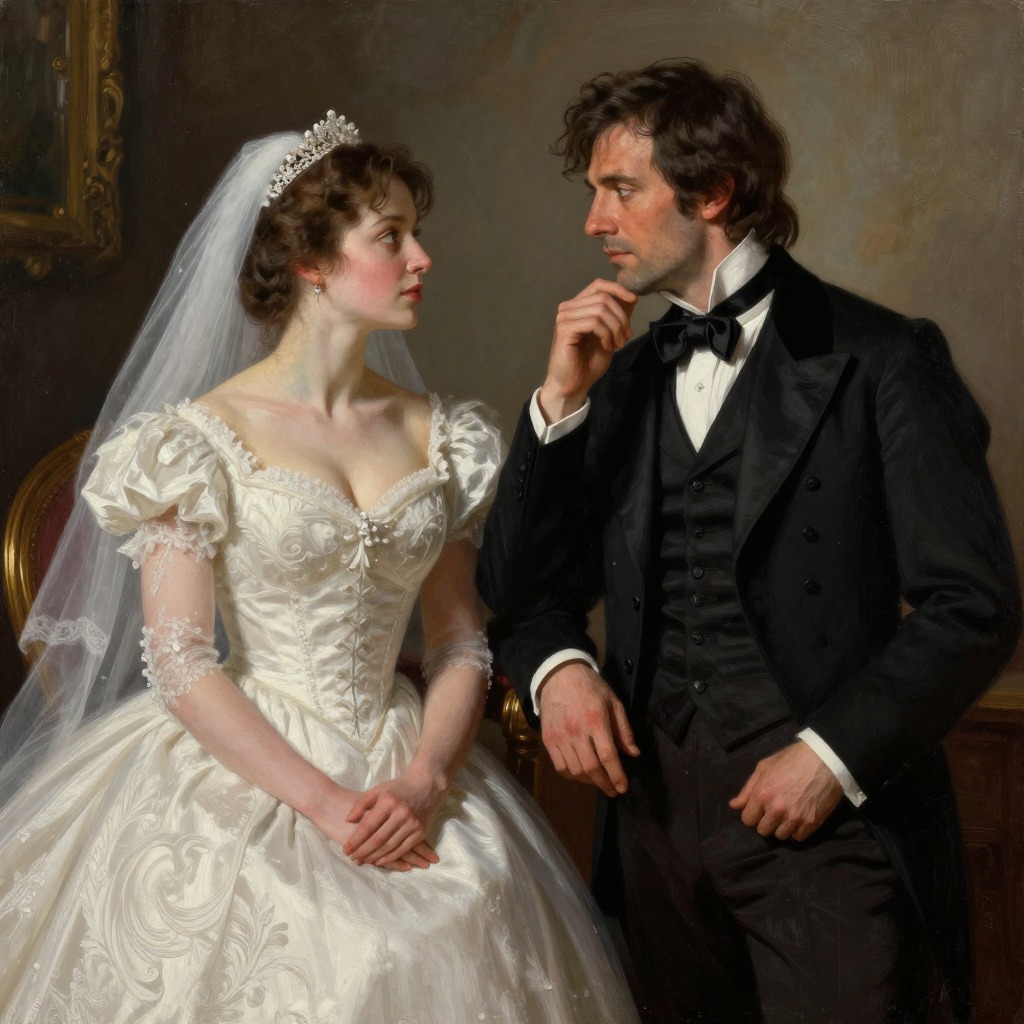
The Picture of Dorian GrayLady Victoria Wotton, known as Victoria and addressed as Lady Henry, is the wife of Lord Henry Wotton. She appears only briefly in the novel, yet her presence crystallizes the hollow, performative nature of upper-class marriage and the constrained position of women within it. Her nervous laughter, untidy dress, and trivial conversation mark her as a figure both comic and pathetic, a woman whose life is a series of unreturned passions and whose marriage is a theater of mutual deception.
Identity and Introduction
Lady Victoria Wotton is introduced when Dorian Gray, waiting for Lord Henry in the library of the Curzon Street house, is startled by a woman's voice instead of his friend's. She enters with a nervous staccato laugh, her dresses always appearing "as if they had been designed in a rage and put on in a tempest." She is described as a curious woman, always in love with somebody, but because her passion is never returned, she has kept all her illusions. Her name is Victoria, and she has a perfect mania for going to church. She tries to look picturesque but only succeeds in being untidy. Her conversation is a flurry of disconnected observations: she likes Wagner's music because it is so loud that one can talk the whole time without being overheard, she adores music but is afraid of it because it makes her too romantic, and she has simply worshipped pianists—two at a time, sometimes. She tells Dorian that she cannot afford orchids but spares no expense on foreigners, as they make one's rooms look picturesque.
Marriage and Relationship with Lord Henry
Lord Henry's attitude toward his wife is one of amused, cynical detachment. He tells Dorian that the one charm of marriage is that it makes a life of deception necessary for both parties. He never knows where his wife is, and she never knows what he is doing. When they meet, they tell each other the most absurd stories with the most serious faces. He claims his wife is very good at it, much better than he is, and that she never gets confused over her dates. When she does find him out, she makes no row at all; she merely laughs at him. This portrait of a marriage built on mutual deceit and emotional indifference is a key illustration of Lord Henry's philosophy that all relationships are ultimately performances. Lady Victoria's own behavior—her nervousness, her trivial chatter, her inability to sustain a coherent conversation—suggests a woman who has internalized this performance, filling the void of genuine connection with a frantic social display.
Narrative Role and Thematic Significance
Lady Victoria functions as a foil to the novel's central male relationships and as a living example of the fate of women in this world. She is a figure of pathos, her unreturned passions and her desperate attempts at charm revealing the emotional starvation that underlies the glittering surface of high society. Her presence also highlights the gendered double standard of Lord Henry's philosophy: while he preaches self-development and the pursuit of new sensations for men, his wife is left to fill her time with church, foreign pianists, and aimless social calls. When she leaves the room, Lord Henry remarks to Dorian, "Never marry a woman with straw-colored hair, Dorian—because they are so sentimental," and then advises him never to marry at all. Lady Victoria is thus reduced to a cautionary anecdote, her individuality erased by her husband's aphorisms. Her final appearance in the novel is a brief mention by Lord Henry, who notes that the man with whom his wife ran away played Chopin exquisitely, and that he was very fond of her, finding the house rather lonely without her. This casual revelation of her departure—treated as a minor inconvenience—completes the portrait of a woman whose life is defined by her husband's indifference and whose story is told only in fragments, as a footnote to the more dramatic fates of Sibyl Vane and Dorian Gray.