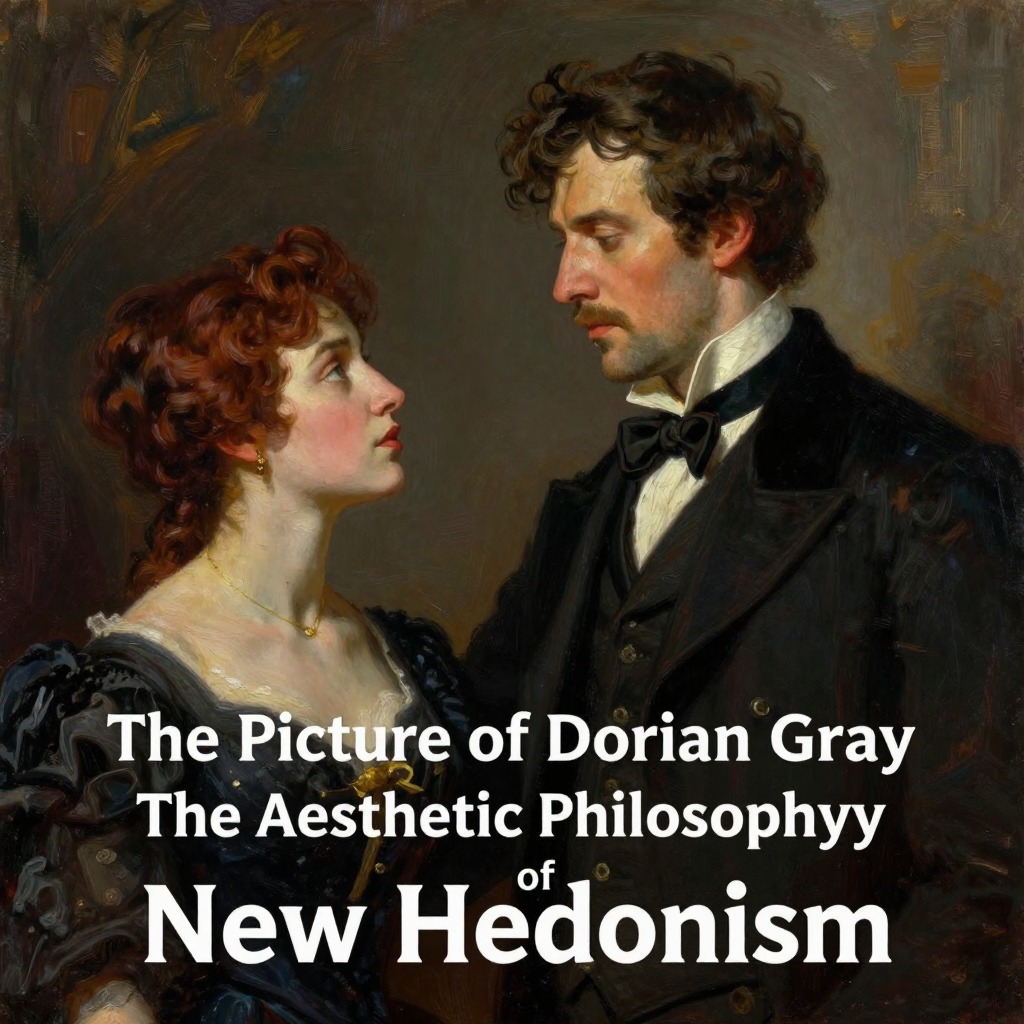
The Aim of Life is Self-Development
The Picture of Dorian GrayThe Aim of Life is Self-Development is a central philosophical tenet in Oscar Wilde's The Picture of Dorian Gray, first articulated by Lord Henry Wotton during his initial encounter with Dorian Gray in Basil Hallward's studio. Lord Henry declares that "the aim of life is self-development" and that "to realize one's nature perfectly—that is what each of us is here for." He argues that people have forgotten "the highest of all duties, the duty that one owes to one's self," and that they are governed by "the terror of society, which is the basis of morals" and "the terror of God, which is the secret of religion." This speech, delivered with Lord Henry's characteristic languid charm, strikes Dorian with the force of a revelation, awakening in him "entirely fresh impulses" that seem to come from within himself. The principle becomes the intellectual cornerstone of Dorian's transformation, providing a seemingly noble justification for his subsequent descent into hedonism and vice.
The Principle's Immediate Impact on Dorian Gray
The effect of Lord Henry's words on Dorian is immediate and profound. As Dorian stands before the completed portrait, the full reality of his own beauty and its inevitable decay flashes across him. He realizes that "the life that was to make his soul would mar his body" and that he would "become ignoble, hideous, and uncouth." In this moment of crisis, Dorian utters a desperate wish: "If it was I who were to be always young, and the picture that were to grow old! For this—for this—I would give everything!" This wish, born from Lord Henry's philosophy that youth is the only thing worth having, sets in motion the supernatural bargain that defines the rest of his life. The principle of self-development, as interpreted by Dorian, becomes a license to pursue every impulse without regard for consequence, and the portrait becomes the visible emblem of his soul's degradation.
The Principle's Role in Dorian's Moral Decline
As Dorian's life unfolds, the aim of self-development, twisted by Lord Henry's influence, leads him to embrace a philosophy of "eternal youth, infinite passion, pleasures subtle and secret, wild joys and wilder sins." He decides that "the portrait was to bear the burden of his shame: that was all." This rationalization allows him to commit acts of cruelty and corruption without remorse, believing that he is merely fulfilling his own nature. The principle, originally presented as a call to authenticity, becomes a mask for selfishness and a justification for the destruction of others. Dorian's pursuit of self-development, divorced from any ethical framework, results in the atrophy of his conscience and the progressive disfigurement of his soul, as reflected in the portrait's changing features.
The Principle's Failure and Dorian's Final Crisis
In the final chapter of the novel, Dorian experiences a fleeting moment of self-reflection, feeling "a wild longing for the unstained purity of his boyhood." He acknowledges that he has "tarnished himself, filled his mind with corruption, and given horror to his fancy" and that he has been "an evil influence to others." Yet, even as he contemplates reform, he cannot escape the logic of the principle that has governed his life. When he examines the portrait after his supposed good deed of sparing Hetty Merton, he finds no change; instead, the face now bears "the curved wrinkle of the hypocrite." The principle of self-development, which promised liberation, has delivered only a deeper enslavement to his own worst impulses. In a final, desperate act, Dorian seizes the knife that killed Basil Hallward and stabs the portrait, attempting to destroy the evidence of his soul's corruption. The result is his own death, as the servants find "a dead man, in evening dress, with a knife in his heart," withered and loathsome, while the portrait is restored to its original youthful beauty. The aim of life as self-development, when pursued without moral restraint, leads not to fulfillment but to annihilation.
The Principle's Thematic Significance
The Aim of Life is Self-Development functions as a critique of the New Hedonism that Lord Henry espouses. While the principle appears to champion individual freedom and authenticity, the novel demonstrates that such freedom, when divorced from ethical responsibility, becomes a destructive force. Dorian's tragedy is that he takes Lord Henry's philosophy literally, pursuing self-development as the relentless gratification of desire, only to find that the self he develops is a hollow, monstrous thing. The principle, in its pure form, is a seductive ideal; in practice, it becomes a rationalization for the worst excesses of human nature. Wilde's novel ultimately suggests that true self-development cannot be achieved through the denial of conscience or the sacrifice of others, but requires a balance between the claims of the self and the demands of the moral world.